





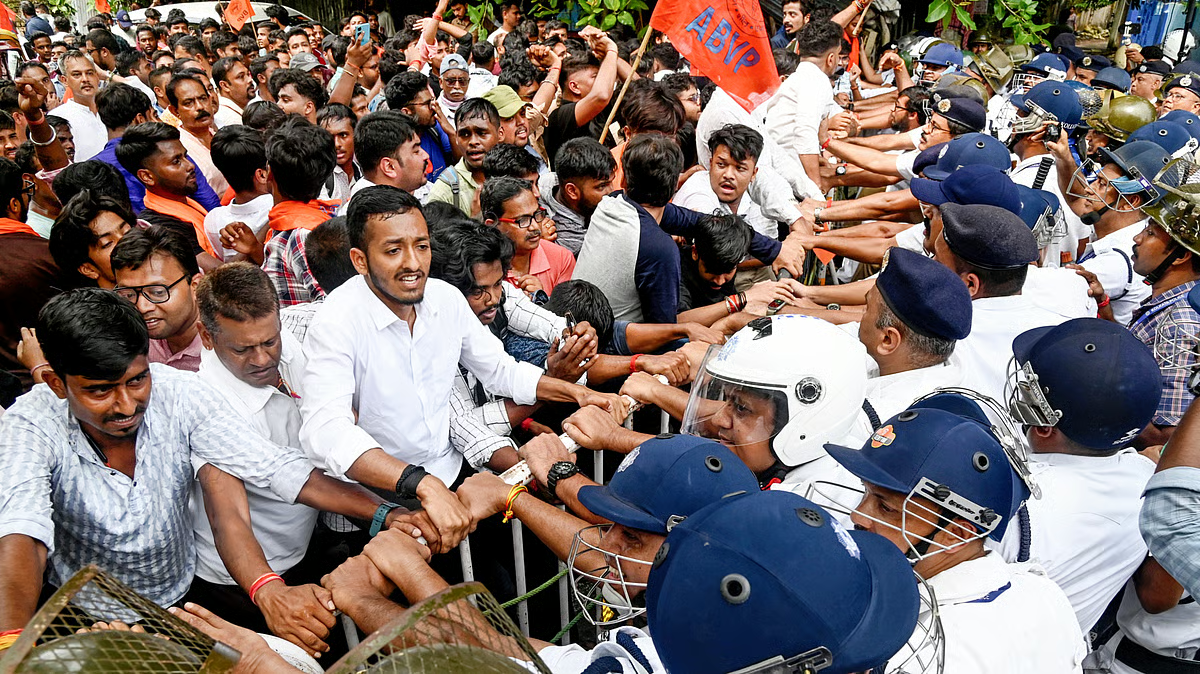


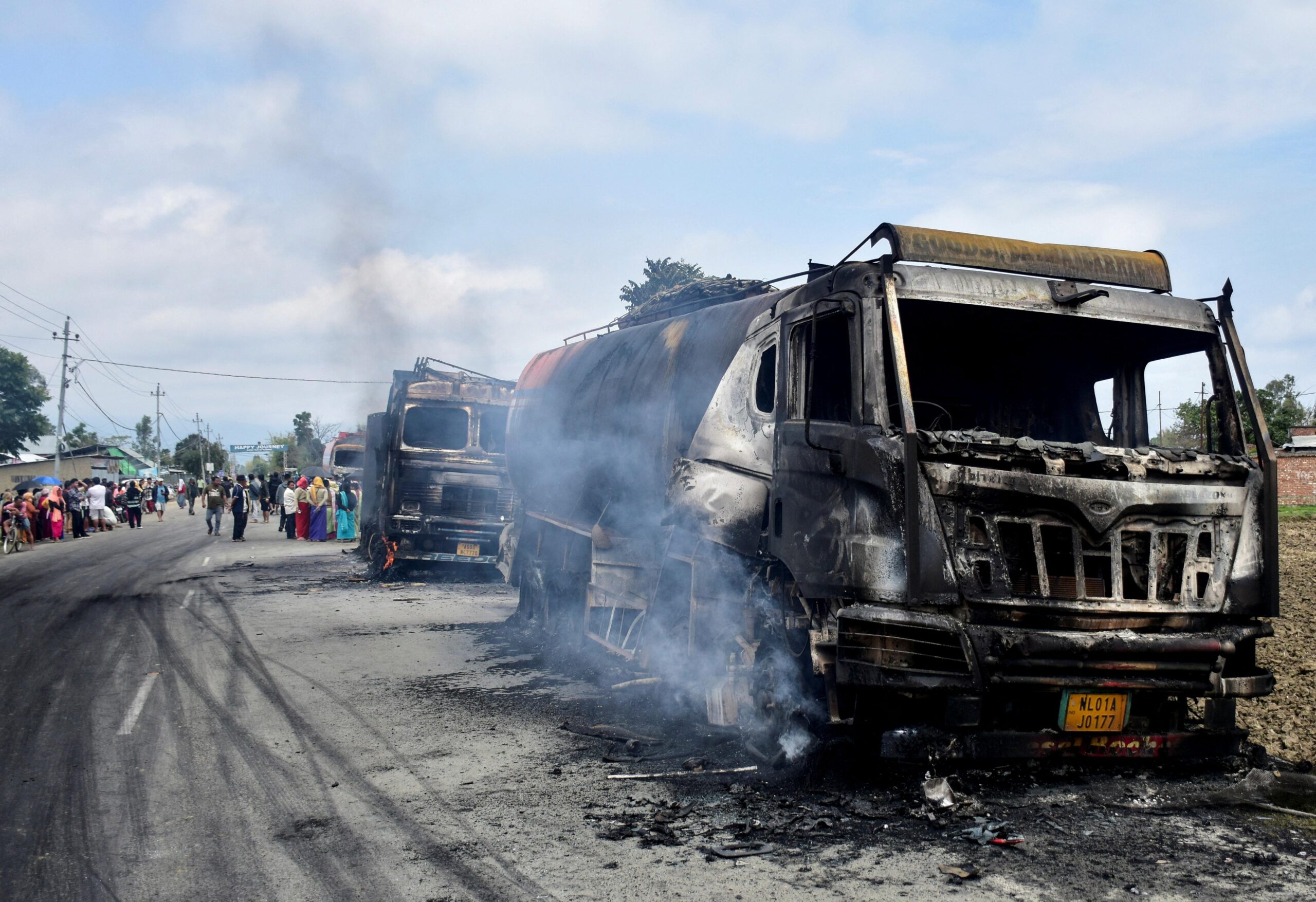
Three years after the bloodshed, a ‘New Delhi Post’ ground report finds that the state remains as fractured as earlier, where fresh conflicts simmer, armed groups hold sway, and Delhi continues to wield decisive control
For much of India, Manipur has quietly disappeared from the headlines. The television crews have moved on. Political attention has shifted elsewhere. National debates have found new flashpoints. But in India’s troubled north-eastern frontier, peace remains an illusion.
Three years after the ethnic violence of May 2023 tore Manipur apart, the state remains deeply fractured. Entire communities continue to live in ethnic enclaves, thousands of displaced families have yet to return home, highways remain vulnerable to crippling blockades, and armed groups continue to exert significant influence. Despite the return of an elected government, large parts of the state remain beyond its effective authority.
Although Manipur has largely slipped out of the national spotlight, the crisis on the ground is far from over. The violence has not ended so much as it has changed form, evolving into a more fragmented conflict marked by fresh fault lines, recurring tensions and persistent insecurity. For the people of Manipur, peace remains an aspiration rather than a reality, as the state continues to grapple with the long and painful legacy of a conflict that refuses to fade.
>> A CM Without Full Control
The change of government earlier this year has not changed this reality. When Yumnam Khemchand Singh took the oath as chief minister following the end of President’s Rule in February 2026, many hoped the former Speaker and Taekwondo champion would usher in a fresh beginning. Instead, he has inherited perhaps the most difficult political assignment in the country. Barely months into office, his government is confronted not only with the unresolved Meitei-Kuki conflict but also a dangerous new confrontation involving Nagas and Kukis, exposing just how fragile the state’s social fabric has become.
Although Manipur formally returned to an elected government after nearly a year under President’s Rule, the Centre continues to exercise overwhelming influence over key decisions.
One of the clearest examples came with the appointment of the state’s director general of police (DGP). Instead of allowing the newly elected government to choose its police chief, the Centre brought a former DGP of Ladakh to the state. It was another reminder that while Manipur has an elected government, the ultimate levers of power continue to remain in New Delhi.
Even five months after assuming office, Khemchand Singh has been unable to expand his Cabinet beyond the four ministers who were sworn in alongside him. Political observers believe Delhi remains unconvinced that a larger ministry can survive the state’s volatile political arithmetic ahead of next year’s Assembly elections. That uncertainty has reduced the government’s room for manoeuvre at a time when decisive leadership is desperately needed.
Nothing illustrates Manipur’s fractured politics better than its two deputy chief ministers. One is Lossii Dikko of the Naga People’s Front, representing the Naga community. The other is Nemcha Kipgen of the BJP, representing the Kuki community.
Ordinarily, such an arrangement would symbolise inclusiveness. In fact, it is just the opposite. Today’s Manipur reflects the fault lines running through the state. Those divisions exploded into public view after Lossii Dikko accused the husband of Deputy Chief Minister Nemcha Kipgen—Thangboi Kipgen, President of the Kuki National Front (KNF-P)—of being responsible for the recent abduction, killing and mutilation of six Nagas. Dikko publicly demanded his arrest.
The allegations did not stop there. It has also been alleged that security forces comprising the Army, CRPF, CoBRA battalions and the Manipur Police had surrounded Vaiphei village, where the killings occurred, but allegedly allowed nearly 100 Kuki militants to escape the security cordon. The operation reportedly resulted only in the recovery of some weapons and explosives.
Whether these allegations are eventually proved or disproved, they expose the extraordinary predicament confronting the CM, Khemchand Singh. Arrest the husband of one of his own deputies and risk collapsing the government. Ignore the allegations and risk further eroding public confidence in the administration. Few chief ministers in India have inherited such a combustible political landscape.
>> Conflict Has Entered a New Phase
The latest violence suggests that Manipur’s crisis is no longer confined to the Meitei-Kuki divide. A fresh Naga-Kuki confrontation has reopened wounds dating back more than three decades. Between 1992 and 1994, Nagas and Kukis fought one of the bloodiest ethnic conflicts in the region. Around 1,000 Kukis and nearly 400 Nagas were killed. Today, that painful history appears to be resurfacing.
The latest tensions began in May this year after a BJP leader, Michael Lamjathang Haokip, declared that the Thadou community should no longer be identified as Kuki, distancing the tribe from the larger Kuki political identity. Soon afterwards, three Thadou church leaders were killed on Tiger Road, a strategically important road connecting the Kuki strongholds of Churachandpur and Kangpokpi.
While Kuki organisations blamed Nagas for the killings, Haokip questioned the narrative, arguing that since the murders occurred in Kuki-controlled territory, responsibility rested with those exercising control over the area. The killings deepened mistrust. What followed was even more horrifying.
According to local accounts, 14 Nagas, including husbands and wives who had travelled to a Kuki village for trade, were abducted and allegedly handed over to Kuki militants.
The Nagas retaliated by detaining 12 Kukis. After the incident triggered outrage on social media, the women and children were released. Their testimonies painted a chilling picture. One woman alleged that the captives had been forced to consume meat, which they later believed belonged to their murdered husbands. Later, security personnel reportedly recovered the mutilated bodies of six Nagas without heads and limbs. The allegations have horrified communities across the state and intensified fears of another cycle of retaliatory violence.
As tensions escalated, so did economic warfare. Nagas imposed an economic blockade targeting the Kuki stronghold of Kangpokpi. Kuki groups, in turn, reportedly prevented Tangkhul Nagas from travelling to their homeland in Ukhrul.
The Committee on Tribal Unity (COTU), a prominent Kuki organisation known for organising highway blockades, later marched towards Imphal demanding that the restrictions be lifted. The consequences were immediate. Petrol prices reportedly climbed to around ₹250 a litre. An LPG cylinder reportedly touched ₹5,000. For ordinary citizens, it was a grim reminder that in Manipur, highways remain more than transport corridors; they are lifelines whose closure can cripple daily life within days.
Meanwhile, in the latest episode of violence, two Assam Rifles personnel were killed in an ambush on July 6 in Ukhrul district, the home district of Th. Muivah, the supremo of the NSCN-IM.
>> Even the CM Cannot Travel Freely
One incident perhaps captures the state’s reality better than any political speech. When former MLA Vungzagin Valte, who had remained critically injured since the mob violence of May 2023, recently died, Chief Minister Khemchand Singh wanted to attend his funeral in Churachandpur. The town lies barely 60 kilometres from Imphal. Yet he could not make the journey by road. Kuki organisations opposed his visit. The chief minister had to fly by helicopter instead.
Although he later shared lunch with Kuki leaders and the meeting generated cautious optimism, the symbolism was impossible to ignore. The elected chief minister of Manipur could not safely travel by road within his own state.
>> Delhi Continues to Call the Shots
The continuing violence has kept New Delhi firmly engaged. Union Home Minister Amit Shah recently convened a high-level security review after more than 40 people were killed following the end of President’s Rule. Curiously, neither Chief Minister Khemchand Singh nor State Home Minister Govindas Konthoujam was invited to participate physically.
Both attended virtually. The episode reinforced a perception that security decisions concerning Manipur continue to be shaped primarily in Delhi rather than Imphal.
>> How the State Collapsed
To understand why Manipur remains trapped in instability, one must revisit the events of May 2023. The violence began after armed Kuki protesters marched from Churachandpur towards Imphal. The attacks triggered fierce retaliation from Meitei groups. Within days, ethnic segregation became complete. Meiteis disappeared from Kuki-dominated areas such as Churachandpur and Moreh.
Likewise, Kukis fled the Imphal Valley. Neighbourhoods that had existed for decades became ethnically exclusive almost overnight. The violence claimed around 270 lives. Nearly 65,000 people were displaced. Thousands of houses were reduced to ashes. The humanitarian scars remain visible even today.
One of the most controversial episodes during the violence was the looting of police armouries. According to available figures, around 7,000 firearms, approximately 3.5 lakh rounds of ammunition and nearly 3,000 bombs disappeared from government armouries during the violence. The unprecedented loss of state weaponry fundamentally altered the security landscape. Armed civilian groups became major players in the conflict, complicating efforts to restore order.
As the violence unfolded, questions increasingly emerged over who was actually governing Manipur. The elected government remained in office. Yet the Centre steadily assumed operational control. The chief secretary and DGP were replaced. A Security Adviser took charge of the Unified Command overseeing all security forces, including the Army. President’s Rule followed. During that period, authorities ordered the surrender of looted weapons. Around 3,000 firearms were reportedly returned, largely from the valley.
However, many Kuki militant organisations remained covered under the Suspension of Operations agreement with the Government of India. Critics argued that while weapons were recovered from one side, concerns persisted over armed groups operating under the agreement.
Observers say nearly three years after the violence first erupted, Manipur remains divided not only by geography but also by memory. Communities continue to live apart. Political distrust runs deep. Security remains heavily dependent on central intervention. Fresh conflicts threaten to undo even the limited progress made over the past year.


