






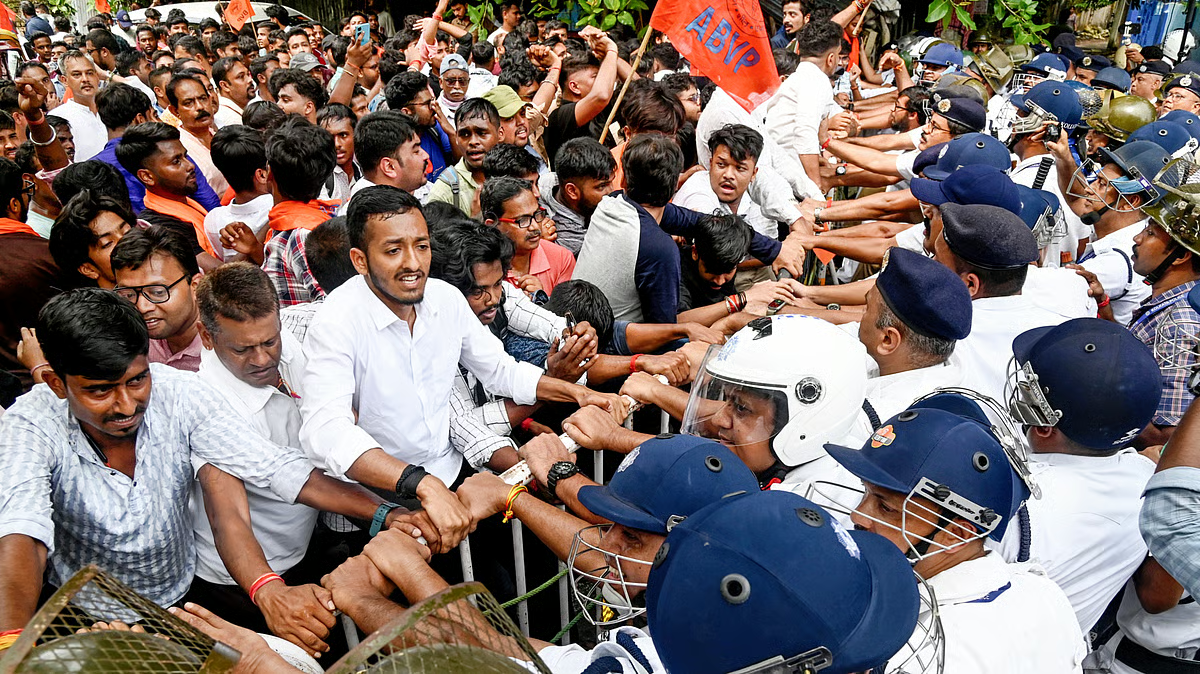
Jadavpur University has always been political. That is not its shame. It is, in many ways, its inheritance. It was born out of the nationalist educational movement; Jadavpur was never intended to be an institution that produced merely obedient graduates. It was meant to cultivate independent minds. Its history of dissent from the radical politics of the late 1960s to the anti-Emergency movement and the more recent protests over Singur, Nandigram and a range of national and campus issues is part of the intellectual character of the university. But there is a point at which a tradition of dissent becomes a culture of disruption.
The latest confrontation between ABVP and Left student groups at Jadavpur University is a reminder that the university might have reached that uncomfortable point. A dispute around a general body meeting escalated into physical clashes, allegations of outsiders entering the campus, injuries and protests outside the university gates. The confrontation subsequently drew police and political attention, with competing allegations from the Left and ABVP camps.
The immediate political blame game is predictable. The Left blames the Right. The Right blames the Left. Political leaders enter the conversation. Students mobilise. Social media amplifies the confrontation, but the university waits. This is the larger tragedy.
Because the question that ought to be asked is not simply who started the latest clash. It is why a university of Jadavpur’s intellectual stature has repeatedly allowed party politics to become so central to campus life that academic excellence might appear almost secondary.
Forty-five years of protest
For approximately four and a half decades, student politics has been deeply embedded in the institutional culture of Jadavpur. The Democratic Students’ Front has exercised prolonged influence over engineering student politics, while Left organisations have historically enjoyed considerable presence across the university. That political continuity has given Jadavpur something unusual in Indian higher education: a campus political culture that is not episodic but generational.
One generation teaches the next generation how to organise, mobilise, gherao, protest and occupy political space. There is something admirable about this: that young citizens should learn to question authority and hold the regime accountable. Universities should be uncomfortable places for governments. Students should be able to criticise political parties, university administrators and even society itself.
But there is another side to this story too. When successive generations of exceptionally bright students are socialised into believing that the most consequential activity on campus is political mobilisation, politics tends to gradually become an end in itself. The student who organises a protest becomes more visible than the student who spends months in a laboratory.
The slogan becomes more memorable than the research paper. The confrontation becomes more newsworthy than the innovation. And political identity begins to compete with academic identity and integrity. That is dangerous for any university, and it is particularly dangerous for Jadavpur.
Not just the Left
It would be convenient and politically fashionable in some quarters to blame everything on the Left, and that would also be intellectually lazy. For decades, the Left enjoyed disproportionate influence on Jadavpur’s campus. But the answer to Left dominance cannot be the replacement of one political monopoly with another. The emergence of the ABVP and other competing political formations might actually represent greater ideological pluralism. That, in itself, is not unhealthy.
A university should have Left-wing students, and it should have Right-wing students as well. It should have liberals, conservatives, radicals, centrists and students who could not care less about party and electoral politics.
What it cannot have is a culture in which ideological disagreement routinely becomes a justification for intimidation or physical confrontation. The recent clashes show how quickly political competition can turn into a battle over who has the right to define the university. And once that happens, everyone loses.
The Left loses because its historic association with democratic dissent becomes confused with political intolerance. The Right loses because its demand for ideological space becomes associated with violent confrontation. And the university loses because its institutional authority is steadily weakened over the past few years.
Academic decline?
Here, some uncomfortable nuance is necessary. It would be wrong to portray Jadavpur University as an academically failed institution. It is not. The university remains India’s top-ranked state public university and ninth among universities in the NIRF 2025 rankings. It continues to produce important research and internationally visible scholarship. Its researchers remain active in areas ranging from chemistry and physics to engineering and the social sciences.
Indeed, that is precisely why the present situation is so frustrating. Jadavpur is not a mediocre university struggling to become good. It is a potentially outstanding university struggling to become what its intellectual resources should allow it to be.
The distinction matters. The university’s 2024–25 annual report itself acknowledges that while it remained first among state public universities and ninth among universities, its rankings in engineering, research and pharmacy declined compared with the previous year.
Its engineering rank fell from 12th to 18th in NIRF 2025, and its research rank also slipped. Analysts have attributed these challenges to a combination of structural and institutional factors, including persistent faculty vacancies, constraints on research funding, administrative and governance-related challenges, the impact of prolonged student-political mobilisation on the academic environment, and the relatively weak industrial and economic ecosystem in West Bengal.
Therefore, the argument should not be that Jadavpur has stopped producing good students. The argument should be that Jadavpur is not producing or retaining the intellectual ecosystem that its exceptionally talented students deserve.
Bright students leave
This is where the Jadavpur story becomes part of the larger Kolkata story. For generations, Bengal has produced extraordinary students, but many of its most ambitious young people have learnt to see leaving Kolkata as a natural part of becoming successful. They go to Delhi, Mumbai, Bengaluru, Hyderabad, Pune, Chennai. Furthermore, increasing numbers go to universities and workplaces in North America, Europe, Australia and elsewhere.
This cannot be blamed on Jadavpur University. Nor can it be blamed entirely on party politics. West Bengal has fewer high-paying private-sector opportunities than several competing Indian states. Industrial growth has been uneven. Research funding remains constrained, and the country’s major technology, finance and corporate clusters have developed elsewhere.
But institutional culture matters. A student does not only ask: Where can I get a degree? A talented student asks: Where can I build a life? Where can I find people who are ambitious? Where can my work matter? Where can my university help me grow rather than continually consume my attention?
When the most visible aspects of university life are demonstrations, factional disputes, political slogans and clashes, some students will inevitably conclude that their ambitions lie elsewhere. Moreover, the most mobile students are often the brightest ones. This creates a quiet form of institutional attrition. The student leaves. The university continues. The campus remains. But something intangible disappears.
Bengal’s brightest export
There is a deeper irony here. Bengal has historically celebrated intellectualism. It takes enormous pride in its culture of debate, literature, art, political consciousness and intellectual argument. But debate without institution-building eventually becomes performance.
The state has become remarkably good at producing arguments about why things are not working. It needs to become equally good at building institutions that work.
Jadavpur University could be at the centre of that transformation. It has the faculty. It has the alumni. It has the intellectual tradition. It has talented students. It has a brand that remains extraordinarily powerful. What it lacks is a sufficiently stable institutional environment in which all of those advantages can compound.
The university should therefore resist two equally dangerous temptations. The first is to romanticise its political past. Not every protest was heroic. Not every political movement was intellectually serious. Moreover, not every confrontation represented democratic dissent. The second is to respond to political conflict by trying to depoliticise the university. That would be equally misguided.
Jadavpur should remain a place where students can challenge governments, criticise political parties and question authority. But it must also become a place where academic achievement carries greater social prestige than political visibility.
Activist and scholar
There is no reason why a student cannot be both. A student can organise a peaceful demonstration and publish a research paper. She or he can campaign for social justice and build a start-up. They can criticise the government and win a fellowship abroad too.
A politically engaged student can become a scientist, engineer, economist, political scientist, sociologist, physicist, journalist, civil servant or professor. That is the model Jadavpur should aspire to.
The problem is not politics. The problem is politics without limits. A university that teaches students how to challenge power must also teach them how to exercise power responsibly. A university that celebrates dissent must also teach students how to disagree without violence. Therefore, a university that has spent decades cultivating political consciousness must now cultivate something equally important: academic ambition.
Beyond political confrontation
The current moment should therefore be treated as an opportunity for institutional introspection rather than another chapter in Bengal’s endless political polarisation. The Left should ask whether its long association with student politics has sometimes allowed organisational interests to overshadow academic ones. The Right should ask whether expanding ideological space requires confrontation or whether it can be achieved through patient democratic organisation.
The university administration must ask why disputes repeatedly escalate before institutional mechanisms can contain or address them. Furthermore, the state government must ask whether its universities are being given the administrative stability, funding and autonomy necessary to compete nationally and globally. Most importantly, students themselves should ask a difficult question: When you leave Jadavpur University, what do you want your university to have given you?
A repertoire of slogans? A political identity? A collection of political confrontations? Or an education powerful enough to change your life and perhaps the country or the wider global world for the good?
Jadavpur University does not need to abandon its political soul. It needs to recover its academic centre. Its tradition of dissent is worth preserving, and its culture of intellectual independence is worth protecting. Its students have every right to protest, but protest should be a means, not a destination. Because the greatest failure would not be that Jadavpur produces politically active students. The greatest failure would be if some of India’s brightest young people come to Jadavpur University, spend their formative years learning how to fight over the university, and then leave Kolkata believing that their real future lies somewhere else.
Jadavpur University was built to educate a generation capable of changing India and the world for the better. Therefore, it should not become a place that teaches that generation only how to protest against it. That is the conversation West Bengal needs to have now.


