


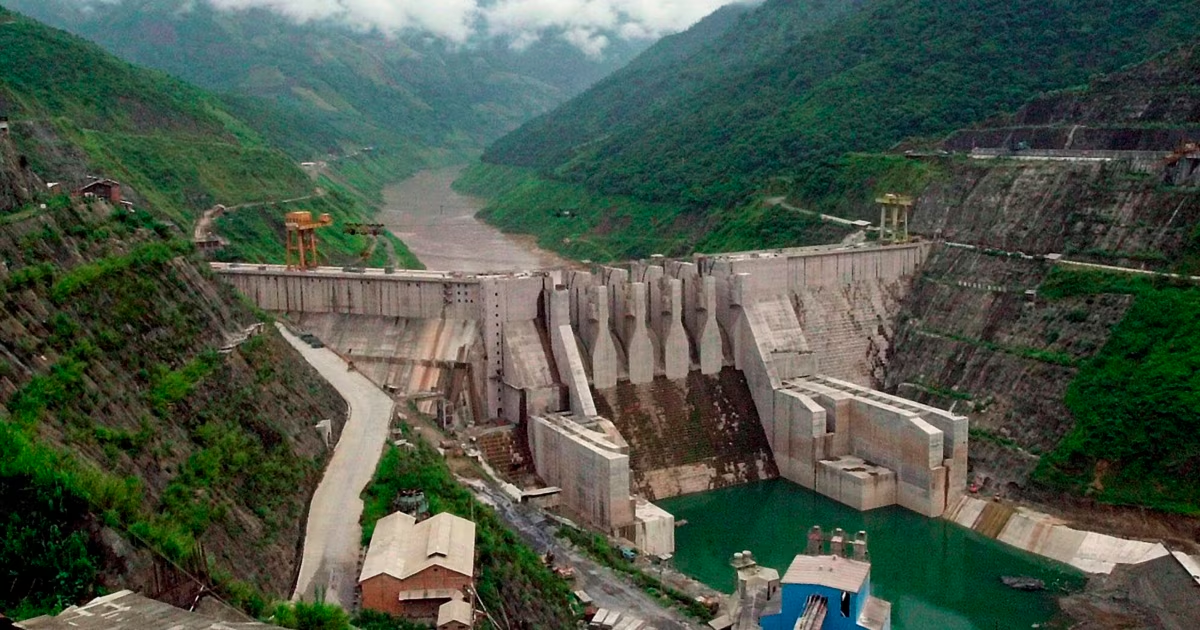
The catastrophe on the Nepal-Tibet border on August 26 has brought an uncomfortable truth rushing downstream with the floodwaters: China has acquired extraordinary power over the waters of Asia, while the countries below it have remarkably little power over what Beijing chooses to do upstream.
For decades, China has been transforming the Tibetan Plateau through dams, reservoirs, tunnels, roads and gigantic hydropower projects. Beijing calls this development clean energy and economic progress. Its neighbours have reason to see something else as well: the growing capacity of one state to influence rivers upon which hundreds of millions of people beyond its borders depend.
Professor Brahma Chellaney, strategic analyst and author of Water: Asia’s New Battleground, has warned for years about China’s emergence as an Asian “hydro-hegemon”. His argument has become increasingly difficult to dismiss. Geography gave China control of the upper reaches of some of Asia’s great river systems. Engineering is converting that geographical advantage into strategic power.
India has reason to worry. Bangladesh lies farther downstream on the Brahmaputra-Jamuna system. Pakistan depends overwhelmingly on the Indus basin. Nepal shares several trans-Himalayan river systems with Tibet. Bhutan’s rivers eventually feed the Brahmaputra system. Myanmar is connected to the eastern Tibetan watershed. And in Southeast Asia, Laos, Thailand, Cambodia, and Vietnam are downstream along the Mekong. Their vulnerabilities are different, and China’s ability to regulate each river is not identical. But they share one uncomfortable geographical reality: China sits upstream.
Water therefore becomes something more than a natural resource. Control over it can become an instrument of power, even without a single dam gate being deliberately opened as an act of aggression.
A Dam Does Not Have to Be Built as a Weapon
This is where the discussion becomes uncomfortable. Water does not have to be deliberately poisoned, diverted or released in a catastrophic torrent before it becomes a strategic weapon. Simply controlling the flow creates leverage.
For India, the sharpest alarm is China’s Medog Hydropower Station, also known as the Motuo project, on the lower Yarlung Zangbo near the Indian frontier. The river enters India as the Siang and feeds the Brahmaputra system.
Beijing calls it clean power and promises no harm downstream. But national security cannot rest on another country’s press release. The real question is not what China intends today, but what it will be able to do tomorrow. Geography already ignores Beijing’s borders: Chinese industrial pollution has crossed the Pacific to the western United States, much of it from factories making goods for American consumers. America outsourced production; China exported pollution; the wind delivered it. If dirty air can travel thousands of kilometres without permission, the potential leverage over water flowing downhill towards China’s neighbours is difficult to ignore.
Control over the upper river also means control over crucial hydrological information. Roads, bridges and tunnels constructed around these projects can serve civilian purposes in peacetime and military logistics during confrontation.
China and India have already fought a war and continue to confront each other across an unsettled Himalayan border. Under such circumstances, India would be extraordinarily complacent to assume that enormous Chinese infrastructure immediately upstream has no strategic dimension.
Then Came August 26
Then August 26 turned theory into mud, wreckage and missing people. On the Nepal-Tibet border, a colossal ice-rock and glacial collapse hurled water, sludge and debris through mountain valleys, tearing through settlements, roads, bridges and lifelines. Hundreds remain missing, including Indians travelling to or from Kailash Manasarovar.
The evidence so far points to nature, not sabotage. The tremor first reported as a magnitude 4.4 earthquake was later assessed by the US Geological Survey as the seismic signature of the glacial collapse itself.
Did China cause the flood? There is no evidence of that. But stopping there would be dangerously complacent. If nature alone can do this in the Himalayas, what happens when giant dams, reservoirs and tunnels are planted in the same unstable terrain? What happens when an earthquake cracks a reservoir, a landslide blocks a river, or one failure triggers the next?
Chellaney has called China’s Himalayan mega-dam a possible “water bomb”. It is a grim phrase, but not a frivolous one. A catastrophic failure could send devastation through India’s Northeast and into Bangladesh. Before August 26, that warning could be dismissed as strategic exaggeration. After August 26, it is harder to dismiss as mere rhetoric.
And Then There Is the Kailash Question
There is another coincidence India should not dismiss too casually. This is Kailash Manasarovar pilgrimage season. The Indian government’s 2026 Yatra was scheduled from June through August. Thousands undertake the pilgrimage in the broader season, including travellers using private routes through Nepal. On August 26, the very Nepal-Tibet corridor used by Kailash travellers was overwhelmed.
At least 133 Indians have been reported missing, with many believed to be Kailash pilgrims. Reports from Tamil Nadu alone initially listed 37 pilgrims unaccounted for, while 77 members of an Isha Foundation group were reported stranded on the Tibetan side after communications were severed.
Perhaps it is entirely coincidence. Perhaps nature chose the place, the hour and the pilgrimage season with the indiscriminate cruelty for which nature needs neither motive nor permission.
But must India therefore stop asking questions? Certainly not. What did Chinese authorities know about conditions upstream before the catastrophe? When was unusual geological or hydrological activity first detected? How quickly was Nepal warned? What real-time information crossed the border? What happened around Gyirong, an important gateway for Kailash travellers? And what information has Beijing provided concerning Indians who were on Chinese-controlled territory?
Asking these questions does not establish a conspiracy. Nor should the word “conspiracy” become a convenient device for preventing questions from being asked. There is a large territory between paranoia and gullibility. That territory is called investigation.
And when one’s own citizens are missing on or around territory controlled by a strategic adversary, India has every right to investigate what happened there. The unease becomes sharper because China possesses three advantages simultaneously: upstream control, infrastructure control and information control.
Are these facts connected to what happened on August 26? We do not know. And in matters of national security, “we do not know” cannot be the end of the conversation.
China’s Case, and Why It Is Not Enough
A balanced argument must acknowledge Beijing’s position. China says its Himalayan hydropower development will generate clean energy, contribute to economic development and not adversely affect downstream countries. Hydropower itself is not an act of aggression, and the present Nepal-Tibet catastrophe cannot simply be blamed upon a Chinese dam because it suits a geopolitical argument.
But China’s assurances cannot be the final word. If these projects are safe, Beijing should welcome independent environmental and seismic assessments. If downstream countries face no danger, real-time hydrological data should be automatic and transparent. If the dams are purely developmental, advance-warning and emergency-release protocols should not be politically difficult.
China cannot demand trust while retaining overwhelming control over the information required to verify that trust. Transparency is what separates reassurance from propaganda.
India Cannot Afford to Merely Watch
New Delhi must therefore stop treating Himalayan water security as a subsidiary environmental issue. India needs independent satellite surveillance of upstream developments, stronger flood-warning systems across Arunachal Pradesh and Assam, better hydrological modelling and much deeper cooperation with Nepal, Bhutan and Bangladesh.
More importantly, the downstream countries need a common framework demanding real-time data sharing, advance notification of major upstream construction and releases, independent seismic assessments, emergency protocols and mechanisms for investigating transboundary disasters.
China will undoubtedly invoke sovereignty. But sovereignty cannot stop at the dam wall while the consequences travel downstream. A Chinese dam may stand on Chinese-controlled territory. Its water does not. Neither do sediment, ecological disruption or a catastrophic flood.
The Brahmaputra does not carry a Chinese passport.
When Water Becomes Power
For most of modern history, countries worried about armies coming across mountains. Asia may increasingly have to worry about what comes down the rivers. China’s strategic advantage is not merely its enormous army, nuclear arsenal, manufacturing capacity or technological reach.
It is altitude. China controls the roof of Asia, and it is turning that geographical advantage into infrastructure. Every reservoir, tunnel and mega-dam gives Beijing greater influence over rivers flowing towards its neighbours.
The 26 August catastrophe may prove wholly natural. That is precisely what makes it so frightening. The disaster has shown, in the starkest possible way, how quickly conditions in the Tibetan heights can affect communities far downstream. A single surge can erase settlements, snap roads and bridges, cut communications and leave hundreds missing below.
India should study that lesson as a warning, not an accident. It should assume Beijing is studying it too. Tomorrow’s coercion may not announce itself with missiles, tanks or war cries. It could come through a closed dam gate, a sudden release into swollen rivers, or a warning sent only after the damage has begun.
Every country downstream should understand the changing geography of water and power. When one state controls the tap and much of a continent lives below it, water stops being merely a resource. It can become leverage, a source of fear and, ultimately, a source of power.
