

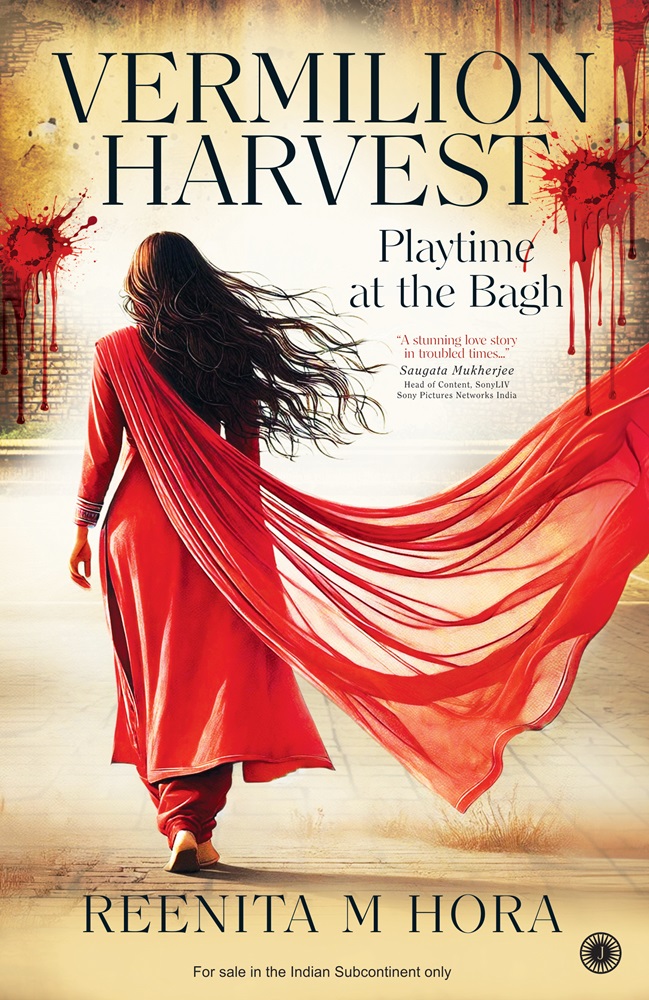
About the Book
Love, hate, denial and betrayal are woven into a single love story that captures today’s hope against yesterday’s despair. In the politically charged city of Amritsar in 1919, as unrest simmers under British colonial rule, Aruna, a spirited nineteen-year-old Anglo-Indian schoolteacher, and Ayaz, a passionate Muslim law student, fall in love. But their love is far from free. Bound by the expectations of their respective communities and shadowed by Ayaz’s dangerous political activism, they must navigate a world where both rebellion and romance carry an unbearable cost.
When a sinister military order threatens unsuspecting crowds gathered at Jallianwala Bagh during the Baisakhi festival, Aruna races against time to warn Ayaz of the impending massacre. The gardens, once a place of joy and harmony, are transformed into a harrowing scene of chaos and bloodshed under the British army’s relentless gunfire. In that moment, their love story becomes inseparable from the cries of a nation.
Aruna and Ayaz’s journey mirrors a country torn between its yearning for freedom and the devastating price of resistance. Can love endure when history itself conspires to tear it apart?
Excerpts
Mid March 1919
Amritsar—a romantic interlude
Sitting on a bench under the bushy-green jujube tree at the Rambagh with Ayaz, my hands refused to remain still. My fingers clasped and rubbed before releasing, only to beg to be together again. The gardens surrounding Baradari with the twelve-doored pavilion now filled my view. The huge summer palace of Maharaja Ranjit Singh with the domed corners gave me reason to pause. The ancient beauty had long since given way to dilapidation and weeds, but its lush green gardens seemed to be the choice for morning and evening walks.
It was also our secret place. A secluded bench far from the prying eyes of nosy onlookers. The wide-open expanse of the inner lawns only a few feet away created a new perspective on life for me, and the aroma of freshly cut grass added to the overall mystery of the moment.
Three of Amritsar’s gentlemen clubs, frequented by the British army and civil officers, were within the boundaries of the gardens. But the thick leaves of the jujube tree cast deep shadows, hiding us within the safety of its branches. The disappearing evening sun lingered, pushing the club-goers indoors and providing us our much-desired privacy. The Rambagh filled with sounds of crickets created the ideal place for young love to blossom.
“Ironic, isn’t it?” I glanced up at Ayaz. “We espouse the concept of freedom, yet we ourselves must escape dismissive eyes to see each other?”
It was the perfect Jane Austen moment, and Ayaz started with, “‘You must, therefore, pardon the freedom with which I demand your attention; your feelings, I know, will bestow it unwillingly, but I demand it of your justice.’” His hand slowly found its way onto mine.
My fingers barely wrapped around his thicker hands. The difference made it hard to believe we were just a year apart. I eighteen, and he just recently celebrated his nineteenth birthday.
It wasn’t only the size of our hands that set us apart. Ayaz was a large man with bushy brows and a thick, black beard. His dark coloring against my fair complexion made me pale in comparison. Two souls plucked from the same matter—spirited, passionate, and idealistic.
How could I fall in love with someone so different? He a Muslim, I, a young Anglo-Indian schoolteacher. He, so fearless and daring. And I, naturally drawn to keeping up my guard. Opposites do attract. Were it not true, this moment would never be. What a feeling, signified by our longing touch contrasted by his hand caressing my trembling fingers. His warm grasp made my heart pound.
“As I said … isn’t it ironic?” I sighed. “We ask for freedom from the British … to be pardoned, yet you yourself have no freedom to even speak of it.” I glanced out at the dark lawns and frowned. My words conveyed a tease or taunt.
Ayaz remained quiet, perhaps too quiet. As he had said before, molehills were meant to remain molehills. He pulled me closer, his chin rubbing gently across the top of my head. Something that calmed me down. Not that I was overly excitable or anything like that, but Ayaz often sensed my agitation layered behind the irony. “Perhaps,” he whispered. “Freedom may be a concept, but it’s also a choice.”
But it wasn’t a choice. We were not truly free. If we were, we would not need to hide to steal a kiss. Could we ever be daring enough to kiss without stealing?
About the Author
Reenita Malhotra Hora is a Mumbai-born, California-based novelist and screenwriter whose work spotlights the South Asian experience. Her award-winning historical love story, Vermilion Harvest: Playtime at the Bagh, set against the 1919 Amritsar massacre, won the Overall Grand Prize at the Chanticleer International Book Awards. Her YA romcom Operation Mom has also received widespread recognition, including honours from the Sundance Institute Development Slate, The Writers Lab, the Eric Hoffer Book Award, and the Indie Reader Discovery Award. LA Weekly has hailed her as a leading indie writer redefining Indian culture and comedy for global audiences. She is a former journalist with Bloomberg and RTHK, and her work has appeared in The New York Times, CNN and Bloomberg.