


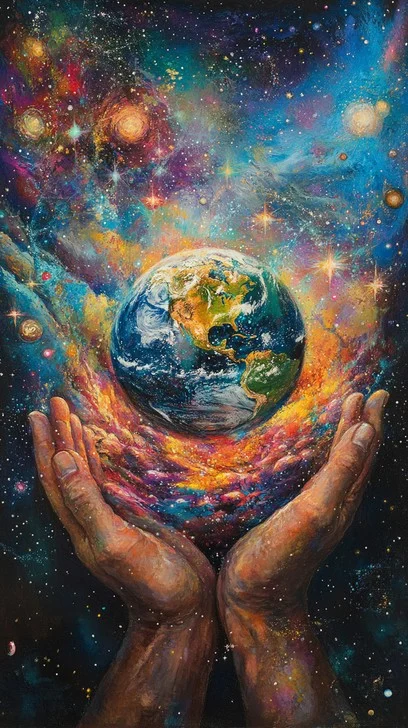
After spending 178 days aboard the International Space Station, astronaut Ron Garan returned to Earth carrying something far heavier than mission data: a transformed understanding of humanity.
From orbit, Earth does not look divided by countries or borders. It appears as a single radiant blue sphere suspended in darkness. No lines separate continents. No flags mark territory. Human conflicts, so fierce and consuming on the ground, seem suddenly diminished. What becomes undeniable instead is our shared connection. The atmosphere, a paper-thin blue halo, looks almost invisible, yet it is the only shield protecting every forest, ocean and breath of life.
This experience is known among astronauts as the “Overview Effect”: a cognitive and emotional shift in which the planet is perceived not as a political map but as one closed, interdependent system. There is no backup planet. No parallel civilisation waiting elsewhere. From that vantage point, the idea of “us versus them” dissolves into a simpler truth: there is only us.
Yet what feels like revelation in orbit is not new to Indian thought. The “Overview Effect” is, in many ways, the secular articulation of the Vedic ideal Vasudhaiva Kutumbakam, the world as one family. Indian philosophy has long offered a vocabulary for this awakening. The notion that the “outer space” we explore mirrors the “inner space” (Chidashakasha) we inhabit. The dissolution of boundaries described by astronauts closely parallels the ancient concept of Samadhi, a state of heightened consciousness in which the distinction between self and universe fades into a singular, luminous awareness. In such a state, the conflicts of the mainland appear as Maya, the transient illusions obscuring a deeper unity.
This continuity becomes especially poignant in the Indian space journey. When Prime Minister Indira Gandhi asked Rakesh Sharma in 1984 how India looked from the Salyut 7 space station, his response, “Saare Jahan Se Achha”, was celebrated as patriotic poetry. It anchored national pride in the cosmos. But beyond the poetry lay a quieter transformation. To see India from space is also to see its borders vanish into the curvature of the Earth. It becomes less territorial and more planetary, almost a silent prayer for a world without frontiers.
In the contemporary era, explorers like Sunita Williams embody this deeper arc. For Williams, carrying the Bhagavad Gita and the Upanishads into orbit was not merely symbolic. It reflected an understanding that space travel is as much an inward journey as an outward expedition. The cockpit can become a temple; the view from the cupola, a meditation. The farther one travels from Earth, the clearer its indivisibility becomes.
Across this arc, from Garan’s fragile blue halo to Sharma’s poetic patriotism to Williams’ spiritual interiority, a consistent message emerges. Space does not diminish identity, it expands it. The astronaut may launch under a national flag, but returns as a witness to unity.
What Indian philosophy articulated millennia ago, orbital mechanics has now made visible: the planet is one organism, life is interdependent and humanity’s survival depends not on sharper divisions, but on remembering that we were never separate to begin with.
(The author is a storyteller and image consultant. She writes on social issues)
