

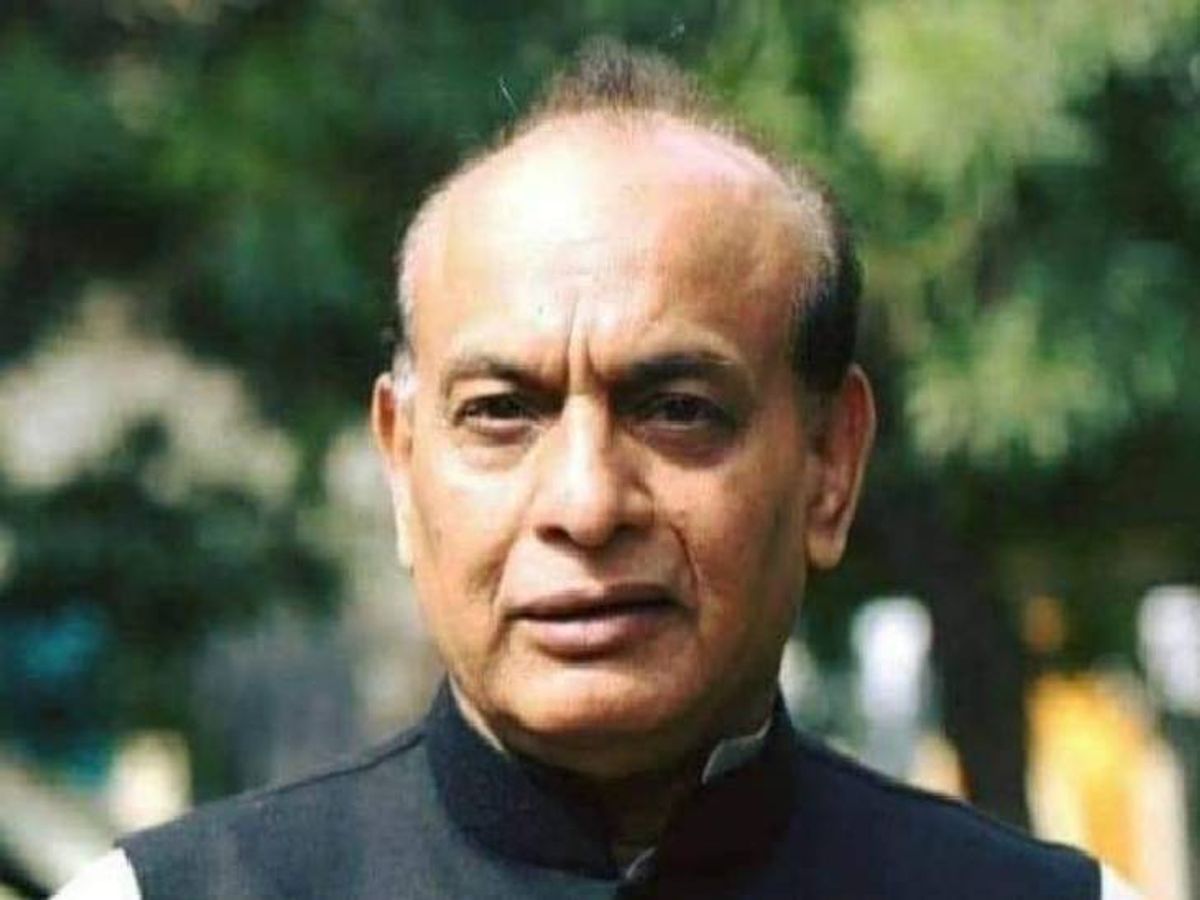
Vagish Pathak, a retired Central Excise official, received ‘professional fees’ from tobacco and pan masala businesses while corporate records show his association with 18–19 companies
A “Cobrapost” analysis of statutory filings, Ministry of Corporate Affairs (MCA) records, sworn election affidavits and other relevant documents reveals that Uttar Pradesh Legislative Council member Vagish Pathak did not disclose his business ties with any of the 18–19 corporate entities with which he was associated in his 2022 sworn election affidavit. His wife, Sonali, is a director in eight entities. Together, the couple share directorships of 27 companies. Six of these entities are linked to the Kamla Pasand Group, the manufacturers of pan masala, gutkha, tobacco, betel nut and other scented chewable products.
The records examined by “Cobrapost” also show that Pathak, a retired Central Excise Department official, has received professional fees from a range of businesses, including companies operating in the pan masala and tobacco trade. Among them are Dharampal Satyapal, or the DS Group, makers of Rajnigandha; Trimurti Fragrance, the Kanpur maker of Shikhar Pan Masala; Reliable Cigarette & Tobacco; Royal Grains; Synergy Steels; Synergy Advanced Metals; and KY Tobacco Works. Sources say Pathak received between Rs. 20 lakh and Rs. 32 lakh a year for six years from Emerald Multiventure, a Madhya Pradesh-based tobacco company.
The corporate trail intersects with a substantial property portfolio accumulated by Pathak and his wife between 2005 and 2013. Their acquisitions included two parcels of agricultural land in Jewar, Gautam Buddha Nagar, measuring 12.39 acres and 11.62 acres respectively, as well as properties in Gurgaon and Greater Noida. The total recorded acquisition cost of these properties was about Rs. 2.56 crore. The Jewar parcels were purchased just 11 days apart in March 2013 and together measure 24.01 acres, almost twice the 12.50-acre family cap referred to in the report.
The parcels also sit in the immediate vicinity of four almost-identical parcels owned by the Chaurasias of the Kamla Pasand Group. The corporate records examined by Cobrapost show a direct connection between the Pathaks and the Chaurasia family through several companies, most notably Cryogenic Food Processing, where Shashi Kant Chaurasia holds 60 per cent and Pathak 20 per cent, while Shashi Kant’s brother Navneet Chaurasia sits on the board.
The affidavit and the corporate record
The most striking discrepancy emerges when Pathak’s election affidavits are compared with MCA filings. Section 33A of the Representation of the People Act, 1951, read with Form 26 under the Conduct of Elections Rules, 1961, requires a candidate to provide details of movable assets, including shares in listed and unlisted companies. Pathak filed such affidavits in 2014, when he contested the Lok Sabha election, and again on March 21, 2022, when he filed his nomination for the Legislative Council. Neither affidavit records a single company by name.
The 2022 affidavit declares aggregate family equity of Rs 1.61 crore — Rs 1.19 crore for Pathak, Rs 36.7 lakh for his wife and Rs 6 lakh for the Hindu Undivided Family. Yet filings made by Pathak to another arm of the government list 18 directorships by name in the period following the affidavit; a year earlier, the number was 19. MCA records also associate him with listed Chamak Holdings Ltd. as a director since August 14, 2010, and list him among its promoters.
The entities span a broad range of businesses, including ABV Alcohols, Chamak Holdings, Cryogenic Food Processing, Idha Enterprises, Idha Iron and Steels, Medhavi Sports, RSV Acts Applications, Rajshree Copper, Rajshree Metal, Rajshree Zink, several V.I.S.V. companies, Vagish Metals, Vagish Pathak Properties and VISV Properties, besides a partnership in a consultancy firm. His wife’s eight directorships include ABV Alcohols, Idha Iron and Steel, Rajshree Gold, Vagish Metals, Vagish Pathak Properties, VISV Marble, VISV Properties and VISV Real Estate.
Section 125A of the Representation of the People Act makes false declaration, misrepresentation or omission by candidates in election affidavits a criminal offence that may lead to disqualification from legislative bodies. The question raised by the records, therefore, is not merely why individual companies were absent from the affidavit, but whether the statutory disclosure requirements were complied with at all.
The discrepancy becomes sharper in the case of Cryogenic Food Processing. The company’s records show reserves of Rs 18.15 crore against paid-up capital of only Rs 1 lakh. Pathak’s 20 per cent stake, at book value, is worth more than twice the entire Rs 1.61 crore equity declared by his family in the 2022 affidavit. The report raises the question whether Pathak is the beneficial owner of all the equity recorded in his name, an issue it says needs to be tested against the definition of a name-lender under the benami law.
Sonali Pathak’s shareholding pattern also attracts attention. She is reported to own shares in Pelican Tobacco, Imperial Tobacco, Jubilee Commodities, Rajshree Copper, Rajshree Gold, Rajshree Metal, Rajshree Zink, Idha Enterprises, Idha Iron and Steel and the family’s Vagish and VISV companies. Many of these shares were declared at par or near-par cost, amounting to a few lakh rupees. The report says the pattern — token consideration, extensive coverage and concentration in another family’s business sector — warrants scrutiny.
Six companies in the Kamla Pasand orbit
Four of the companies linked to the Pathak household carry the Rajshree brand associated with the Kamla Pasand Group: Rajshree Copper, Rajshree Metal and Rajshree Zink, in which Pathak is a director, and Rajshree Gold, in which his wife is a director and shareholder. Two of these companies, according to the records examined, were held half by the Group and half by Pathak, had accumulated losses of about Rs 5 crore each and were subsequently struck off the register.
Cryogenic Food Processing provides the clearest documented intersection between the two sides. Shashi Kant Chaurasia holds 60 per cent, Pathak 20 per cent and Navneet Chaurasia sits on the board. The company has reserves of Rs 18.15 crore against paid-up capital of Rs 1 lakh. Around it are other companies associated with the Pathak household, including Idha Iron and Steels, Vagish Metals, Vagish Pathak Properties and the V.I.S.V. companies. One of the entities, VISV Properties, later resurfaced under the name Tiranga Buildcon Private Limited, with the same PAN.
The significance of these corporate relationships lies not simply in the number of companies but in their concentration. The same records that show Pathak’s directorships also place him and his wife in a network touching the business empire of the Chaurasia family, while the election affidavits filed by Pathak do not identify the companies individually.
From taxman to recipient of tobacco-sector fees
Pathak’s professional history gives the corporate links another dimension. His own filings identify his employer as the “Pension from Excise Department”. The pension rose from Rs 1.68 lakh in 2015–16 to Rs 5.79 lakh in the latest year examined. Pathak, born in July 1959, is a retired Central Excise Department official — the department responsible for taxation involving pan masala, gutkha and tobacco, among other products.
In the first year in which the pension appears, Pathak also drew a Rs 6 lakh private salary from VISV Marble and received professional fees from Dharampal Satyapal, Trimurti Fragrance, Reliable Cigarette & Tobacco, Royal Grains, Synergy Steels, Synergy Advanced Metals and KY Tobacco Works. The report asks when and in what manner Pathak ceased to be a tax official, and whether any engagements with tobacco-sector companies began while he was still in government service or within any post-retirement restriction period.
By the latest year examined, Pathak was receiving Rs 30 lakh from his own company, Vagish Pathak Properties, Rs 15 lakh from the Uttar Pradesh legislature as a sitting MLC and Rs 5.79 lakh as his Central Excise pension. His wife also drew substantial private income. From 2024–25, Vagish Pathak Properties paid the couple Rs 54 lakh in salaries — Rs 30 lakh to Pathak and Rs 24 lakh to Sonali.
Among the private companies paying Pathak, Emerald Multiventure stands apart. It was incorporated in 2002 as Emerald Tobacco and classified as a manufacturer of tobacco products, operating from Pithampur in Madhya Pradesh. Sources say it paid Pathak roughly Rs 32 lakh in 2019–20, comparable amounts during the next three years, about Rs 31.6 lakh in 2023–24 and about Rs 20 lakh in 2024–25. Its director, Satish Chandra Joshi, also sits on the board of Idha Iron and Steels alongside Vagish and Sonali Pathak.
The report also identifies a payment of Rs 1.5 lakh from KY Tobacco Works. A 2023 order of the Benami Prohibition Adjudicating Authority identifies KY Tobacco Works by name and address as one of the franchise units through which the Kamla Pasand Group runs manufacturing. What professional services Pathak rendered to the various businesses is a question the report says warrants scrutiny.
The Jewar land question
The second major thread runs through Jewar, where the Pathaks bought 24.01 acres of agricultural land in two parcels measuring 12.39 acres and 11.62 acres. The purchases were made 11 days apart in March 2013. The report says the combined holding exceeds the 12.50-acre family cap under Section 154 of the Uttar Pradesh Zamindari Abolition and Land Reforms Act, now Section 89 of the UP Revenue Code, unless government permission exists. No such permission has been produced.
The affidavits themselves contain a discrepancy. The 2014 affidavit records 14.228 acres costing Rs 1.08 crore, while the 2022 affidavit records 11.62 acres costing Rs 61 lakh for the spouse’s parcel. The report identifies this contradiction as one of the issues requiring examination.
The valuation raises another question. Pathak’s 2022 affidavit puts the value of the Jewar land at Rs 9.70 crore, roughly Rs 1,000 per sq m. The report compares this with the government’s acquisition benchmark of Rs 4,300 per sq m and calculates a value of about Rs 42 crore. The affidavit was sworn seven years after the airport’s location had become public.
The Jewar airport project had first been proposed in 2001 by the BJP-led Uttar Pradesh government. The Central government cleared the techno-feasibility report two years later, after which the project remained dormant for almost a decade. It was revived in 2014 and received Central government approval in 2015. The report notes that the revival led to a scramble for land in the area as the airport became a realistic prospect.
The land acquired by the Pathaks sits alongside the four near-identical parcels owned by the Chaurasia family. Yet the agricultural land generates virtually no significant income. The report therefore argues that the land appears to have been held principally for appreciation, rather than agricultural activity, raising a question because maintaining the agricultural character of the land is relevant to its lawful acquisition.
The Gurgaon property test
The valuation issue is not confined to Jewar. In 2012, Pathak bought a commercial property measuring 5,421 sq ft in Gurgaon for Rs. 53,73,614, recorded in the affidavit as Vipul Ward No. 3. The report says the property appears to be situated in Vipul Square at Sushant Lok, although a complete address was not provided.
The couple had earlier purchased two 2,160 sq ft properties in Sushant Lok on March 4, 2009, recording purchase prices of Rs 2,56,352 and Rs 2,53,610 respectively — approximately Rs 119 per sq ft. The report questions whether the difference between the recorded consideration and the prevailing value was ever examined under Sections 50C and 56(2)(x) of the Income-tax Act.
The Vipul property subsequently provided a real-world test of the declared valuations. Pathak sold it on May 14, 2024, for Rs 6.25 crore, while his March 2022 affidavit had valued it at Rs 4.50 crore. The property had been recorded as purchased for Rs 53.73 lakh. Pathak claimed Rs 5.06 crore as exempt under Section 54F of the Income-tax Act, which applies when the net consideration is reinvested in another residential property.
The transaction meant that the 2022 sworn valuation was exceeded within just over two years. The report says this does not by itself establish wrongdoing, but it becomes relevant when considered alongside the much larger difference between the declared Jewar value and the government’s acquisition benchmark.
Wealth up 114 per cent, income down 24 per cent
The family’s affidavits provide another numerical puzzle. In 2014, Pathak declared assets of Rs 13.90 crore against liabilities of Rs 4.26 crore, giving a net worth of about Rs 9.64 crore. By March 2022, declared assets had increased to Rs. 26.13 crore and net worth to Rs 20.64 crore, a rise of 114 per cent. Yet declared income fell by 24 per cent, from Rs 25.44 lakh to Rs 19.33 lakh.
The family’s liabilities also rose. It owed Rs 5.50 crore to unnamed private parties, compared with Rs 4.26 crore in 2014. At the same time, its own lending had almost doubled to Rs 3.27 crore. The two Sushant Lok properties remained recorded at an acquisition cost of about Rs 119 per sq ft and were later valued at many times their recorded purchase cost.
The report argues that the growth in net worth cannot be explained simply by the income declared in the affidavits. It points instead to the appreciation of assets acquired between 2005 and 2013, while questioning whether some of those assets themselves had been understated in the affidavits.
[GFX: THE WEALTH GAP]
| 2014 | 2022 |
| Declared assets | Rs. 13.90 crore |
| Declared liabilities | Rs. 4.26 crore |
| Net worth | Rs. 9.64 crore |
| Declared income | Rs. 25.44 lakh |
| 2022 | Change |
| Declared assets | Rs. 26.13 crore |
| Liabilities | Rs. 5.50 crore |
| Net worth | Rs. 20.64 crore |
| Declared income | Rs. 19.33 lakh |
| Net-worth increase | 114% |
| Income change | -24% |
The Ashish Begwani tax assessment
The most serious document identified by the report is an assessment by tax authorities following a raid on Ashish Begwani. Records examined by “Cobrapost” show that Pathak and his wife were assessed by the Central Circles of the Income Tax Department in Delhi. The matter arose after the department searched Begwani’s company premises in October 2016.
Begwani has been described in media reports as a facilitator of accommodation entries and a hawala operative. According to the department’s account, the operation involved unaccounted cash from end beneficiaries being moved through hawala couriers between Delhi and Kolkata and returned as loans and share capital through shell companies.
The department found Pathak’s name in entries totalling Rs 78.50 lakh for a single year. On that basis, it added Rs 80.85 lakh to his declared income of Rs 17.32 lakh for that year and raised a disputed demand of Rs 38.89 lakh. Pathak has contested the assessment on limitation and merits.
The assessment does not, by itself, establish that Pathak participated in any accommodation-entry operation. The significance of the document lies in the fact that a tax assessment identified entries in his name and resulted in a substantial addition to his declared income, another issue that sits alongside the discrepancies in the affidavits and corporate records.
The questions that remain
The records admit of innocent explanations, and the report identifies them. Pathak may have been engaged in legitimate post-retirement consultancy as a former excise specialist. His shareholdings may represent genuine early-stage investments. The Jewar land may have been lawfully acquired if the necessary government permission, classification or other legal basis exists.
But those explanations do not resolve the central documentary questions. If the directorships were genuine post-retirement business activities, why were none of the companies named in the election affidavits? If the shareholdings were genuine investments, why were so many recorded at par or near-par value across companies associated with the same business network? How did four companies bearing the Rajshree name enter the Pathak family’s corporate structure? Why were two of them struck off after absorbing losses of about Rs 5 crore each? And how should the 20 per cent stake in Cryogenic Food Processing, where the Chaurasia family holds the majority interest, be understood in relation to the family’s declared equity?
The same questions extend to Jewar. The combined holding of 24.01 acres is above the 12.50-acre family cap cited in the report unless there is a legal exception or government permission. The affidavits contain conflicting figures. The declared value of Rs 9.70 crore is substantially below the government acquisition benchmark of about Rs 42 crore. The land generates virtually no significant agricultural income. And it lies alongside four similarly sized parcels owned by the Chaurasia family.
There is also the question of Pathak’s professional relationship with the tobacco and pan masala trade. A former Central Excise official whose department dealt with taxation of these products received fees from companies in the same sector. One of the largest private payers, Emerald Multiventure, is itself a tobacco company, and its director sits with the Pathaks on the board of Idha Iron and Steels. KY Tobacco Works, meanwhile, paid Pathak professional fees and appears in the 2023 benami proceedings as a franchise unit through which the Kamla Pasand Group runs manufacturing.
Taken together, the records present what “Cobrapost” describes as twodocumented lives. In one, sworn before a notary and filed with the Election Commission, Pathak appears as an agriculturist-businessman with land, loans, an unnamed basket of shares and declared income that fell from Rs 25.44 lakh to Rs 19.33 lakh over eight years. In the other, disclosed through MCA and other corporate records, he appears as a retired Central Excise Department official associated at one point with 18–19 companies, six of them linked to the Kamla Pasand Group.
The question now is what these two records mean when placed side by side.
Cobrapost’s findings, based on the documents examined, call for scrutiny under Section 125A of the Representation of the People Act, 1951; the Prohibition of Benami Property Transactions Act; the applicable state land-acquisition and ceiling provisions; Sections 68, 69 and 115BBE of the Income-tax Act in relation to unexplained credits; Sections 89 and 90 of the Companies Act, 2013, concerning beneficial ownership; and securities law in relation to the undisclosed promoter position in a listed company.
Before making the findings public, Cobrapost says it sent detailed questionnaires to Vagish Pathak and his wife. The questionnaires remained unanswered.
[GFX: THE INVESTIGATION AT A GLANCE]
Corporate connections
- 18–19 — Corporate directorships attributed to Pathak in the records examined
- 27 — Companies linked to Pathak and his wife
- 6 — Entities linked to the Kamla Pasand Group
- 20% — Pathak’s recorded stake in Cryogenic Food Processing
- Rs. 18.15 crore — Reserves of Cryogenic Food Processing, against Rs. 1 lakh in paid-up capital
Election affidavit
- Rs. 1.61 crore — Aggregate family equity declared in the 2022 affidavit
Jewar land
- 24.01 acres — Combined Jewar land holding of Pathak and his wife
- 12.50 acres — Family landholding cap cited in the report
- Rs. 9.70 crore — Value of the Jewar land declared in the 2022 affidavit
- About Rs. 42 crore — Estimated value at the government acquisition benchmark
Wealth and income
- 114% — Rise in declared family net worth between 2014 and 2022
- 24% — Fall in declared income over the same period
Tax and property trail
- Rs. 78.50 lakh — Entries found in Pathak’s name in the tax assessment
- Rs. 6.25 crore — Sale price of the Gurgaon property in May 2024
- Rs. 5.06 crore — Section 54F exemption claimed on the Gurgaon property
Disclaimer: This story is based on sworn election affidavits; Ministry of Corporate Affairs records and stock-exchange records; publicly available tribunal, regulatory and court orders; press reporting of enforcement action; and records obtained as per source. Statements drawn from the subjects’ own filings are their declarations to the authorities concerned. Every effort has been made, in good faith, to be complete and meticulous in extracting, collating, interpreting and verifying the information in the interests of readers and the public. Before publication, detailed questionnaires were sent to Vagish Pathak and his wife; they remained unanswered.