


Indian weddings are among the few occasions where clothes mean far more than fashion. A Banarasi sari, an embroidered sherwani, or a piece of heirloom jewellery is rarely just an outfit. Each reflects family traditions, regional identity and social memory. Weddings become a public display of those traditions, and everyone—not just the bride and groom—is expected to play a part.
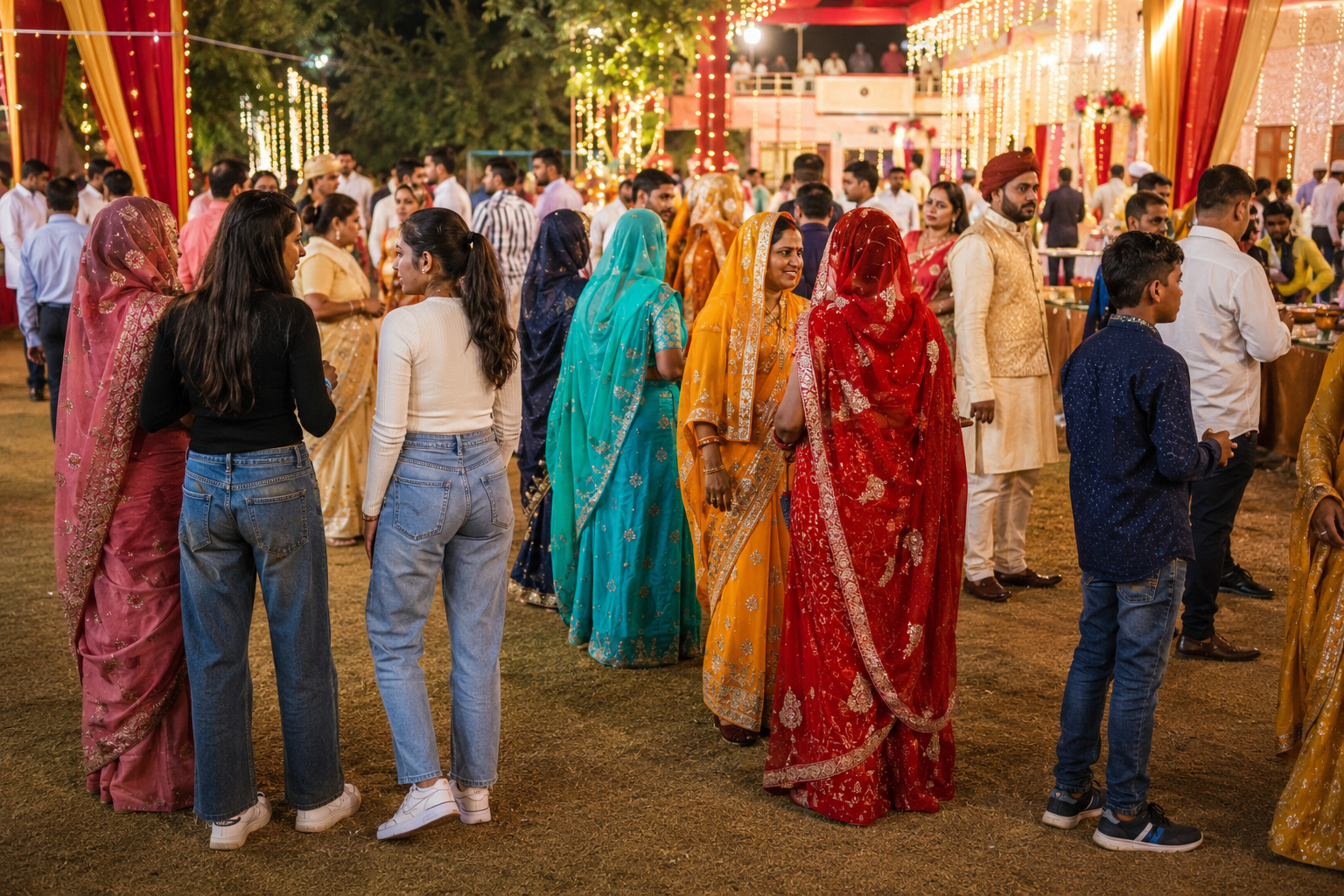
About fifteen years ago, something unusual began to catch attention at weddings in North India. Amid the sea of silk saris, lehengas, ornate jewellery and embroidered kurtas, there would occasionally be a handful of young women dressed in blue or black jeans with a simple top.
They stood out immediately. Indian weddings are among the few settings where traditional clothing is almost an unwritten rule. Against such elaborate surroundings, denim looked oddly ordinary, almost as though it had wandered into the wrong celebration. The instinctive conclusion was that these young women were making a statement by rejecting convention.
The reality, however, was rather different. Most of them were not urban professionals or fashion-conscious college students. They had travelled from villages and small towns to attend weddings in the city. Back home, their clothing reflected local customs and community expectations. Ironically, it was the visit to the city that gave them the freedom to wear jeans. What looked like a rejection of tradition was, in fact, an embrace of another aspiration.
Clothes have always conveyed more than personal taste. They reveal where people come from, the groups they identify with and, just as importantly, the lives they hope to lead. Throughout history, people have borrowed styles from those they admire, whether to signal status, belonging or ambition. Fashion often says as much about the future people imagine for themselves as it does about the present they inhabit.
At roughly the same time, another change was quietly gathering pace across India. Social media was beginning to connect families that had long been separated by geography. For relatives living in villages, urban life was no longer something glimpsed during an annual visit or through films and television. It arrived every day on the screen of a mobile phone.
For the first time, cousins in villages could follow the lives of relatives in Delhi, Mumbai or Jaipur almost in real time. They saw birthday parties, weekend outings, restaurants, shopping malls, holidays and ordinary family gatherings. Just as significant was the way people dressed while doing these everyday things.
The effect was subtle but profound. Urban lifestyles were no longer distant or anonymous. They belonged to family members. Aspirations that had once travelled slowly through cinema or advertising now moved through WhatsApp groups, Facebook photographs and Instagram posts. Social media has narrowed geographical distance while making differences in lifestyle more visible than ever before.
Clothing became one of the easiest ways of expressing those aspirations. For many young people in rural India, jeans gradually came to represent much more than a practical garment. They suggested education, confidence, mobility and participation in an urban world. Wearing denim to a family wedding was therefore less an act of defiance than a way of identifying with a life that seemed modern, independent and full of possibility.
The German sociologist Georg Simmel explained this phenomenon more than a century ago. Fashion, he argued, spreads because people imitate social groups they admire or hope to join. Styles that begin within one section of society gradually move outwards as others adopt them in the search for acceptance or advancement.
Digital technology accelerated that process dramatically. Social media compressed social distance, allowing ideas, tastes and aspirations to move across regions almost instantly. A trend that once took years to travel could now spread within weeks. Yet by the end of the following decade, something unexpected had begun to happen. The flow of influence was no longer moving in only one direction.
In February 2020, delegates gathered at Harvard University for the 17th Annual India Conference to discuss entrepreneurship, innovation and India’s changing economy. Among the speakers was someone who seemed an unlikely fit for such a platform. Instead of a business suit, she wore the vibrant traditional dress of western Rajasthan, a richly embroidered lehenga and odhni that reflected the craft traditions of her home district of Barmer.
Her name was Ruma Devi. Only a few years earlier, few beyond her village had heard of either her or the embroidery traditions she had inherited. Like many girls in rural Rajasthan, she learnt kashidakari from her grandmother as a child. The craft was part of everyday life, passed quietly from one generation of women to the next. It was valued within the family but rarely seen as a means of earning a livelihood.
Life gave her little reason to believe otherwise. She lost her mother while still young, married at seventeen and soon found herself raising a family whose future depended largely on uncertain, rain-fed agriculture. The death of her first child, who could not receive timely medical treatment because the family lacked money, proved to be the turning point. In the midst of personal tragedy, she decided that the embroidery she had grown up with would no longer remain confined to the household. It would become her livelihood.
Ruma Devi began with just two other women from her village. The early days were modest. They stitched embroidered bags by hand because even a sewing machine was beyond their means. Orders were few, resources were scarce, and every rupee mattered. But the work slowly gathered momentum. A small group became a self-help initiative, then a cooperative, and eventually a network that now supports nearly 30,000 women across Rajasthan.
The transformation went well beyond embroidery. The women learnt how to negotiate with buyers, maintain quality standards, prepare invoices, package products and deal with customers. Skills that had traditionally been handled by men gradually became part of their working lives. Financial independence brought confidence, and confidence encouraged ambition.
As their work found wider markets, Ruma Devi made a conscious decision that would define the movement. Rather than adapting village embroidery to resemble urban fashion, she chose to preserve the distinctive character of Barmer’s traditional craftsmanship. The colours, motifs and techniques that had once belonged to village households became the very features that distinguished her work in the marketplace.
That decision changed the narrative. For decades, rural artisans had often been encouraged to modernise by moving closer to urban tastes. Ruma Devi demonstrated that authenticity itself could become an advantage. The appeal of her work lay not in copying contemporary fashion but in presenting a craft that remained unmistakably rooted in its own cultural landscape.
Recognition followed naturally. Her handcrafted textiles were displayed at international exhibitions, including Germany’s prestigious Heimtextil fair. Her artisans later showcased their work at Lakme Fashion Week, introducing audiences to embroidery traditions that had rarely travelled beyond Rajasthan. Ruma Devi herself received the Nari Shakti Puraskar, one of India’s highest civilian honours for women.
By the time she addressed the Harvard conference, she was no longer simply an entrepreneur from Barmer. She had become a recognised representative of rural enterprise and traditional Indian craftsmanship on the global stage.
There was a quiet irony in that moment. A decade earlier, many young women from villages had worn jeans to weddings because cities represented modernity and aspiration. Now, a woman from one of those very villages stood before an international audience dressed exactly as she would at home, without feeling the need to imitate anyone.
The confidence had shifted. What had once been dismissed as village craft was now being appreciated in fashion capitals, at international trade fairs, and at one of the world’s leading universities—not because it had abandoned its roots, but because it had remained true to them.
(Dr Nirupama Singh Dar is a writer and researcher whose work explores the intersections of fashion, political economy and culture. An alumna of Jawaharlal Nehru University and Lady Shri Ram College, she is the author of the book “Fashion, Popular Culture and Political Economy”)