

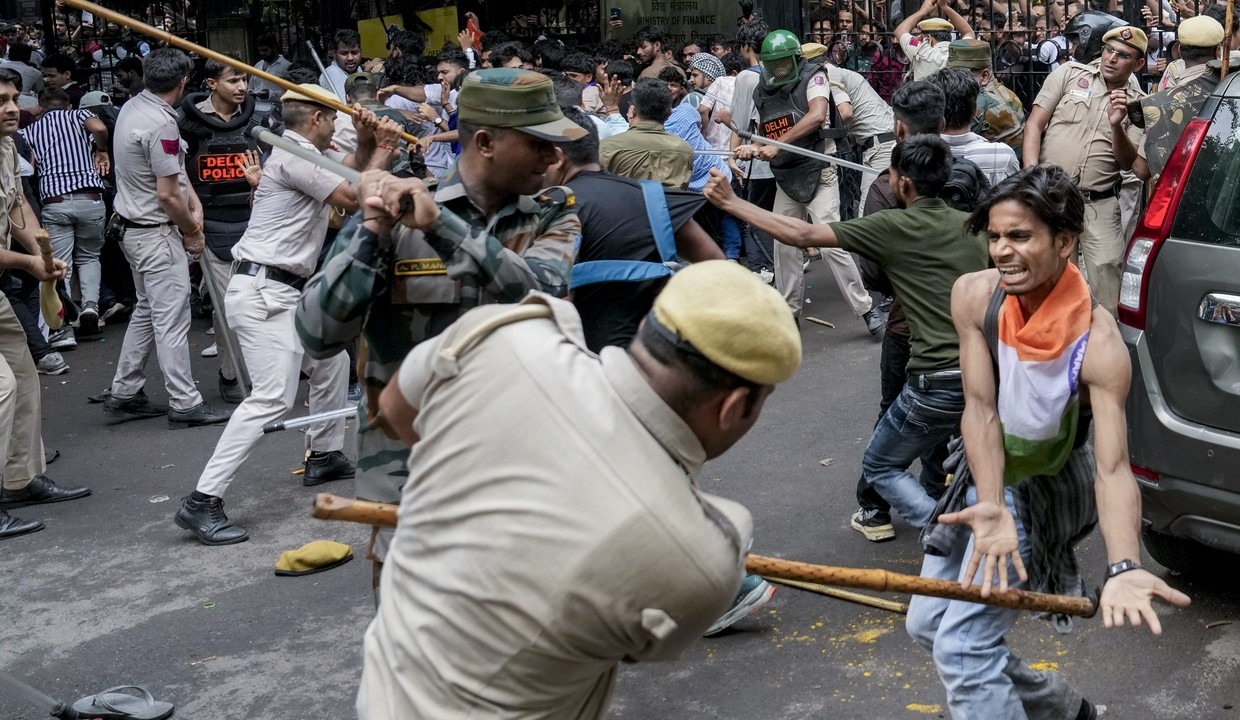
Let’s start with an image, because in this part of the world images travel faster than arguments. Picture Jantar Mantar in New Delhi in the last week of July: thousands of young Indians, many of them dressed in cockroach costumes, camped beside an eighteenth-century observatory built to measure the movement of stars, demanding the resignation of a cabinet minister over a leaked exam paper. Now hold that image next to three others from the same neighbourhood in the last three years: Sheikh Hasina fleeing Dhaka by helicopter as a mob stormed her palace; Gotabaya Rajapaksa’s swimming pool in Colombo filled with jubilant protesters who had just chased a president out of the country he had run into the ground; and Kathmandu’s parliament in flames as Nepal’s Gen Z, organised on Discord of all things, forced a prime minister to resign in seventy-two hours.
As in some cases. And yet only one of these stories ends with the government still standing, the prime minister still in office, and the protest leaders themselves calling off the march and going home satisfied. That, my friends, is not a small difference. That is the whole ballgame.
So let’s ask the blunt question: why didn’t the Cockroach movement eat the house down, the way its cousins did next door? Is it because India is somehow immune to the externally amplified people-power playbook that toppled Dhaka and Colombo and Kathmandu? Is it because New Delhi wears democracy’s silk glove over an iron fist that nobody sees until they touch it? Or is it because Indian political culture, messy, argumentative, endlessly self-correcting, has simply gotten better at the most underrated skill in politics: knowing exactly when to bend so you don’t have to break?
I think the honest answer is: a little bit of all three, plus a fourth ingredient nobody wants to say out loud, which is scale. Start with scale, because in India everything eventually comes back to scale. Sri Lanka has twenty-two million people and one Colombo. Nepal has thirty million people and one Kathmandu. When the capital falls in those countries, the country falls, because the capital is the country in any meaningful political sense. India has one and a half billion people and no single Colombo. It has Delhi, yes, but it also has Mumbai’s financial muscle, Bengaluru’s tech money, Chennai’s Dravidian pride, Kolkata’s old Left instincts, and two dozen state capitals each with its own chief minister who answers to a different electorate on a different clock. You cannot set fire to a country that has no single roof.
The Cockroach protests drew tens of thousands into the streets and dressed grown-ups in insect costumes to make a point about the Chief Justice’s careless words, but they never became national in the way Nepal’s uprising became national in a matter of days. They stayed, largely, a Delhi story with satellite sympathy elsewhere. Federalism, it turns out, is a shock absorber. Call it the flywheel effect of a very large, very diverse democracy: energy that would flatten a small, centralised state simply disperses across a thousand miles of difference.
Now to the second question, the iron fist inside the velvet glove. Let’s not romanticise this. The Delhi Police used tear gas and batons on protesters marching towards Parliament; by their own count nearly two hundred people were hurt, dozens were detained, and there were internet restrictions in the way there always are when a government wants a story to move more slowly than the feed. That is not the behaviour of a state relaxed about dissent.
But here is the crucial distinction worth sitting with: the fist closed on the march, not on the demand. The government negotiated even as it swung the baton, cabinet ministers sat down with twenty-something spokespeople of a party whose own slogan called itself the “Voice of the Lazy and Unemployed”, and within weeks the education minister had resigned, compensation was promised to grieving families, and the hunger-striking activist Sonam Wangchuk ended his fast on the strength of a government assurance. Compare that to Sri Lanka’s Rajapaksa, who kept doubling down on an economy that had literally run out of foreign currency to buy diesel, or Bangladesh’s Hasina, who answered a student quota protest with mass arrests and, eventually, live fire, until the army itself declined to keep shooting its own children. India’s iron fist is real, but it is a fist that still knows how to open. That is not immunity from pressure. That is pressure being processed rather than ignored, the single most important difference between a government that survives and one that gets swept out to sea.
Which brings us to the third and, I’d argue, decisive factor: maturity, or more precisely, the presence of what one may call institutional slack, room inside the system to concede without the whole structure losing face. Rajapaksa had no slack left; his economy had defaulted, his currency had collapsed, and there was no minister he could sacrifice to make the crisis go away, because the crisis was the government itself. Hasina had spent fifteen years hollowing out every check on her power: courts, election commission, media, until there was no pressure valve left except the street, and the street, once it moved, had nowhere to stop but her office.
Modi’s government, whatever else one says about it, entered this crisis with a functioning cabinet reshuffle available as a release valve. Sacking one minister over a genuinely indefensible exam scandal cost the ruling party very little and bought it a great deal of quiet. That is not moral courage. It is something more mundane and, frankly, more durable: political technology. A system that has built enough redundancy into itself that it can lose a minister without losing the government.
And here is the unspoken part: the Cockroach movement’s own target selection made this outcome almost inevitable. Nepal’s Gen Z protesters were reacting to a corruption-soaked government that had banned the very social media apps they used to organise, an existential threat that fused millions of grievances into one. Bangladesh’s students were up against a leader who had rigged three straight elections. India’s cockroaches were angry, brilliantly so, at one insult from one judge and one broken exam system, a wound real enough to mobilise a generation, but narrow enough to be dressed and treated rather than requiring surgery on the whole body politic. You cannot topple what you never actually aimed at.
So not immunity, not just an iron fist, and not pure political grace either. What India demonstrated this summer was something closer to metabolic capacity. The ability of a sprawling, federal, still-legitimate democracy to absorb a shock, digest it, spit out one minister, and keep walking. Bangladesh, Sri Lanka, and Nepal didn’t fall because their people were angrier. They fell because their systems had no slack left to give. India still does.
The cockroaches went home. The house is still standing. Whether it stays standing the next time the exam gets leaked, or the next insult lands, is the only question worth asking now.