


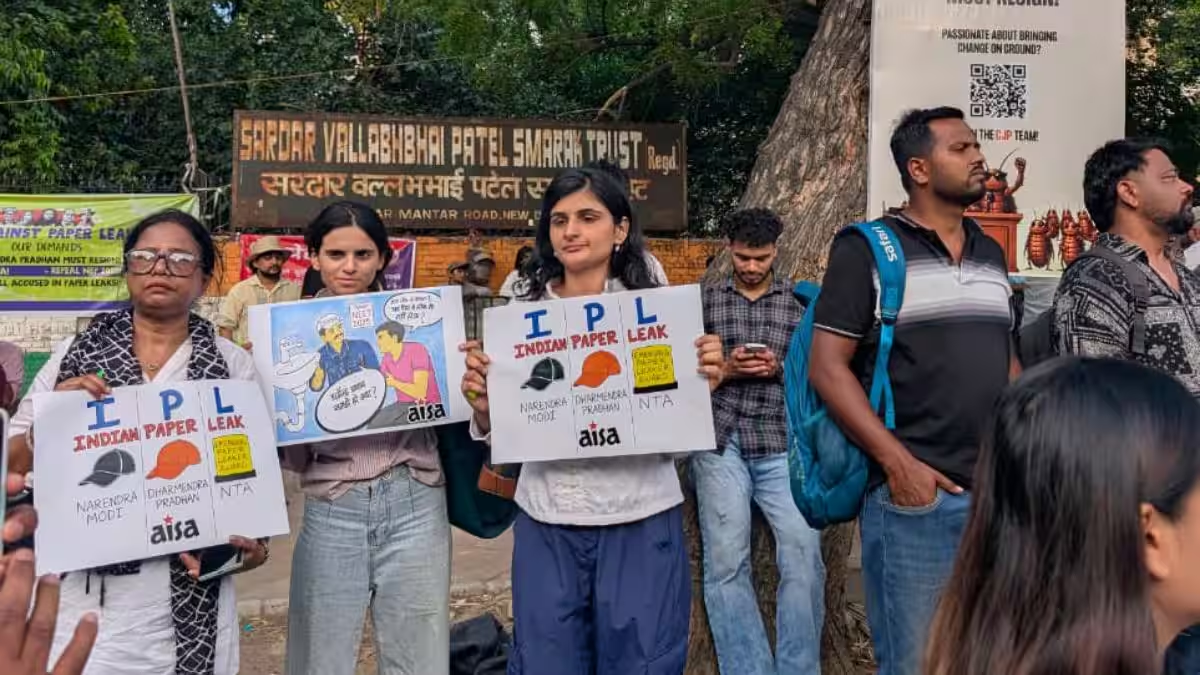
At Jantar Mantar, a protest organised by the Cockroach Janta Party (CJP) over the NEET paper leak and the deaths of several students is underway. From the makeshift dais, a young student named Neha, herself on a hunger strike, begins to read aloud the final letter of a student who is no longer alive. With each passing day, her body has grown weaker, but her resolve has only strengthened. As she reads, the slogans, the traffic and the clamour of the capital seem to dissolve into silence. There is only the voice of someone who can no longer speak for himself, carried by someone determined that it will not be forgotten.
Why should this bother all of us, collectively? In the twenty-first century, nations are increasingly judged not only by their military strength but also by their technological prowess and the sophistication of their artificial intelligence ecosystems. Yet there is another measure of national greatness that receives far less attention: how a country responds when its youngest citizens begin to lose faith in the future it has promised them.
Every society asks its students to devote the best years of their lives to discipline, perseverance and relentless hard work. In return, it enters into an unwritten covenant with them that honesty will be rewarded, merit will matter and the institutions they trust will prove worthy of that trust. Education is not merely about examinations or careers; it is society’s assurance that effort has meaning and integrity is not a losing proposition.
When that assurance breaks down, the damage extends far beyond academic disappointment. It fractures a young person’s faith in the future itself.
That is why the image of Neha reading another student’s final words is so difficult to erase from memory. It is an image no nation should have to own. Behind every examination result is a young life. Behind every rank is a family that has invested years of hope. Behind every statistic is a future imagined with extraordinary care. Every sentence in that final letter is a plea for justice. Every line asks a question that the country cannot afford to ignore.
Sometimes history survives because someone dares to read a forgotten letter aloud. To hear the last words of a young person who found greater refuge in death than in the life his country offered him is more than heartbreaking. It forces us to confront a disturbing question: what kind of society allows despair to become more convincing than hope? That question cannot be directed at the young alone. It turns, inevitably, towards those entrusted with power.
How does a political class read the anguish of a suicide letter and see only a public relations problem or an inconvenient headline? At what point do electoral calculations and party loyalties eclipse the most basic human instinct for empathy? Politics demands difficult choices; it should never demand the surrender of conscience.
When a young person, poised to inherit the future, comes to believe that death offers more certainty than life, the failure cannot be laid at the door of a single institution or government. It is a failure of the state itself.
Nor does the responsibility end with politics. Corporate India celebrates the country’s demographic dividend and competes fiercely for its brightest graduates. These students are hailed as the human capital that will power the economy of tomorrow. Yet when some of those same young people lose faith in the system, where are the voices of the business leaders who speak so confidently about India’s future?
The same question applies to those who shape the nation’s cultural life. Actors, filmmakers, scientists, writers, artists and public intellectuals routinely urge the young to dream big, persevere and embrace failure. But when the institutions meant to protect those dreams falter, too many retreat into silence. If the pursuit of progress exacts such a human cost, then it is worth asking what kind of progress we are celebrating.
This points to a deeper malaise. We have become adept at celebrating individual success while distancing ourselves from collective pain. Ambition commands admiration; empathy rarely attracts the same urgency.
Yet there are always a few who refuse to look away. Sonam Wangchuk is one of them. At considerable personal cost, he has continued to challenge the nation’s conscience, reminding us that citizenship is measured not by comfort but by conviction.
History offers the same lesson repeatedly: courage is seldom found in proportion to power. More often, those with the least protection are the first to take a stand.
That is why Neha’s courage matters. She has neither political influence nor institutional authority, yet she has assumed a responsibility that many with far greater power have avoided. The same is true of Dalit student Abhijit Dipke, who continues to demand accountability, and stand-up comedian Sanjay Rajoura, who has chosen solidarity over convenience.
They come from different worlds, but they are united by one conviction: authority may command obedience, but it cannot command conscience.
These are the real heroes of India, not because they wield power, but because they refuse to surrender their humanity when so many others have.
As a filmmaker, I hesitate to judge professions beyond my own. Yet I have been fortunate to know artists who believed creativity carried responsibilities beyond entertainment. Kundan Shah was one of them. His Jaane Bhi Do Yaaron remains one of Indian cinema’s finest political satires, a film that used humour to expose corruption, media complicity and institutional decay. Its final sequence remains as unsettling today as when it was first released. At a time when much of mainstream cinema has grown cautious, the film reminds us that art fulfils its highest purpose when it challenges power rather than accommodates it.
Indian public life has witnessed similar courage before. During the Emergency in 1975, when the state demanded conformity, some chose dissent instead. Dev Anand refused to fall in line. Kishore Kumar declined to sing a propaganda anthem and paid the price when his songs were banned from state media. Balraj Sahni endured imprisonment for his political convictions without sacrificing his integrity. Their choices affirmed a simple truth: public stature acquires meaning only when it is matched by moral courage.
Aristotle defined courage not as the absence of fear but as the willingness to act despite it. Hannah Arendt warned that democracy is endangered not only by the abuse of power but also by citizens withdrawing from public responsibility. Those insights remain as relevant today as ever.
History rarely remembers people simply because they were famous. It remembers those who chose principle over comfort and conscience over convenience.
That is why the real heroes of India are not always the most powerful or the most celebrated. They are people like Neha, who refused to let a forgotten student’s final words disappear into silence; Abhijit Dipke, who continues to demand accountability; Sanjay Rajoura, who stood beside them when many with greater influence remained silent; and Sonam Wangchuk, who continues to speak despite the personal cost. They represent countless unnamed Indians who refuse to compromise their conscience even when doing so would be easier.
Institutions, laws and constitutions are indispensable, but they cannot defend themselves. Democracies ultimately endure because ordinary citizens defend the values on which those institutions rest.
Perhaps that is the truest measure of a hero: not fame, wealth or office, but the willingness to risk comfort in defence of truth. Nations are sustained as much by such quiet acts of courage as by those who govern them. They are the real heroes of India.
(Shobhita Thakur is an award-winning filmmaker and author. She is an alumna of the FTII, Pune)
