

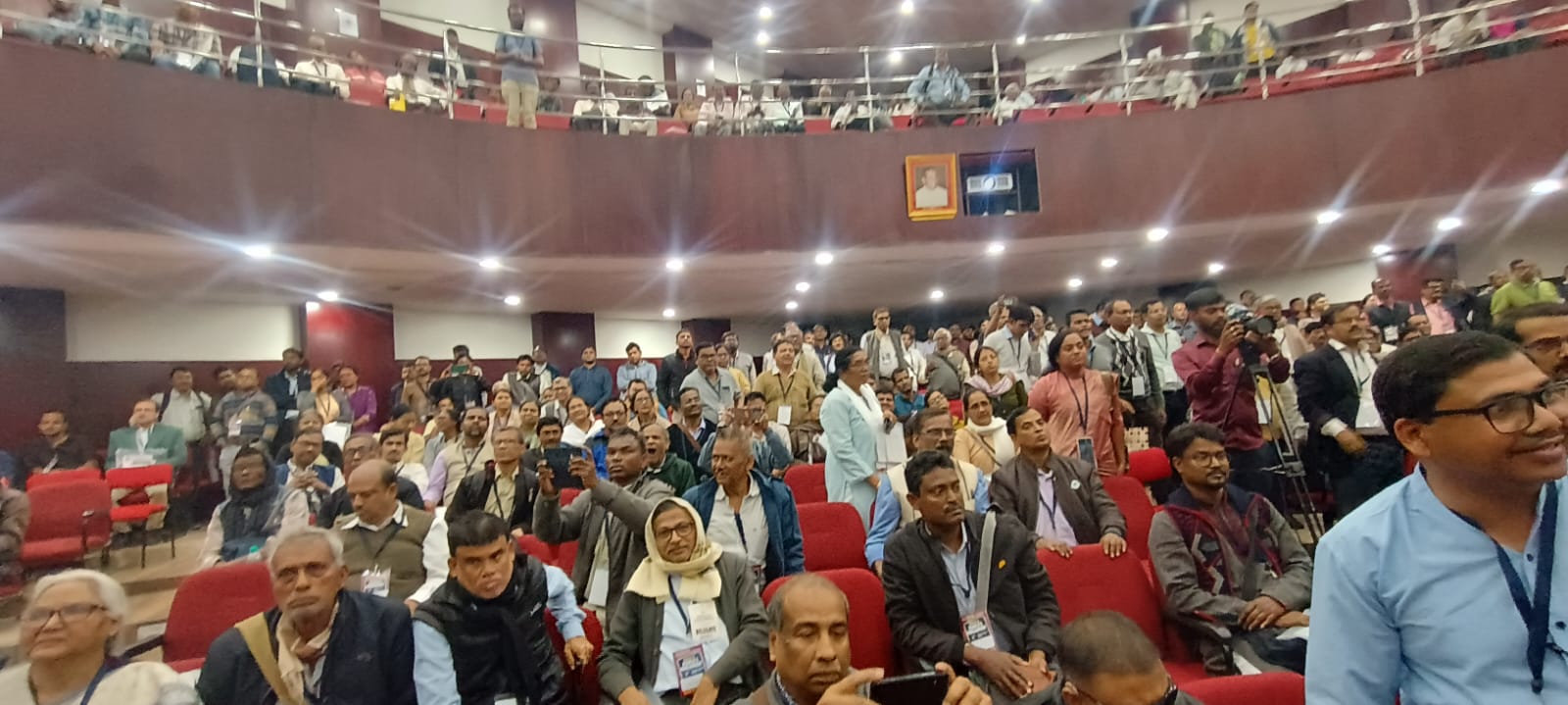
In a significant mobilisation of India’s teaching community, nearly 1,000 educators from schools, colleges and universities across 20 states and Union Territories assembled in Bengaluru recently to convene People’s Parliament on Education, rejecting the National Education Policy (NEP) 2020 and unanimously adopting an alternative framework titled the People’s Education Policy 2026 (PEP 2026).
Under the banner of the All India Save Education Committee (AISEC), participants said the gathering was not a symbolic protest but the culmination of year-long consultations and conventions held in multiple Indian cities, aimed at reclaiming education policy as a democratic and parliamentary exercise rather than an executive announcement.
‘People’s Parliament’ Against Executive Policy-Making
Opening the proceedings, organisers said the central purpose of the assembly was to assert that national education policy must be accountable to Parliament and the teaching-learning community. Speakers repeatedly criticised NEP 2020 for having been announced during the Covid-19 pandemic without parliamentary debate or legislative ratification, arguing that such a process undermined the democratic foundations of policy-making in a sector as critical as education.
“The issue is not minor reform but direction,” said speakers from the dais, stressing that education policy could not be treated as a technocratic document insulated from public scrutiny. According to the organisers, PEP 2026 represents an attempt to restore education as a constitutional responsibility, a public good and a national investment, rather than a market-driven service.
Alarming Indicators of Decline in Public Education
A substantial part of the deliberations focused on what participants described as the “quiet dismantling” of India’s public education system. Presentations and discussions cited data showing that nearly 90,000 government schools have closed over the last decade, up to December 2025, even as India continues to face deep regional and social inequities in access to quality education.
Speakers pointed out that although government institutions still constitute roughly 70 per cent of India’s schools, nearly half of all students are now enrolled in private institutions. This trend, they argued, reflects not informed parental choice but the systematic weakening of government schools through underfunding, closures and staff shortages.
Teacher vacancies featured prominently in the discussions. Participants cited figures indicating more than seven lakh vacant posts at the elementary level and over 1.2 lakh vacancies at the secondary level nationwide. It was also stated that approximately one lakh government schools, serving around 33 lakh children, are operating with only a single teacher.
“This is not an administrative lapse; it is an institutional failure,” several speakers said, arguing that such arrangements deny children the basic conditions of schooling while allowing the system to maintain the façade of universal access.
Precarious Faculty and Infrastructure Deficits
The issue of contractualisation of teachers was raised as a major structural concern. According to figures cited at the Parliament, nearly 40 per cent of schools and 74 per cent of colleges and universities are currently functioning with guest or contract teachers, a model that speakers said erodes academic culture, mentoring systems and institutional memory.
Economist and former JNU professor Arun Kumar highlighted the continuing deficits in basic infrastructure, noting that a significant proportion of government schools still lack safe drinking water and functional toilets. He warned that such failures disproportionately affect girls and marginalised communities, contributing to early dropouts and widening inequality.
The long-term impact of these trends, speakers argued, is visible in enrolment data. Citing studies discussed during the session, participants said that only about 28 per cent of children who enter Class 1 eventually reach higher education, a statistic they described as incompatible with India’s demographic ambitions.
Sharp Critique of NEP 2020
The People’s Parliament adopted a strongly worded rejection of NEP 2020, describing it as structurally aligned with privatisation, stratification and ideological interference. Speakers argued that the policy, when combined with rising education costs, risks creating parallel systems of schooling for different social classes, even within publicly funded institutions.
One of the recurring critiques concerned language policy. Participants alleged that NEP 2020 has manufactured a conflict between English and Indian languages, weakening English-language acquisition for first-generation learners while turning language education into a cultural battleground rather than a pedagogical question.
Former IISER director Soumitra Banerjee warned against what he termed the erosion of scientific temper in curriculum design. He criticised attempts to present mythological claims as scientific fact, arguing that such practices undermine both pedagogy and India’s global credibility in science and research.
Concerns Over Academic Freedom and Research
Historian Mridula Mukherjee called for a national movement to defend academic freedom, particularly in higher education and research institutions. She alleged that research, especially in the social sciences, has been systematically weakened through funding constraints and administrative controls, including in institutions such as JNU, AMU and DU.
The concern, she said, was not only about access but about the kind of intellectual culture India is nurturing: one that encourages questioning and critical inquiry, or one that rewards conformity and ideological compliance.
What PEP 2026 Proposes
The People’s Education Policy 2026, adopted unanimously at the session, calls for a decisive reversal of current trends. Central to the policy is a demand for substantially increased public funding, including allocation of 10 per cent of the Union Budget to education, reaffirmation of the 6 per cent of GDP target, and a call for 25 per cent of state budgets to be earmarked for education.
AIFUCTU president Arun Kumar Singh said declining public spending has diminished not only infrastructure but also the social meaning of education itself. “When the state retreats, education is reduced to a private transaction,” he said.
PEP 2026 also demands permanent recruitment to fill all vacant teaching posts, phased infrastructure development, and an end to what it identifies as four systemic distortions: commercialisation, communalisation, centralisation and discrimination. On language policy, the draft advocates mother tongue instruction alongside English, with safeguards for linguistic minorities and flexibility for institutions and learners to choose additional languages.
The policy insists that curricula and textbooks be prepared exclusively by academicians and education researchers, free from political interference, and grounded in secular, scientific and internationally recognised knowledge systems.
Broad Coalition of Support
The credibility of the People’s Parliament, organisers said, lay in its broad coalition of supporters from across ideological and institutional backgrounds. Those associated with the initiative include former UGC chairman Sukhdeo Thorat, former Supreme Court judge Justice J Chelameshwar, Gujarati writer and editor Prakash N Shah, economist Parakala Prabhakar, former Prasar Bharati CEO Jawahar Sircar, historian Aditya Mukherjee, educationist Shinty Antony, and AISEC general secretary Tarunkanti Naskar.
JNU professor Sachidananda Sinh presided over the proceedings as Speaker of the People’s Parliament.
Taking the Movement Nationwide
The session concluded with the adoption of the Bangalore Declaration, committing participants to take the campaign for PEP 2026 across the country. Organisers said the next phase would involve outreach to students, parents, state governments and Members of Parliament.
“The question before India,” speakers said in their concluding remarks, “is whether education will remain a public guarantee or become a private purchase.” The People’s Parliament, they argued, was a reminder that the future of Indian education cannot be decided without those who teach, and those who learn, at its centre.