


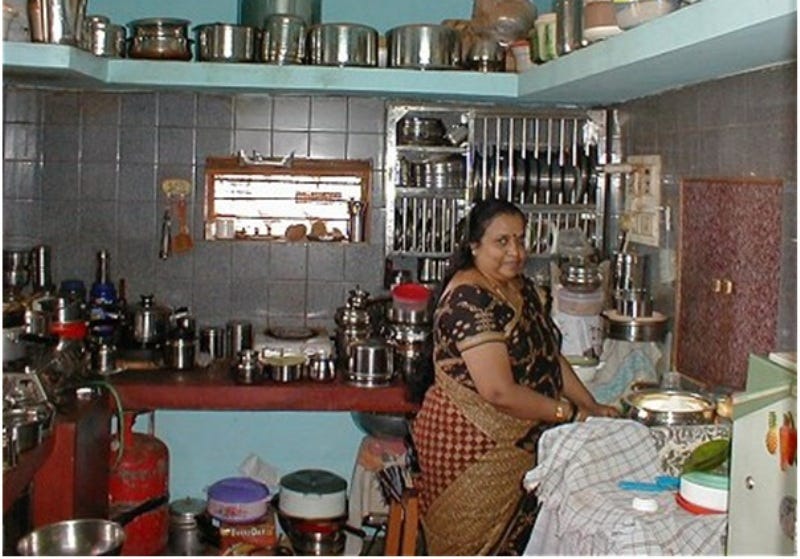
A woman lost her life in a road accident in November 2001. She was a homemaker and had no formal income. It took almost twenty-five years for the courts to decide what her work was worth. When the answer finally came on June 11 this year, it was higher than any value the Indian state had ever placed on such labour.
Justices Sanjay Karol and N Kotiswar Singh decided that if a homemaker dies without her own income, her lost domestic work should be valued at no less than ₹30,000 a month. The Court created a new category of compensation for this, called ‘loss of domestic care’, which is separate from the categories set out in the 2017 Pranay Sethi case. The Court also said that if a woman both works for pay and manages a household, the value of her housework should be added to her salary, not included within it. The judges called homemakers ‘nation builders’ and pointed out that it is strange to call someone a dependent when the whole household relies on her.
₹30,000 a month. Keep that number in mind. Now think about what the state pays the same woman while she is still alive. Twelve state governments now offer unconditional cash transfers to women, reaching nearly 12 crore recipients. Maharashtra’s Ladki Bahin gives ₹1,500 a month. West Bengal’s new Annapurna Yojana pays ₹3,000. Karnataka’s Gruha Lakshmi offers ₹2,000. Other states have their own programmes, including Ladli Behna in Madhya Pradesh, Subhadra in Odisha, Maiya Samman in Jharkhand, Orunodoi in Assam, and Kalaignar Magalir Urimai Thogai in Tamil Nadu. Across India, these payments range from ₹1,000 to ₹3,000 per month. Altogether, these programmes will cost the states roughly ₹2.5 lakh crore this year, and six of the twelve states are running revenue deficits.
Many of these programmes officially state that they are meant to recognise women’s unpaid work at home. So, in the same year, the state has valued the same work at both ₹30,000 a month and ₹1,500 a month, a difference of about twenty times. Take the most generous case in the country, West Bengal’s ₹3,000, and the gap is still tenfold.
To be fair, these two numbers are not the same thing. The Court’s amount is a one-time calculation for a family that has lost someone who managed the household, spread over the years she would have lived. The state’s payment is a monthly amount given to millions of living women, and it was never meant to be a full wage. No one is suggesting that 12 crore women should each get ₹30,000 a month. That is about ₹40 lakh crore a year, more than the entire Union Budget.
Still, the comparison matters because both numbers try to answer the same question: what is this work worth? One part of the state, looking at time-use data and household economics, says it is worth a lot. The other, thinking about what the treasury can afford and what voters will notice, says it is worth much less. The difference is defensible. What happens on either side of it is not.
The Court put a value on this work but did not claim any credit. No judge’s name is attached to the ₹30,000. No bench takes the spotlight. Lawyers will cite the judgment, but most people will forget it, and none of the judges will ever appear on a billboard next to a thankful widower.
The executive valued the work lower and claimed everything. Every one of those transfers arrives wrapped in an identity. It carries a prefix, the Chief Minister’s or the Prime Minister’s. It carries a face on the card, on the approval letter, and on the enrolment camp backdrop. It carries a name that is either an office, a party founder**,** or a goddess, because those three are what the advertising rules leave open. Kalaignar Magalir Urimai Thogai was launched at Kanchipuram on the birth anniversary of one Dravidian founder, named for another in his birth centenary year, with the Chief Minister handing bank cards to beneficiaries in person. That is not carelessness. That is craft, and I say so as someone who has spent thirty years in the rooms where such things are designed.
Why is there this difference? The Court does not have to answer to voters, but the executive does. A judgment values a woman’s work after her death, once, for a single family. A government transfer values a living woman’s work every month for millions of women, and each of them votes. As soon as the payment is made in public, it gets a face attached to it.
Here, the argument turns on itself. The branding may be the reason the money exists at all. A government will start a scheme it can put its name on. It will defend that scheme in a tight budget, raise it before a poll, and protect it from the auditors, precisely because the credit is worth having. Once ₹1,500 starts arriving in a woman’s own account every month, no successor government can take it away, because she will notice, and she votes. So successors do not abolish these schemes. They rename them.
West Bengal is the cleanest case this year. Lakshmir Bhandar, named after the goddess of wealth, has been replaced by the Annapurnar Bhandar, named after the goddess of food, at double the money. A different party, a different government, an entirely different political tradition, and the new scheme reaches for another goddess. The name changed. The theology did not. Odisha renamed 21 schemes at a stroke after 2024. A housing scheme that once bore one family’s name later came to bear the prime minister’s, even though the state continued to build homes.
The pipe runs on. Only the paint changes. Which means the leader’s face on the card is not simply vanity. It is the mechanism that makes the largest direct transfer to poor women in this country’s history politically survivable. That is an uncomfortable thing for a critic to concede, and I concede it.
But notice what the Court has quietly done. It has not just named a bigger number. It has named a different category. It said that keeping a house is work, that work has a value, and that the value belongs to the person who did it. Not an act of benevolence. Not a gift. Not something a leader hands down from a stage on his birthday. Rather, it is an entitlement arising from labour already performed.
Those two framings cannot both be true. If the ₹1,500 is a gift, the face belongs on it, and gratitude is the right response. If it is part payment for work the economy has been quietly extracting for a century, then the face is an odd thing to find on a wage slip, and thanks are owed in the other direction.
Tamil Nadu, to its credit, named its scheme with the word for entitlement rather than the word for gift. Almost nowhere else has followed.
Closing the gap between ₹30,000 and ₹1,500 is beyond any treasury in India. Closing the gap between the two framings costs nothing at all. It would only require the state to say, in its own advertising, what its Supreme Court has just said: that this money is not a favour and that the woman receiving it is not a beneficiary of anyone’s kindness. She is being paid, late and partially, for work she has already done.
That is a harder sentence to put on a hoarding. There is nobody in it to thank.
