

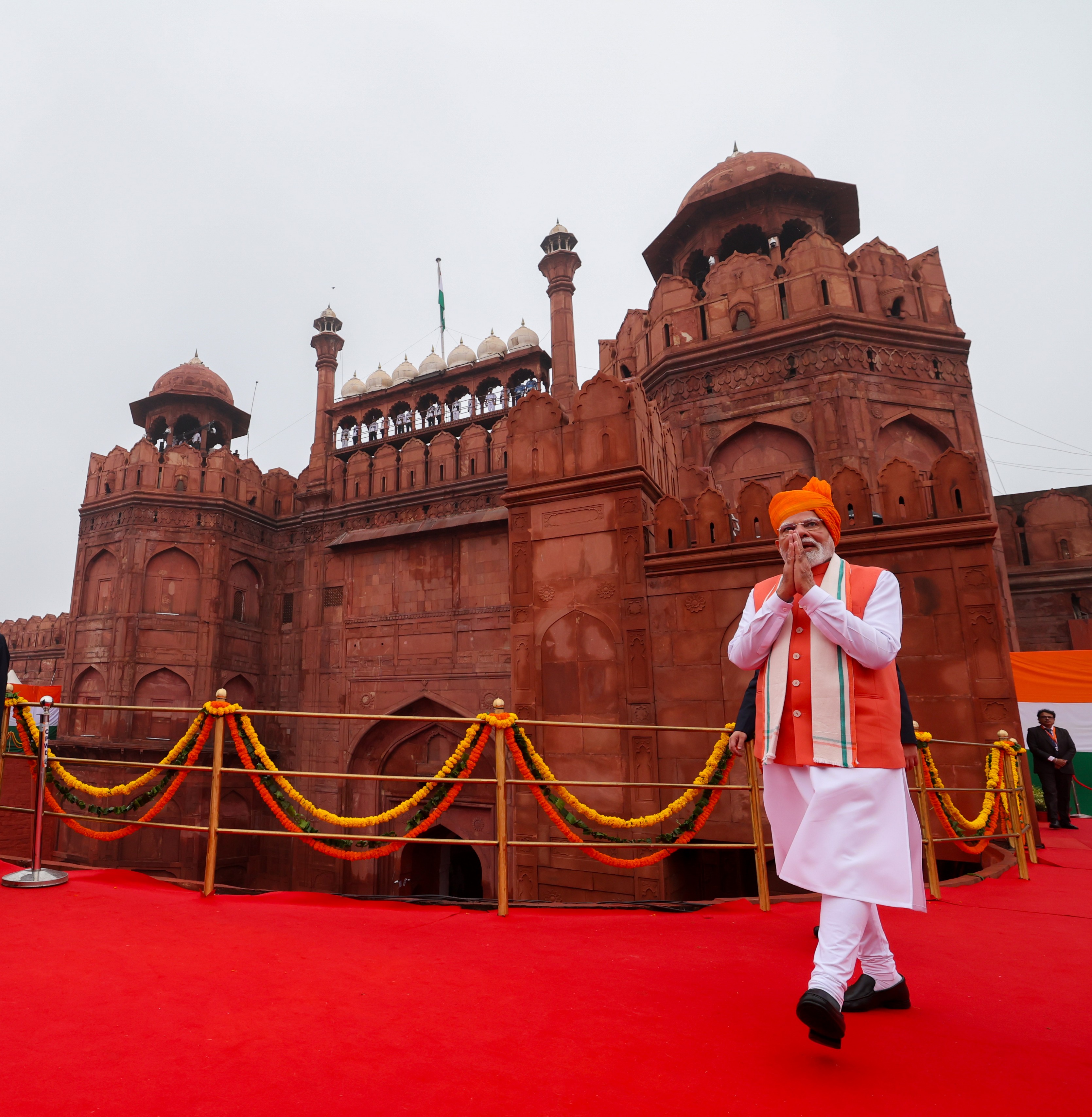
New Delhi, Aug 15: Prime Minister Narendra Modi used his 79th Independence Day address on Friday to formalise a new principle in India’s national security posture: New Delhi will launch pre-emptive cross-border strikes against terror infrastructure without waiting for foreign clearance — and will do so with an arsenal built domestically.
Delivered from the ramparts of the Red Fort just days after Pakistan’s top leadership issued hardline warnings on Kashmir and nuclear deterrence, the 103-minute speech positioned Operation Sindoor as the defining case study for this shift. The retaliatory strikes that followed the Pahalgam terror attack were carried out entirely with indigenously-developed weapons, drones, and surveillance systems — a point Modi repeatedly underscored to frame the operation as proof of India’s “strategic autonomy.”
Modi made the doctrinal change explicit in some of the most forceful language of his tenure: “Our nation has endured terrorism for many decades. The heart of the country has been pierced time and again. Now, we have established a new normal: those who nurture and harbour terrorism, and those who empower terrorists, will no longer be seen as separate. They are all equal enemies of humanity, with no distinction between them. Bharat has now decided that we will no longer tolerate these nuclear threats. The nuclear blackmail that has gone on for so long will no longer be endured. If our enemies continue these attempts in the future, our army will decide on its own terms, at the time of its choosing, in the manner it deems fit, and target the objectives it selects — and we will act accordingly. We will give a fitting and crushing response.”
The declaration marked a break from the earlier public posture, which tended to emphasise reactive defence. This time, Modi openly embraced pre-emptive action as policy, challenging repeated nuclear warnings from Pakistan’s Army Chief Gen. Asim Munir and Prime Minister Shehbaz Sharif. Escalation risks, he signalled, will be managed on India’s terms, not dictated by Islamabad’s red lines.
A former senior defence official said the public rejection of nuclear intimidation represents “a harder edge than anything we’ve seen in India’s declaratory posture before,” signalling a willingness to take calculated military risks.
Self-Reliance as a Force Multiplier
The doctrinal change is anchored in industrial and technological self-reliance. Modi linked Atmanirbhar Bharat directly to deterrence credibility, citing indigenous jet engine programmes, semiconductor manufacturing, nuclear energy expansion, and critical mineral control as the foundation of an independent strike capability.
The defence portfolio’s centrepiece, Mission Sudarshan Chakra, will develop rapid-response weapons systems to complement India’s domestically produced missile and drone networks. Modi pledged a nationwide “security shield” by 2035 — a defensive-offensive grid blending surveillance, interception, and retaliatory strike assets.
In an explicit reference to the Indus Waters Treaty, Modi warned that “blood and water will not flow together,” signalling that water management could become an instrument of strategic pressure. For Pakistan’s water-stressed agricultural economy, such a move would represent a non-kinetic escalation with long-term consequences.
The speech also sought to blunt Islamabad’s attempts to frame India as the aggressor in global forums. By directly attributing the Pahalgam attack to “Pakistan-based infrastructure” and portraying Operation Sindoor as a defensive necessity, Modi pre-empted potential diplomatic pushback ahead of next month’s UN General Assembly.
Alongside defence policy, Modi unveiled domestic economic measures — GST reforms, a ₹1 lakh crore youth employment scheme, and energy independence plans including a tenfold increase in nuclear capacity. By embedding these announcements within a national security framework, Modi positioned economic resilience as a prerequisite for sustained military assertiveness.
The timing and tone suggest that India views the current phase of its rivalry with Pakistan as entering a more volatile, long-term cycle. With both sides hardening rhetoric and posture, Independence Day orations and cross-border strikes are no longer isolated acts — they are interconnected moves on the same strategic chessboard.
“In some ways, the speech was addressed as much to Rawalpindi as to the Indian public,” said a South Asia security analyst. “By elevating Operation Sindoor to doctrinal status, Modi has raised the cost of cross-border terrorism — and made it clear that the tools to impose that cost are now Indian-made.” (5WH)