


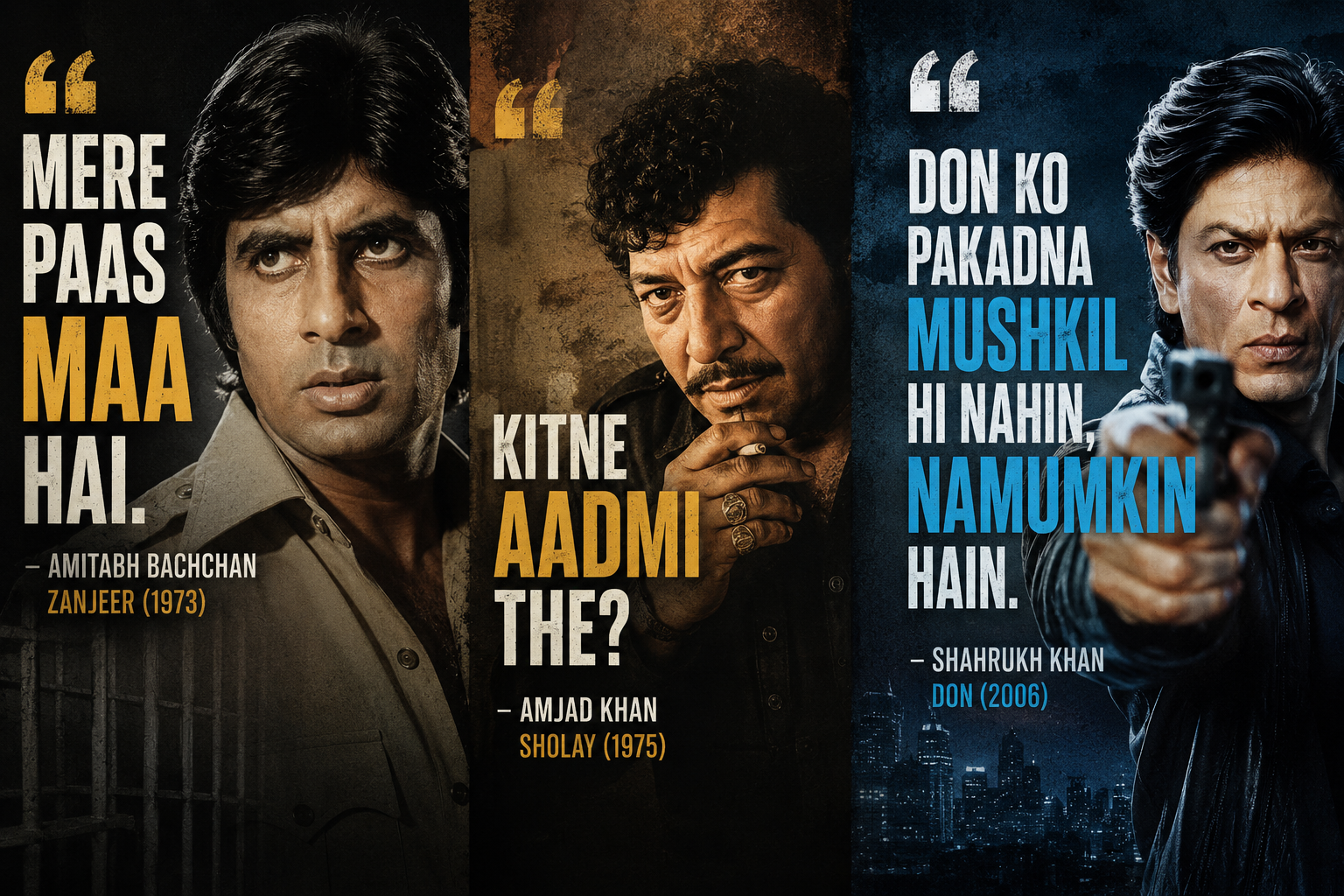
In 1973, two young writers finished the script for a film that would go on to make Amitabh Bachchan a superstar. When the posters went up around Bombay, every name was on them – the producer, the director, the star – except theirs. So they hired a painter and stencilled their own names onto the posters. Those writers were Salim Khan and Javed Akhtar. Decades later, recalling it in the 2024 docuseries Angry Young Men, Salim Khan put it simply: “Our names were nowhere to be seen.” Sit with that for a moment. The men who wrote Zanjeer, Deewaar and Sholay, Hindi cinema’s most quoted dialogues, had to fight simply to be seen at all.
You have quoted their lines more times than you can count. You have almost certainly never said their names while doing it. That gap between the words you remember and the names you don’t is not an accident. It is Bollywood’s oldest, least-examined habit, and Salim-Javed’s fight to change it was never fully won.
Before Salim-Javed, a victory like theirs was almost unheard of. Gulzar became one of the few lyricists of his generation whose name grew as famous as his songs. Kader Khan wrote some of Hindi cinema’s most quoted dialogues for decades yet remained far less known than the stars who delivered them. Rahi Masoom Raza wrote the dialogues for Mahabharat, which an entire generation of Indians can still recite by heart, yet many could not identify him if asked. Salim-Javed weren’t just fighting for a credit line. They were breaking a pattern that had defined Hindi cinema since its earliest days.
A Fight That Never Really Ended
Salim-Javed won their own battle so completely that, at their peak, they commanded higher fees than the actors in their own films. But their victory was personal, not structural; the underlying problem simply moved rather than disappeared. Hindi film credits still separate “screenplay” – structure and character arcs – from “dialogue”, the actual lines you’re still quoting at weddings and on WhatsApp status updates decades later. Veteran writer-director Vinay Shukla has pointed to this split as the reason credit disputes remain so common. When two people can each plausibly claim a script’s most valuable element, producers retain broad discretion over who gets remembered. You’ve almost certainly credited that line to whichever star delivered it, if you credited anyone at all.
Fifty Years On, the Same Unfinished Fight
Even Bollywood’s most decorated writers haven’t escaped it. Screenwriter Varun Grover has pointed out that even industry giants like Gulzar and Javed Akhtar, who fought and won the Zanjeer battle, still go uncredited today. If Salim-Javed’s own partner is still overlooked half a century later, that fight clearly never ended.
At the Indian Screenwriters Conference last year, Niren Bhatt – writer of Stree 2, one of 2024’s biggest Hindi blockbusters – described today’s climate to fellow writers in stark terms: “This is the worst time for writers in the industry.” That came from someone whose film was one of the year’s biggest hits. If box-office success no longer buys a writer leverage, ask yourself what would. This isn’t just one writer’s complaint in December 2023; more than 100 Indian screenwriters gathered under the Screenwriters Association to protest what they called systemic unfair treatment by studios and platforms.
Filmmaker Vikramaditya Motwane, who co-directed Sacred Games with Anurag Kashyap, has made a related point publicly. The writers behind that show’s acclaimed scripts, including Grover himself, rarely received “the recognition they deserved”, even as praise for the series poured in. Motwane’s frustration circles back to Salim-Javed directly: if a writing duo could sell a film on the strength of their names in the 1970s, why can’t Bollywood sell one today on the name of Varun Grover or Juhi Chaturvedi? Fifty years after Salim Khan hired a painter, Hindi cinema’s best writers are still waiting to matter as much as their words.
Here is the detail that should unsettle producers most: the exact problem Salim-Javed fought over has already been solved once for a different group of writers within the very same industry. In February 2025, India’s composers’ and screenwriters’ associations agreed to recognise lyricists as equal co-authors of a song because lyricists organised and pushed for it. That single fact demonstrates that Bollywood’s opacity around credit is a choice, not an inevitability – one that can be dismantled the moment organised pressure makes it more costly to maintain than to fix.
Why Dialogue Writers Are Still Waiting
Which raises the obvious question the industry hasn’t answered: if lyricists won recognition as equal authors of a song, why do dialogue writers, arguably the most quoted and most valuable contributors of all, still lack equivalent protection? The same screenplay-dialogue split Salim-Javed fought against fifty years ago remains exactly as exploitable today, precisely because no comparable agreement has forced producers to formalise it away.
Next time a line from a film stays with you – years after you’ve forgotten the plot, the actor’s face, even the film’s name – ask yourself whose words those actually were. Salim Khan had to answer that question with a paintbrush. Fifty years on, Bollywood’s writers are still trying to ensure their names are remembered for as long as their words.
