


Sometimes the biggest story in literature is hidden in the smallest mark on a page. The renewed interest surrounding Imtiaz Ali’s movie Main Vaapas Aaunga has drawn fresh attention to one of the earliest stories by Munshi Premchand. Yet, amid the discussion, a quiet linguistic casualty has slipped by almost unnoticed.
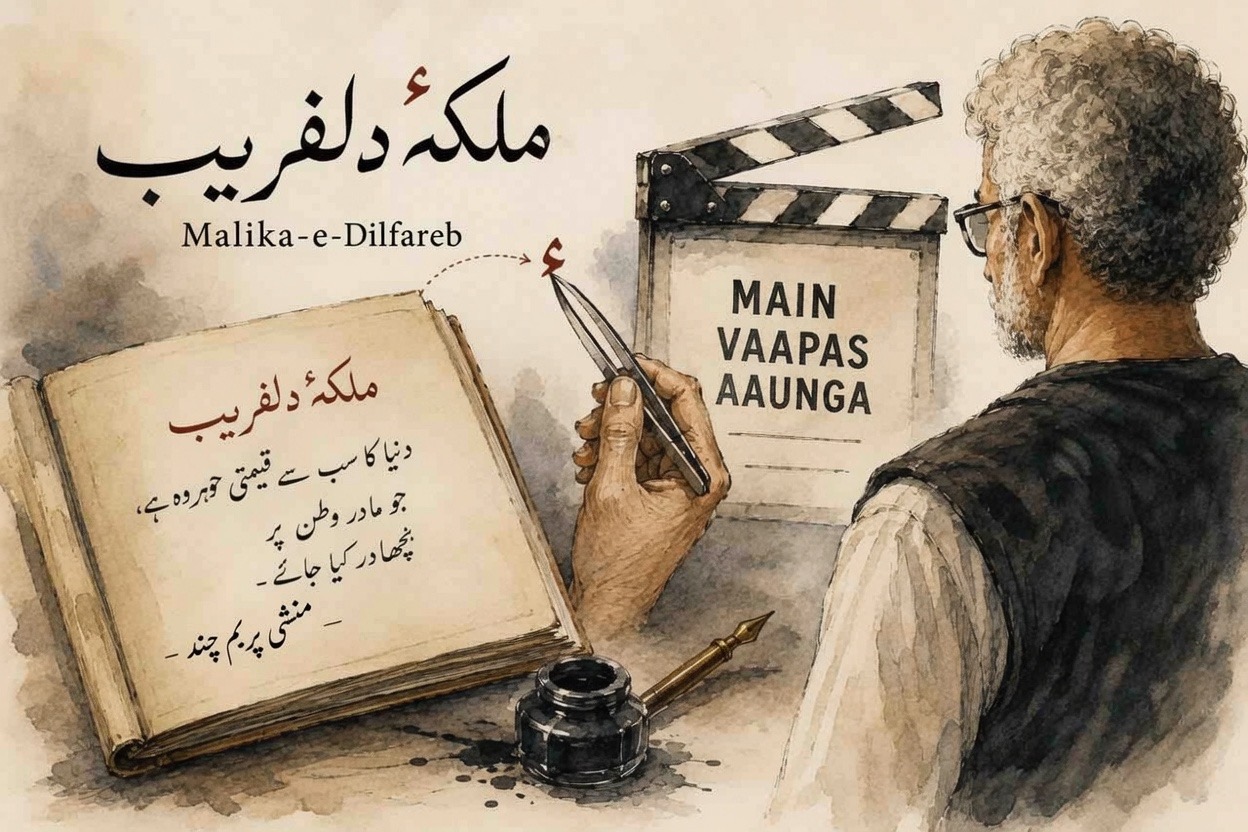
The heroine of Premchand’s original Urdu story is “Malika-e-Dilfareb” (ملکۂ دلفریب). In the film, however, she appears simply as “Malika Dilfareb”, a form also carried as a tattoo by the character played by Naseeruddin Shah. At first glance, it seems an inconsequential omission. It is, in fact, the disappearance of one of Urdu’s most elegant literary devices.
The missing element is the izafat, the Arabic-Persian grammatical construction represented in Urdu by a tiny hamza (ٔ). It links two words to express possession or attribution. Thus, “Malika-e-Dilfareb” does not merely combine two words; it means the “heart-stealing Queen”. The little “-e-” creates both grammatical precision and poetic music. Remove it, and the phrase becomes flatter, less evocative and subtly detached from its original meaning.
Premchand’s story, first written in Urdu in 1907, follows the devoted lover Dilfigar as he searches for the world’s most precious jewel, only to discover that the greatest treasure is the last drop of blood shed for one’s motherland. The story is celebrated for its patriotic symbolism, but it is equally remarkable for the refinement of its language. Editions of Premchand Ke Sau Afsaane faithfully preserve the original form: ملکۂ دلفریب.
So how did the hamza disappear? The answer lies in translation. Unlike Urdu, Hindi has no strong tradition of representing the izafat. As Premchand’s works travelled into Devanagari, many translators quietly absorbed the construction into a single expression. “Malika-e-Dilfareb” became “Malika Dilfareb”. What looked like a harmless typographical simplification gradually became accepted usage.
The phenomenon extends well beyond Premchand. Urdu expressions such as Haal-e-Dil, Soorat-e-Haal, Talib-e-Ilm, Zer-e-Bahas, Jaan-e-Man and Sher-e-Kashmir all derive much of their clarity and elegance from the izafat. Remove the connecting “-e-“, and the relationship between the words becomes less precise. Native speakers usually recover the intended meaning from context, but new readers lose an important linguistic cue—and with it, part of the language’s rhythm.
That is precisely why the omission in Main Vaapas Aaunga feels symbolic. The filmmakers understandably chose the version more familiar to contemporary Hindi audiences. Yet the change also illustrates how the finest textures of a language can slowly fade when scripts change and translations become the primary gateway to literature.
Today, relatively few readers encounter Premchand in the original Urdu script. Most discover him through Hindi or English editions, where such delicate features often vanish unnoticed. The missing hamza in “Malika-e-Dilfareb” is therefore more than a copy-editing oversight. It is a reminder that languages do not lose their richness all at once; they surrender it, one tiny mark at a time.
The hamza occupies scarcely any space on the page. Yet it carries history, grammar, music and memory. Preserving such details is not linguistic purism; it is an act of cultural stewardship. Literature is remembered not only through its stories, but also through the precision of the language in which those stories were first imagined.
(Jameel Gulrays is an acclaimed Urdu connoisseur, storyteller, and veteran advertising professional. He is the founder of ‘Katha Kathan’)