


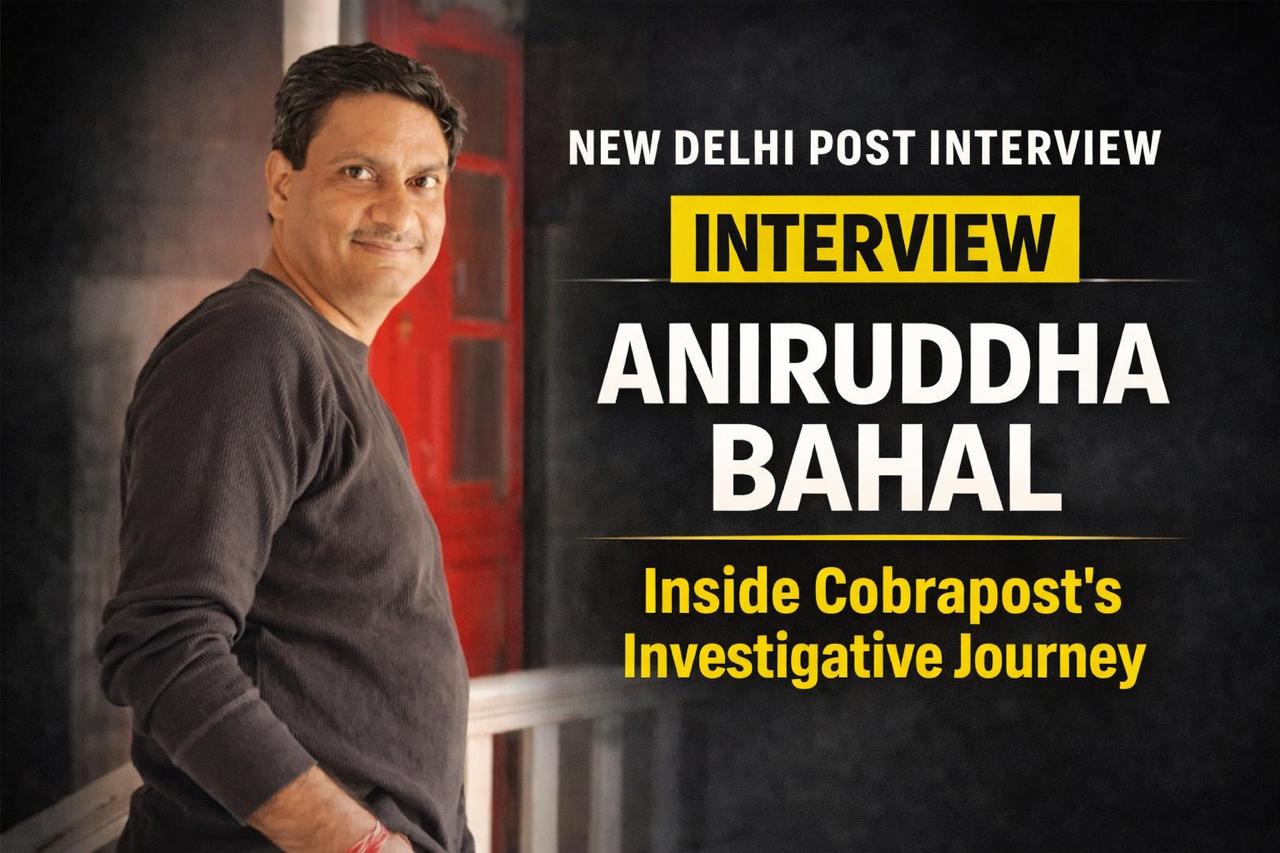
For over two decades, Cobrapost has stood at the forefront of India’s most consequential investigative journalism, exposing corruption, corporate malfeasance and institutional decay, often at high personal and professional cost. From the cash-for-questions sting that shook Parliament in 2005 to landmark investigations into defence procurement, banking fraud, media ethics and Big Tech manipulation, its work has repeatedly forced uncomfortable reckonings within India’s power structures.
In this wide-ranging interview, Cobrapost’s founder and editor Aniruddha Bahal speaks candidly about the origins of the newly launched “Lootwallahs” series, an ambitious investigation into how Indian corporates systematically siphon off public money through complex, often ingenious financial manoeuvres. He reflects on the methodology behind such probes, the impact of the first expose on the Anil Ambani-led Reliance ADA Group, and the backlash that inevitably follows high-stakes investigations.
The conversation also traces the evolution of investigative journalism in India: the rise and decline of newsroom special investigation teams, the chilling effect of political and corporate pressure, and the growing relevance of non-profit journalism as a counterweight to democratic erosion. At its core, this interview is both a defence of investigative reporting and a warning of what happens when journalism loses its nerve, and why truth-telling remains indispensable to governance itself. Excerpts:
How did the idea of the ‘Lootwallahs’ series come up?
It came up many months ago. We have done financial stories in the past—plenty of them, I would say. We broke the DHFL scam in 2019. Before that, we did the “Red Spider” series of investigations on 36 Indian banks, both private and government-owned.
The theme of the series “Lootwallahs” is how Indian businesses are robbing Indians, which is literally what has been happening for a long time. If you look at the way they have been siphoning off money under different pretexts, diverting funds, or carrying out related-party transactions, the pattern becomes clear. Another big thing is that every company indulging in shady dealings and such transactions has its own unique style. No two companies are similar in that aspect. At least from what I’ve seen, there is always some novelty that a particular company uses, or some CA-led transactional details—whether it’s the use of shell companies, mergers and acquisitions, capital gains, or land deals. Every company is different, and especially when they belong to different sectors, they all do dodgy things differently.
How many stories do you intend to do as part of the ‘Lootwallahs’ series?
Well, at the moment, we are on track to break half a dozen of them. Fingers crossed. These investigations are never a sure shot, however. There’s a lot of data collection involved, a lot of understanding, and a lot of analytics. It’s a very rigorous, tedious and time-consuming process, but the ambition is there. I really don’t know how many we will end up doing.
What was the response to the first edition of the ‘Lootwallahs’ series, the one on the Anil Ambani-headed Reliance ADA Group?
I must say it has been very, very encouraging. We did a thorough investigation outlining all the various ways in which they had diverted funds from listed entities—the elaborate modus operandi used to bury the transactions in layers. We also tracked transactions conducted abroad, which were very dodgy in that regard. So it was an extremely comprehensive investigation, and we were appreciated for it. In fact, the agencies did take it forward.
If you notice, before our investigation, the figure being bandied about by the agencies was around ₹3,000 crore worth of fraud. But after our investigation, certain media outlets began reporting that the Enforcement Directorate was assessing that the scam could be upwards of ₹40,000 crore, which is essentially what our findings suggested. And if you look at the timeline of events that unfolded a few days after our story—the attachment of properties, the raids, the beginning of the SFIO investigation—all of it, I believe, took root from what we had uncovered. It also proved that we were in the right, and that all the accusations being levelled against us by the Reliance ADA Group were false and malicious.
Cobrapost has been known for investigations for a very long time, especially since 2005, when you did ‘Operation Duryodhan’, which led to the expulsion of 11 MPs from the Indian Parliament for taking money to ask questions in the House. Can you describe your journey in detail since then?
Yes, our first investigation was in 2005, when we exposed how MPs in India were taking money to ask questions in Parliament. Subsequently, we were under contract with several different television channels, and we would conduct investigations in partnership with them. At that time, it was Aaj Tak, Star News, which later became ABP News, IBN7, Times Now, and even NewsX briefly.
There was also a series of shows that we did—the “Benaqab” for Star News, and a whole bunch of investigations between 2006 and 2008 that had a great impact. Stories like exposing how some maulvis were taking money to issue fatwas, videos of militants planning attacks in Kashmir, and investigations into child abuse. We did stories on people renting out guns from courts, and on how gangs were recruiting new members.
There was a whole body of work during that period, much of which I have documented in my autobiography, A Taste for Trouble, and if someone takes the effort to read it, they will come to know about all of it.
What about subsequent years? I mean, ‘Cobrapost’ became a non-profit sometime in 2013 or 2014, and your stories seemed to acquire a different edge after that?
Yes, you could say that. We did turn non-profit, I think, in 2013. That removed the constraints of being tied to a television channel as a partner. From that point onwards, we did many stories that people actually remember us for. We investigated how the Ranveer Sena committed a whole series of atrocities and mass murders in Bihar over a certain period. We also conducted several investigations on “Love Jihad”.
Then came “Operation Red Spider”, which I’ve already mentioned—an investigation into 36 Indian banks that were ready to launder money. We also did an investigation on the Ram Mandir movement, which again created a significant impact. In fact, “Operation Red Spider” led to a complete overhaul of the KYC procedure. The KYC process became more stringent, and I remember many people blaming me at that time for it. We also investigated how social media companies were indulging in all kinds of mischievous practices, especially promoting different kinds of campaigns.
Undercover reporters approached representatives of these platforms posing as clients who wanted to spread divisive content, communal messaging, and politically loaded narratives.
The investigation documented how many of these companies not only agreed to run such campaigns but also offered strategies to bypass moderation, avoid detection, and exploit algorithmic loopholes. The investigation remains extremely relevant in India today. Social media has become one of the country’s primary battlegrounds for political persuasion, communal polarisation, and electoral messaging. Cobrapost’s findings exposed the ease with which misinformation could be weaponised, the vulnerability of users to influence operations, and the lack of transparency in how online political content is promoted. It helped spark broader public scrutiny of digital advertising practices, the accountability of tech platforms, and the urgent need for stronger regulatory frameworks.
In many ways, the investigation was ahead of its time, foreshadowing the current debates about disinformation, algorithmic manipulation, and the responsibility of Big Tech in shaping India’s democratic processes.
And, of course, we did the famous “Operation 136”, exposing multiple media companies and how willing they were to take money to promote certain ideological content.
So, there was a whole series of investigations we did from 2013 to 2019, and they were very impactful. We also did “1984: The Aftermath”, revisiting the riots that unfolded after Indira Gandhi’s assassination in Delhi.
Many policy changes followed some of our investigations, and that was very, very gratifying.
Did ‘Cobrapost’ do some social stuff as well? I mean, did your team expose malfeasance beyond the government realm?
Of course. We have done some good investigative stories, which covered social issues as well.
Can you tell us more about what kind of investigations you find gratifying?
I think there is a certain satisfaction that comes from impactful investigations or impactful news. Because at the end of the day, we are all news hounds and we love a good story. And I think a journalist who works hard knows it well when he or she is in the process of doing a solid investigation, and when he or she breaks the story, or when the whole team does that, the feeling is completely different.
There are two examples I often mention. One was after “Operation West End”, the famous investigation we did into the defence procurement process in India in 2001 under the banner of Tehelka. That investigation led to the resignation of Defence Minister George Fernandes, BJP President Bangaru Laxman, Samata Party President Jaya Jaitly, and a whole bunch of other officials. Several prosecutions were launched, a commission of inquiry was set up, and ultimately many of them were convicted.
During that period, a friend of mine from Bangalore called to tell me she overheard two women labourers talking on the streets, and one was telling the other that “Tehelka has made a machine in Delhi—if you stand in front of it, it can tell you what kind of corruption you have done in your life.” I lived on that story for a long time, and I still live on it.
There was another moment when one of our reporters was travelling on a bus and overheard a dispute between a passenger and the bus conductor. The passenger felt he was being overcharged and shouted at the conductor, saying he would report him to “Tehelka”. It had become a buzzword at the time because of the kind of investigations we had done and the way we had connected with the Indian public. “Operation West End” was a defining moment for me.
Other gratifying moments have been more personal. I was once told that when I was doing a press conference, the then Prime Minister Shri Atal Bihari Vajpayee was watching it on TV, and he apparently turned around and said to someone I know, “Aise log bahut kam rah gaye hain.” I hope I lived up to that remark in the end.
These small things sustain you. Beyond that, there is the larger sense of simply enjoying the process of doing investigations, because very few journalists these days do investigative work for a variety of reasons.
You mentioned that very few people do investigations these days for a variety of reasons. What do you mean by that?
Well, just to give you an example, in 2006–07, after we did a whole bunch of investigations for Star and IBN7, it became a culture within news channels to have their own special investigative teams. This was essentially an attempt to replicate what ‘Cobrapost’ was doing. Everyone wanted to recreate that success. For a while, it worked. Many of those SIT teams were staffed by ex-Cobrapost employees, and they did some amazing work at that time.
But subsequently, the demands of television channels started weighing heavily on reporters. Investigations take a lot of time and resources, and from the perspective of channels, reporters weren’t able to “produce” something in the daily grind. Channels are used to reporters delivering a story every other day. Investigations don’t work that way. They take weeks, months, and significant resources. As a result, channels started seeing investigative reporters as a burden.
But even that is not the main problem now. The culture of SITs has diminished. People prefer low-hanging fruit. They go after traffic violations, hospital staff, or some easy sting—stories that will not get them into trouble. You can hardly call these investigations. Resources aren’t being used for high-impact stories. Everyone is scared to do such stories.
It is the political culture that sets the tone for whether media organisations have the courage to pursue investigations. Earlier, news organisations felt that there was a democratic temperament in the political environment—that if an investigation was done without malice, the state would not necessarily come after you. Even if the state acted against you, you could count on the judiciary to bail you out. But journalists today do not seem to have that confidence, and channel owners and media platform owners don’t have it either.
You now see that governments at both the state and the central level have an extremely low tolerance for investigative stories. Often, it is the reporters who are targeted even for basic things such as tweets and so on. I feel the culture has deteriorated, and it has had a dampening effect on people doing high-impact investigations.
How do you handle the whiplash from an investigative story that may be against the state or a private entity?
That’s a very interesting question. My hands have always been full countering pushback from the state and private entities. I would have to go all the way back to the cricket match-fixing exposé I did in 1997 with Krishna Prasad, the attitude of the BCCI and the establishment at that time. The BCCI even filed a ₹5-crore lawsuit against us. We personally dealt with many commissions, the Chandrachud Commission of Inquiry on match-fixing, a private inquiry by the BCCI, and the like.
Later, when we did “Operation West End”, the entire central government fell on us. A commission of enquiry was set up which looked into the motives of the media platform rather than what the story exposed. They examined financial aspects—who funded us, what the motive was, etc. Ram Jethmalani defended us against the bogus claim that we did the story to bring the stock markets down so we could benefit from “our stock positions”. That fell flat because we didn’t have any accounts, and First Global proved in court that the market actually rose. In fact, Shankar Sharma of First Global was opposed to us doing the story because he knew the backlash that would follow.
Subsequently, George Fernandes accused us of being ISI agents, then Hinduja agents, then Congress agents. This is the famous rulebook: when you cannot deal with the facts an exposure brings to your doorstep, you attempt to mangle and discredit the messenger. This playbook has been happening for ages and continues today if you do a story they don’t like.
The latest story on the Reliance ADA Group led by Anil Ambani is a prime example.
We sent them a questionnaire on 19 October, but they immediately accused us of defaming them even before the story was published. The questionnaire was private, only to them, yet they accused us of interfering with the criminal justice system because their cases were pending across India. They also accused us of doing the story to profit from a fall in their stock price. Their accusations were so dumb and defamatory that we simply issued a blanket denial of all of them at the press conference, for all and sundry. But we might consider filing a defamation suit.
This playbook is common. But the most interesting and redeeming aspect of it is that people see through it.
Actually, come to think of it, what is wrong with a media platform profiting from a story it does, especially if that story leads to the fall of a particular stock price? What are your thoughts on that?
Well, it is complicated and requires a long answer, for the simple reason that I think the law allows for it if you put in a disclaimer. But I may be wrong. I am just recounting conversations I’ve had with many people who are in this business, and often they have told me that if a media organisation puts a disclaimer stating that this is an investigative story and that the organisation also has a particular position, and declares exactly how much it has bet on that position upfront, then it is totally legal. But again, I may be wrong—this is simply what several people have told me, because people have been curious about it.
We have never done it. First of all, we would need the money to do something like that. Second, I don’t personally own a demat account to do that. There are others who feel that this should be a revenue stream for media platforms—that they should declare their intent upfront, and that way the public can decide what the story is and what the intent behind it might be.
But I think that, in the Indian context, it might detract from the purity of a story. Maybe I’m not entirely sure. If there is pure journalistic intent, then perhaps it should not be polluted by some other intent. That is one aspect of it.
The other aspect is that you end up giving a handle to the people who are the subject of your investigation to come after you, claiming that the intent was to bring down a particular stock and benefit from it, which would be far from the case. So, it’s something that perhaps someone with more courage could explore, but right now our frame of mind doesn’t allow us to pursue that.
But in the US, for instance, there are many short sellers—I am told a multitude of them—who do precisely this. They do investigations, they declare their short positions, and they wear it on their sleeves. You could call them quasi-media organisations because they publish reports about the malfeasance of various corporates, and they openly benefit from it.
How do you see investigations in India developing? Do you think it’s a dying form in the Indian context, or do you see some ray of hope?
At the moment, I wouldn’t have many positive things to say about investigations in India. The spirit, activity, and volume of stories that we saw in the period between 2006 and 2013 have more or less disappeared. It lasted maybe half a decade, six or seven years, and there were a variety of reasons for that.
For TV channels that once had special investigative teams and now don’t, it became a revenue issue. Management started seeing every section as a revenue input on the larger balance sheet. I don’t think an investigative team can ever give you a revenue surplus, because it is a sinkhole in terms of resources—time, travel, money, and the mindshare of top bosses. And of course, the subsequent litigation that follows such stories costs a lot of money. Over the years, I’ve seen journalists lose their appetite as well, because the journalists who used to do investigative stories have realised that many media platforms simply don’t carry those stories anymore.
Reporters also have realised that they have to defend their stories in court many years after release, and quite often the media platforms leave them to fend for themselves. That’s a big dampener.
The sources have also lost their appetite because whatever story they bring to a journalist, the journalist is often unable to fulfil their promises for reasons beyond their control.
The media platforms that do wish to do these stories, and feel the need to, are scared of the pushback by various government agencies that can be let loose on them. They are also scared of lawsuits that would follow if they start doing corporate stories. A general chill factor has developed as a result.
Another factor, perhaps, is the attitude of the judicial system. Earlier, it was very protective towards journalistic freedom. Now, many journalists feel that may not be the case if they are up against the central government or any state government, for that matter. They feel that judicial protection would be a very 50-50 thing. That too has contributed to the chill.
But I think the future of investigations is largely non-profits. America has more than 400 to 500 investigative non-profits—some based in foundations, some in universities, some independent—and they have been doing some amazing work. Europe has a few, and more are coming up.
I think that for a country that sees itself as a superpower in the coming decade, India has to invest in the democratic process. It has to invest in these institutions, because investigative journalism is the essential “penicillin” needed in any governance structure—and if you don’t have that penicillin, then rot takes hold.
There is also a point of view where many readers in the US feel that perhaps media platforms should take things to a logical conclusion, which is to say that they should initiate judicial petitions or other such judicial devices on their stories. So, if you end up doing a great investigation, you should also do a public interest litigation on the said investigation. Do you believe in that?
Well, so far, the stance has been that it is others who should take an investigation forward if they so feel like it. I mean, a lot of our stories have been picked up by investigating agencies, taking them forward in terms of prosecution or commissions of enquiry. But for a general platform to force the judiciary to have a look at its own story through some judicial mechanism, I haven’t really thought long on that. I did think along those lines when we were doing the Ranveer Sena investigation. A lot of people entreated me to think about it, but ultimately I chose not to. In fact, recently I toyed with the idea of a writ petition on a story through someone, but it didn’t come through as I had not thought it through, and there would be elements of it which might give the optics that it was staged.
Public interest litigations are not a complete no, though. Maybe at some stage, when we feel the need for a PIL on any of our stories, and there is a need for that, then we might go ahead. What helps us is that we are a non-profit and governed by the Societies Act.

