

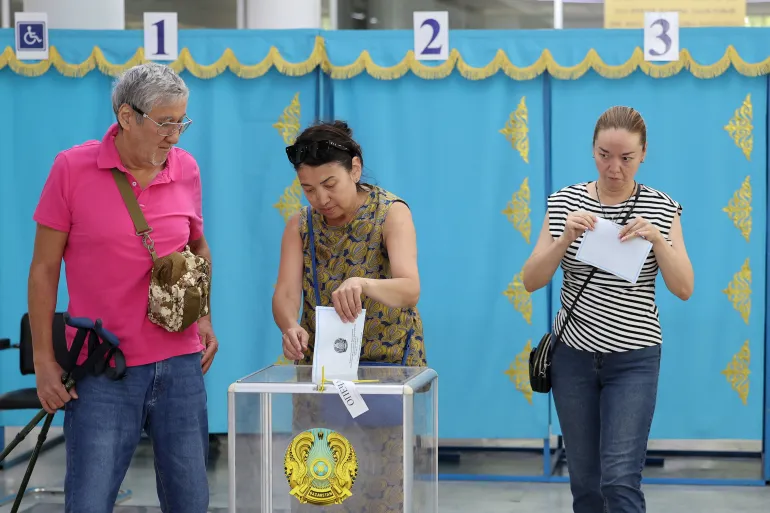
Kazakhstan, Central Asia’s largest economy and the world’s ninth-largest country, has completed the most far-reaching overhaul of its political architecture since its independence in 1991. What began as a response to the January 2022 protests has culminated in a unicameral legislature, a renamed parliament, and a decisive election result that consolidates the post-Nazarbayev order under President Kassym-Jomart Tokayev. A new vice-president post has also been created to ensure a smooth political transition in the near future. This political overhaul has been carried out in line with global and regional geopolitical developments. President Tokayev has frequently reiterated the need to adapt to global changes for countries’ overall development.
From Crisis to Constitutional Reset
The 2022 protests, which were initially triggered by fuel-price rises, exposed deeper dissatisfaction with governance and elite privilege. The authorities restored order, and the Kazakh government under President Tokayev launched the “Just Kazakhstan” concept for equitable governance and a just political system. Over the following years, this agenda produced successive institutional adjustments. The decisive step came in 2026. A nationwide referendum was held to secure citizens’ approval of constitutional amendments touching on 77 articles—roughly 84 per cent of the constitution. The revised text took effect on 1 July and cleared the way for parliamentary elections to an entirely new parliament.
The most visible change is the abolition of the bicameral system. The Mazhilis and Senate have been replaced by a single 145-seat chamber called the Kurultai. Deputies are elected for five-year terms through closed party lists in one nationwide constituency, with a five-per-cent threshold. Candidate lists must reserve at least 30 per cent of places for women, young people and persons with disabilities; in practice, the share has exceeded 40 per cent. Kazakh authorities have claimed that these changes were made to support the efficient delivery of government services, ease the law-making process, and improve the overall welfare of the state.
Symbolism and Design Choices
The choice of the name “Kurultai” is a well-thought-out step. It evokes the traditional assemblies of the Turkic-Mongol steppe and the consultative National Kurultai that operated between 2022 and 2026. Officials present the reform as a return to indigenous models of collective deliberation rather than the simple importation of Western parliamentary forms. Practically, the single chamber is expected to accelerate law-making by eliminating the need for inter-house reconciliation and by removing presidential appointment quotas that previously existed in the upper house. However, observers and experts have noted that a pure list system combined with a limited field of registered parties concentrates influence. Whether the new body functions as an effective check on the executive or as a more efficient transmission belt remains the central open question.
The August 2026 Election
Seven parties registered for the elections. Amanat, an old and long-dominant party, did not run; its structures and personnel largely merged into the newly formed Adilet party. Aibek Dadebay, a former chief of the presidential administration, headed the new party. President Tokayev also nominated him as the first chairperson of the newly formed parliament. The other contenders were Auyl, Respublica, Aq Zhol, the People’s Party of Kazakhstan, the Nationwide Social Democratic Party (OSDP) and the green party Baytaq. Roughly 545 candidates appeared on the lists.
Voter turnout reached 74.08 per cent, well above the 54 per cent recorded in the 2023 parliamentary votes. A sharp regional variation was also recorded, with over 92 per cent voting in the Turkestan region and only 43 per cent in Almaty. Adilet secured 71.17 per cent of the vote (6.53 million ballots) and 110 seats. Four other parties crossed the threshold: Auyl (6.26 per cent, 10 seats), Respublica (5.56 per cent, 9 seats), Aq Zhol (5.21 per cent, 8 seats) and OSDP (5.11 per cent, 8 seats). The People’s Party and Baytaq fell short. A further 2.51 per cent of voters chose the “against all” option.
The elections were watched closely by international observers and the media. Seven hundred and seventy-seven international observers from 42 countries and 13 organisations participated in the Kurultai elections. Almost all assessed the elections as free and fair. But the assessments diverged. Some missions described the process as technically well-organised and orderly; the Parliamentary Assembly of the Council of Europe’s preliminary statement acknowledged good preparation while highlighting the limited political pluralism on offer.
Wider Stakes
Domestically, the election gives the executive a clear parliamentary majority and, with it, heightened responsibility for delivering on economic modernisation, youth employment, digitalisation and education. Externally, a more streamlined legislature could, in principle, translate multi-vector foreign-policy commitments into domestic law more quickly—whether on transport corridors, critical minerals, energy or climate cooperation. Kazakhstan’s size and relative institutional capacity already make it the natural pivot of Central Asia; a parliament capable of sustained oversight would strengthen that position.
From an Indian point of view, India–Kazakhstan relations illustrate the practical dimension. Bilateral trade already covers uranium, oil, critical minerals, pharmaceuticals, digital technology and agriculture. With India chairing BRICS in 2026 and Kazakhstan participating as a partner country, plus ongoing work inside the Conference on Interaction and Confidence-Building Measures in Asia (CICA), a predictable unicameral partner in Astana could facilitate parliamentary exchanges, investment-protection legislation and mobility arrangements. India’s decision to send observers to the Kurultai vote signalled interest in the durability of the new institutions.
An Open Test
The redesign is best understood as carefully managed renovation rather than rupture. The first Kurultai has been seated with a dominant majority and a formal commitment to greater efficiency and representation. The decisive test will be whether the chamber develops genuine deliberative capacity, effective oversight and the ability to shape multi-year policy—or whether it simply streamlines executive preferences. In a region watching institutional experiments closely, and at a moment when Kazakhstan continues to balance relations with Russia, China, the West and others, the performance of the new parliament will matter far beyond the arithmetic of seats.