


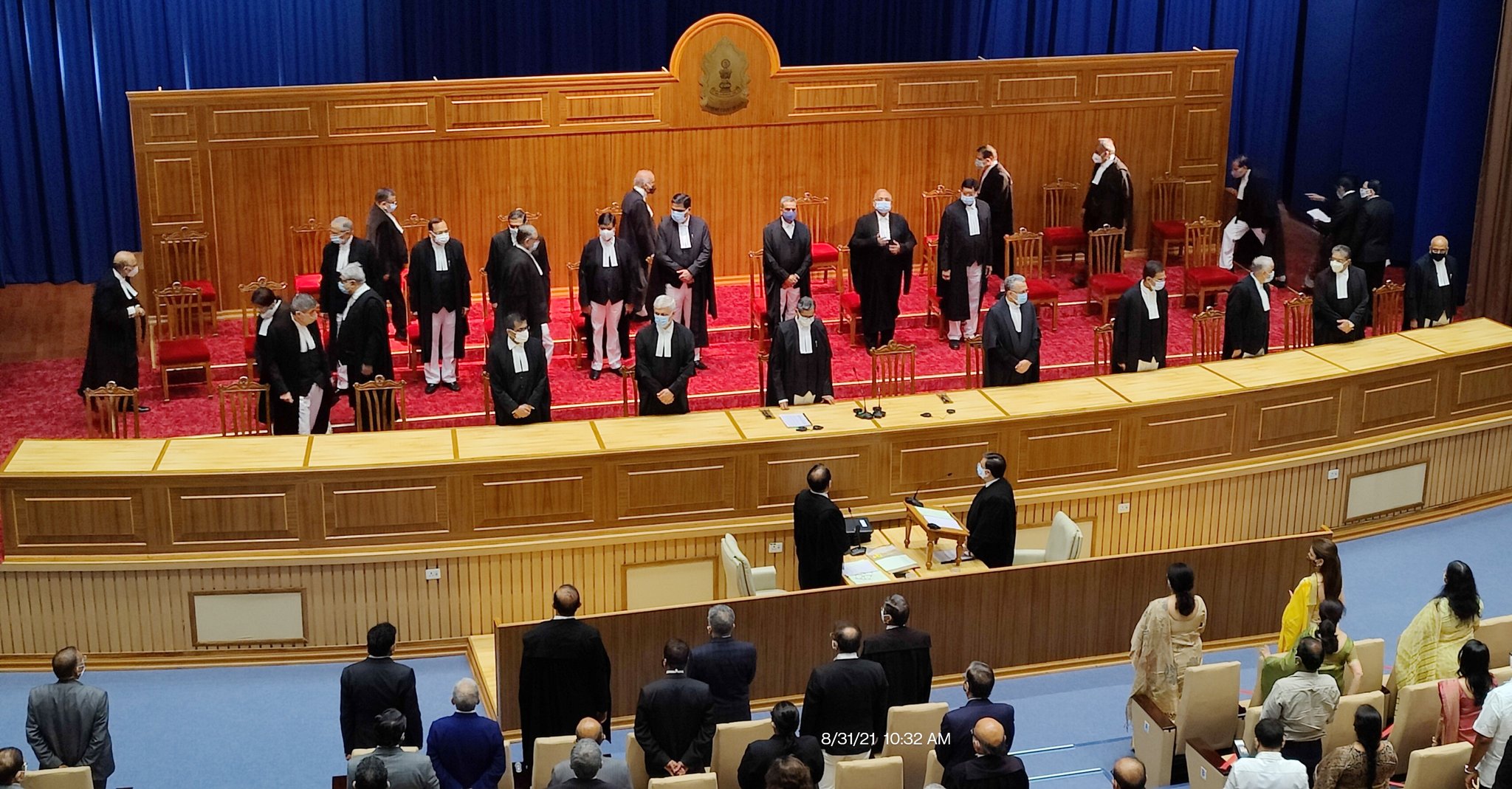
The slow churn of India’s judicial system, long synonymous with staggering pendency and procedural delays, is undergoing a quiet but consequential transformation. Artificial intelligence, once confined to experimental pilots, is now embedded across multiple layers of the court system, altering not only administrative efficiency but the very architecture through which justice is processed and delivered.
With more than 50 million cases pending across district courts, high courts and the Supreme Court, the pressure to modernise has been acute. The judiciary’s embrace of AI is not driven by technological ambition as much as by institutional necessity. What distinguishes the current phase, however, is that AI is no longer limited to digitisation. It is actively reshaping how cases are recorded, researched, prioritised and, in subtle ways, understood.
The most visible shift has occurred inside courtrooms themselves. Real-time transcription systems, powered by speech-to-text AI, are being deployed to record proceedings with far greater speed and consistency than manual note-taking. In Kerala, pilot implementations have already replaced traditional deposition recording in certain proceedings, addressing long-standing concerns about inaccuracies in witness testimony documentation. The implications extend beyond efficiency. A more precise record reduces the scope for disputes in appellate courts, where discrepancies in oral testimony often become pivotal.
Alongside transcription, language has emerged as a major frontier of reform. The Supreme Court’s AI-based translation initiative, known as the Supreme Court Vidhik Anuvaad Software (SUVAS), is converting judgments into multiple Indian languages. For decades, access to justice has been constrained by the dominance of English in legal documentation. By enabling litigants to read judgments in their native languages, AI is expanding legal accessibility in ways that conventional reforms have failed to achieve.
The former Chief Justice of India, D Y Chandrachud, publicly acknowledged both the promise and the limits of such technologies. “We are exploring the use of artificial intelligence in the judicial system, but we are proceeding with caution,” he said at a judicial technology conference, underscoring that AI is intended to assist rather than replace human adjudication.
Beyond the courtroom, AI is increasingly embedded in judicial research and case management. Judges and law clerks now rely on AI-assisted tools capable of scanning vast repositories of case law within seconds, identifying relevant precedents and generating concise summaries. This represents a fundamental shift in judicial workflow. Legal research, once a labour-intensive process, is being compressed into computational time, allowing judges to focus more on interpretation than information retrieval.
The Supreme Court’s AI-powered portal SUPACE (Supreme Court Portal for Assistance in Court Efficiency) is a notable example. Designed to assist judges with legal research, the system can process case files, extract key issues and suggest relevant precedents. Crucially, SUPACE does not provide opinions or decisions; it functions strictly as a support system. This distinction reflects a deliberate institutional boundary: AI may inform judicial reasoning, but it cannot substitute it.
Another underreported transformation lies in case listing and scheduling. AI-based algorithms are being tested to cluster similar cases, prioritise urgent matters and optimise hearing schedules. In a system where adjournments and listing delays contribute significantly to backlog, even marginal improvements in scheduling efficiency can have systemic impact. By identifying patterns across case types and timelines, AI is enabling courts to manage dockets with greater precision.
The use of AI-driven chatbots is also expanding at the litigant interface. Several high courts have already introduced virtual assistants to help users navigate case status, filing procedures and court services. These tools, though seemingly modest, reduce dependence on intermediaries and improve access for first-time litigants—particularly in lower courts where procedural opacity often acts as a barrier.
Yet it is the emergence of predictive analytics that has generated the most debate within legal circles. Research prototypes in India have demonstrated the ability to analyse past judgments and forecast outcomes in specific domains such as bail. By processing variables such as case facts, statutory provisions and historical judicial patterns, these systems can generate probabilistic assessments of likely decisions.
While such tools remain largely experimental, their implications are far-reaching. They raise the possibility that legal outcomes could be anticipated and potentially influenced by algorithmic modelling. Former Chief Justice of India B R Gavai cautioned against the over-reliance on such systems, noting in a public address that “technology can aid the system, but it cannot replace the human element in judicial decision-making.”
Concerns over reliability have also surfaced. Indian courts have already encountered instances where AI-generated legal research produced incorrect or fabricated citations. In a legal framework where precedent forms the backbone of judicial reasoning, such errors are not trivial. They have reinforced the judiciary’s position that AI outputs must be independently verified and cannot be treated as authoritative sources.
“Equally significant are the ethical and constitutional questions raised by algorithmic integration. AI systems are trained on historical judicial data, which may reflect entrenched socio-economic and regional disparities. There is a growing concern among legal scholars that such systems could replicate, or even amplify, existing biases under the guise of neutrality,” says G Venktesh Rao, senior advocate, Supreme Court.
The “black box” nature of many AI models adds another layer of complexity. Judicial decisions in India are required to be reasoned and transparent. If an AI system suggests a particular outcome or highlights certain precedents, the rationale behind those suggestions must be explainable. Without such transparency, the use of AI risks conflicting with the principles of due process.
Privacy and data protection present further challenges. Court records often contain sensitive personal information, including financial details and medical histories. The integration of AI systems capable of large-scale data processing raises questions about data security, storage and access. Ensuring compliance with India’s digital data protection framework will be critical to maintaining public trust.
Despite these concerns, the judiciary’s approach has been notably measured. The Kerala High Court has explicitly stated that AI tools should not be used for judicial decision-making or reasoning. At the national level, the Supreme Court has consistently emphasised that AI’s role is limited to administrative and research assistance.
This cautious stance reflects a broader institutional philosophy: efficiency can be automated, but judgment cannot. The emerging model is one of “augmented justice,” where technology handles repetitive, data-intensive tasks while human judges retain control over interpretation and final decisions.
What remains less visible, however, is the extent to which AI is already influencing the judicial process. It shapes how quickly cases are listed, how efficiently legal research is conducted and how accurately proceedings are recorded. In doing so, it indirectly affects the pace and structure of justice delivery.
The transformation is incremental but unmistakable. AI is not replacing judges in India, nor is it likely to do so in the foreseeable future. Instead, it is redefining the ecosystem in which judicial decisions are made, such as streamlining processes, expanding access and introducing new layers of complexity that the legal system must now navigate.
“As India continues to grapple with its judicial backlog, AI offers a powerful, if imperfect, tool. Its success will depend not only on technological capability but on the judiciary’s ability to integrate it within constitutional boundaries. The challenge is not merely to make justice faster, but to ensure that in the pursuit of efficiency, its fundamental principles remain intact,” noted legal observers.
(Aishwarya Srivastava is a technology and corporate lawyer. She is practising in the Supreme Court of India)
