






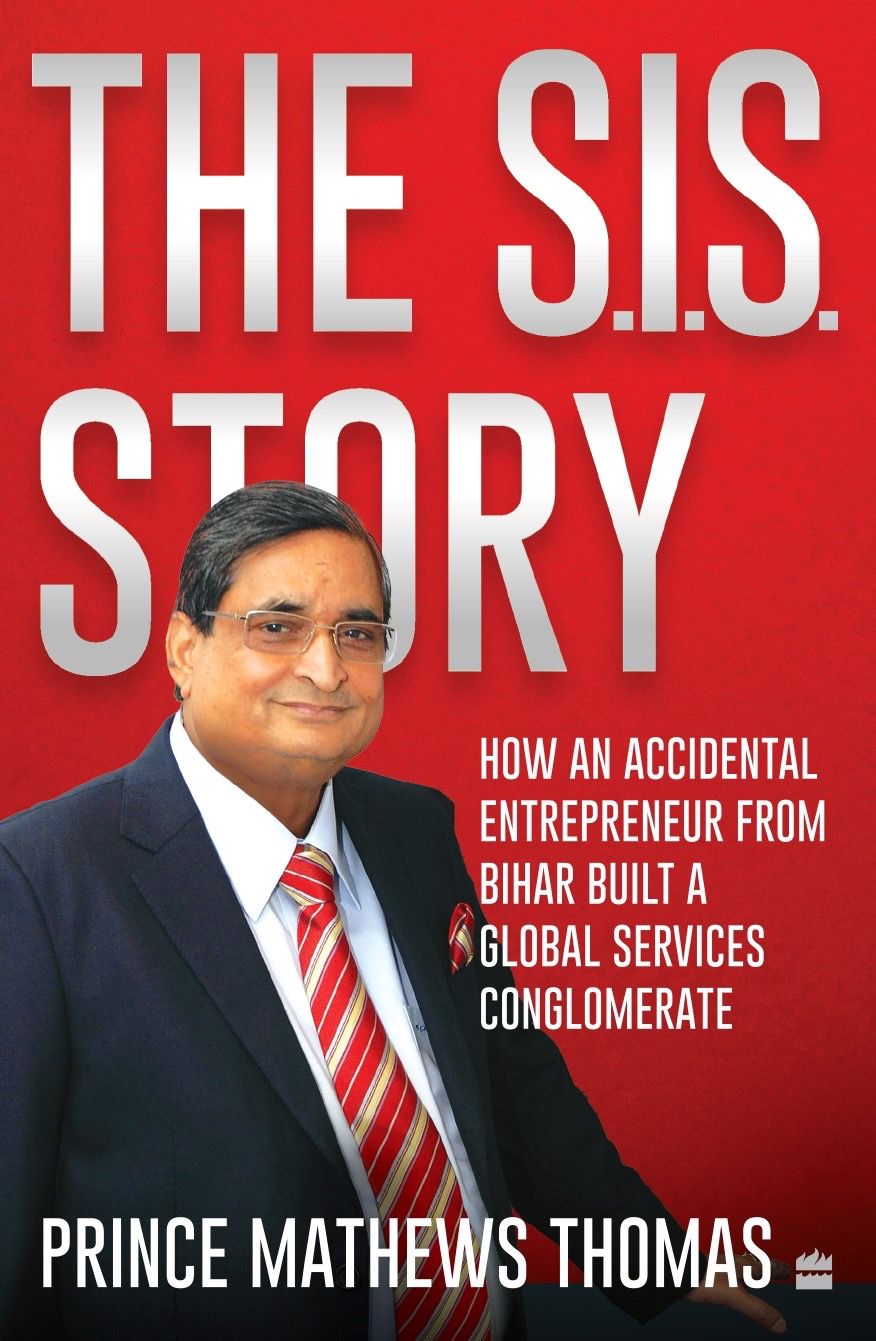
ABOUT THE BOOK
In 1973, inspired by the popular socialist leader Jayaprakash Narayan, Ravindra Kishore Sinha, then a journalist earning a modest salary of ₹250, quit his job to establish SIS (Security and Intelligence Services), a private security firm created to help ex-servicemen find employment as security personnel.
Today, SIS is a multi-billion-dollar conglomerate, ranked among India’s top ten private employers, with over 300,000 employees and more than 22,000 clients spanning security, facility management and cash logistics.
So how did an accidental entrepreneur, with no formal management education, go on to build one of the largest global companies in its sector? How has SIS preserved its employee-centric culture amid rapid expansion? And what lies behind its bold strategy of acquiring high-risk global firms and turning them around?
In The SIS Story, journalist and author Prince Mathews Thomas captures this extraordinary journey of entrepreneurship — from the era of the Licence Raj to economic liberalisation and beyond. The shaping of an industry, the forging of a distinctive work culture, and the passage through professionalisation and generational transition — SIS has witnessed it all in its fifty-year journey. This inspiring tale stands as a testament to what can be achieved when vision, passion and purpose come together.
EXCERPTS
Who is the largest employer in India? The obvious names that come to mind are the Indian Army and Indian Railways. That’s correct. The Indian Army has nearly 25 lakh personnel. The Indian Railways, about 12.5 lakh. Who is the largest private employer in India? Again, if your answer is Tata Consultancy Services (TCS), that’s right. It has a little over 6 lakh people on its rolls. Next on the list is another IT giant, Infosys, with about half of TCS’s number. In third place is Reliance Industries Ltd, with a workforce of nearly 3.5 lakh. All of these are blue-chip companies with millions of investors. Their chief executives, founders and promoters are among the most followed businesspeople in corporate India. Everything they do, in office and outside it, makes headlines. If you thought, like me, the next company in the pecking order to be either Larsen & Toubro (L&T) or Tata Steel, it’s a logical expectation. Both have a huge geographical and manufacturing presence. Imagine my surprise when I came to know that it’s not them but SIS Group Enterprises that comes next. Previously known as Security and Intelligence Service Ltd, SIS currently employs over 3 lakh people as on 31 March 2025. Give it a thought. That’s more than what conglomerates like the Aditya Birla Group and the Adani Group employ, with all their companies put together. Despite its size and over fifty years of operations, little is known about SIS. Chances are that before you picked up this book, you would have heard of the company only fleetingly. It was the same with me until I met its founder Ravindra Kishore Sinha and his son Rituraj Sinha in 2013 for a story in Forbes India. By that time, the company had already charted a fascinating journey. SIS was founded by Sinha in Patna in 1974. It was on the suggestion of socialist leader Jayaprakash Narayan that Sinha, till then a journalist, started helping out retired army jawans and officers get jobs as security personnel. ‘It was a social service. I had no intention of making a business out of it,’ Sinha would say. That’s understandable. The 1970s were not a time for capitalist ambitions. But over the years, Sinha took decisions that seemed to be pulled right out of management books, just that he didn’t have an MBA. What he had were the street smarts of a rustic entrepreneur, eye for detail and a connection with people. Look at some of the decisions he made. In November 1984, SIS started a training institute for security guards, something no one had thought of doing in the security business. Not just in India, but globally. Two years later in 1986, the company added a graduate trainee officer program. Today, the same training programme, now conducted in twenty-two training facilities across 14 states, is the bedrock of SIS’s growth. Also, SIS was among the first, across any industry, to bring in computers—in 1989—to manage organizational processes. It was around the time that then Prime Minister Rajiv Gandhi brought in the computer revolution to India. That early introduction of technology is seen in SIS’s operations today, which are based on artificial intelligence and machine learning. SIS now has its own IT team. This includes 59 engineers who produce a suite of proprietary products custom made for business requirements. In the early 1990s, just as the domestic economy was opening up amid a slew of reforms and private enterprise was taking off, Sinha expanded SIS beyond eastern states and entered major urban markets like those in Delhi and Bengaluru. And then, just after the turn of the century, as the information technology-led tech boom was taking off, Sinha did something uncharacteristic for a first-generation entrepreneur. He took a back seat and handed over the business to Uday Singh, a childhood friend who had a successful corporate career with stints in Indian and multinational companies. Second, he brought in his twenty-two-year-old son Rituraj into the company, in an unexpected generational shift in SIS’s leadership. Handing over the reins of the business to his son and a professional who would also double as the youngster’s mentor was a rare decision for a first-generation entrepreneur. No entrepreneur really lets go of his company. Sinha did. And it turned out to be a masterstroke. Few business families in India, including the biggest ones, have managed such transitions. SIS scaled from 14 branches to 100 by 2012. With Rituraj’s youthful vigour, risk-taking mentality and out-of-the-box ideas, coupled with the disciplined professional in Uday Singh who couldn’t stress more the importance of processes, training and quality, SIS grew vertically and horizontally. Just like McDonald’s created a cookie-cutter model that became a template for its exponential expansion across the world, SIS did something similar to get to over 300 branches today. It developed a replicable business model for a simple service to be delivered with quality standards, consistently.
ABOUT THE AUTHOR
Prince Mathews Thomas is a financial journalist with over 21 years of experience. He has worked with leading business newsrooms, including The Economic Times, Business Standard, Dow Jones Newswires, and Forbes India. He is currently the Managing Editor at The Morning Context. Over the years, he has written extensively on India’s leading business houses, offering sharp analyses of their business models, strategies, and management styles.


