


India’s rise in the maritime domain of the Indo Pacific is no longer a quiet evolution. It is becoming a visible assertion, manifested not only through the growth of its naval power but also through its ability to bring nations together, build partnerships and develop regional institutions. February 2026 offered a striking illustration of this transformation. At intervals of just a few days, India hosted the International Fleet Review in Visakhapatnam, Exercise MILAN 2026 and the conclave of the chiefs of the Indian Ocean Naval Symposium. These were not identical instruments of maritime diplomacy. The IFR demonstrated naval capability and diplomatic reach, MILAN converted relationships into operational cooperation, while IONS provided an institutional setting for sustaining maritime relations. Together, they reveal a shift from presence to partnership and from partnership towards networks.
This distinction matters. Naval power may provide the foundation of maritime power, but influence over the maritime order depends on how effectively a country leverages that power. For India, this means converting its geographical position in the Indian Ocean into diplomatic relationships, mutually beneficial partnerships, information sharing, interoperability and common goods. Yet participation alone does not create influence. Countries may engage with India for diplomatic, commercial or geopolitical reasons without sharing its broader preferences. The real question is whether India can transform its growing convening ability into durable partnerships capable of shaping the regional agenda.
Janvi Singhi
Janvi Singhi is a Gold Medalist in International Relations and holds a Master’s degree in Political Science. She is an independent researcher whose research interests focus on geopolitics, strategic affairs, India’s foreign policy, and global governance.
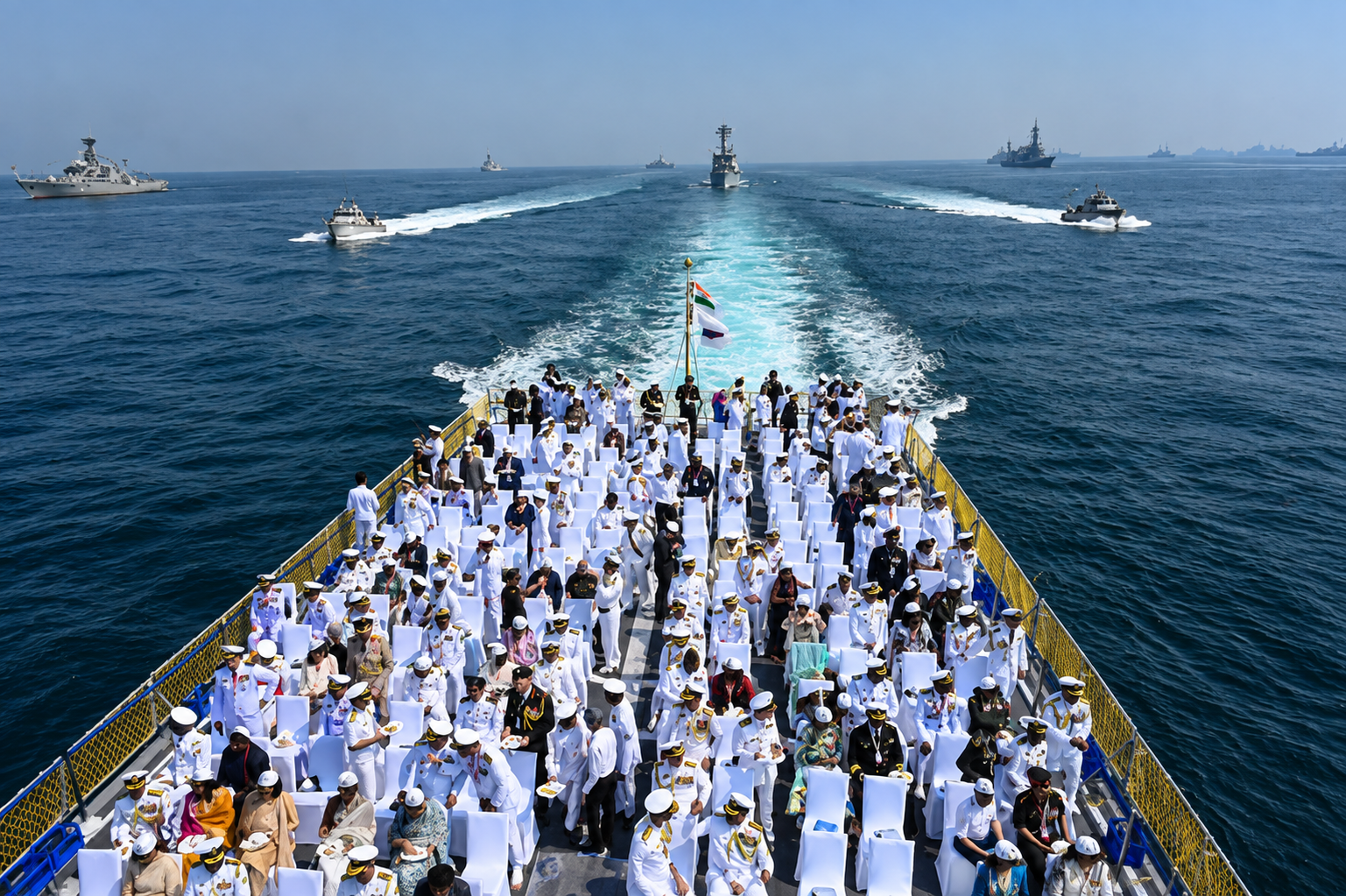
The first layer was visible at the third International Fleet Review, held off Visakhapatnam on February 18. Unlike operational exercises, IFR serves as a powerful visual and strategic statement of India’s maritime capabilities. India’s IFR journey began with the first edition in 2001 in Mumbai with participation from 20 countries, followed by a significantly expanded second edition in 2016 at Visakhapatnam. The third edition in February 2026, marked a qualitative and quantitative leap as under the theme “United Through Oceans” India invited participants from 74 countries which signalled its intent to act as a unifying maritime force. The scale was so remarkable that a total of 85 ships participated, including 19 foreign warships and 60 Indian Navy vessels, four Indian Coast Guard ships and one ship each from the Shipping Corporation of India and the National Institute of Ocean Technology. Apart from Naval ships the review also featured three Indian Navy submarines, one French Atlantique maritime patrol aircraft and participation by over 60 aircraft. While an IFR is traditionally ceremonial, its strategic value lies in the diplomatic space it creates for defence relations, professional interaction and networking. Yet multiple flags do not automatically mean strategic convergence. The significance of the IFR therefore lies not simply in how many countries India can assemble, but in whether those relationships become sustained partnerships.
This is where MILAN comes in to play a crucial role. MILAN 2026, which took place in Visakhapatnam from February 15 to 25, saw participation from naval delegations of 74 countries and concentrated on sophisticated maritime operations, such as anti-submarine warfare, aerial defence operations, rescue search, and combined security missions. India focused on cultural exchange with setting up a MILAN village on 15th February, which served as a hub for cultural and diplomatic engagement. Following the cultural exchange phase, MILAN 2026 shifted into a harbour phase on 21st February which focused on seminars, discussions, cross-deck visits and professional exchanges. After the harbour phase, the sea phase was initiated under which all the participant countries did complex naval exercises and high intensity operational drills. These included air defence, search and rescue, anti-submarine warfare, surface strike coordination and cooperative security missions. During these phases MILAN 2026 witnessed the participation of 42 ships and submarines and 29 aircrafts, including 18 ships from the participating foreign country. If the IFR showcased capability and assembled maritime actors, MILAN sought to make these connections operationally useful. Naval exercises create repeated interactions, common procedures and practical interoperability without requiring formal alliances. In a politically diverse Indo Pacific, this flexibility is central to India’s approach. MILAN’s emphasis on “Camaraderie, Cooperation, Collaboration” therefore reflects a strategy of practical cooperation across political differences and can be viewed as an operational manifestation of the MAHASAGAR vision.
The third layer emerged through the 9th IONS Conclave of Chiefs on February 20, while India assumed the IONS chairmanship after 16 years. The 9th Conclave brought together chiefs of navies and heads of maritime security agencies from 33 countries including IONS members, observers and other Indian Ocean littoral nations spanning from the Atlantic to Pacific. This provided an opportunity to move from participation towards institutional leadership. India’s geographical position gives it strategic centrality in the Indian Ocean, but geography alone does not produce influence. It must be converted into relationships and institutions through which states can cooperate. The goals have been reiterated in the proposals launched under the chairmanship of the IONS. The Philippines is receiving observer status, Oman is getting involved in HADR Working Group, and India provides its input concerning the IONS maritime exercises, the use of the ocean ship SAGAR and arranging maritime information sharing workshops and discussions. All these measures are supposed to strengthen awareness about the maritime space, operational interaction, interoperability, exchanges of experience and HADR capacity at sea.
Taken together, the IFR, MILAN and IONS reveal three interconnected layers of maritime statecraft. The IFR creates visibility and diplomatic reach. MILAN moves relationships towards operational collaboration. IONS provides institutional continuity. Their importance therefore lies not merely in their scale, but in the progression from presence building to relationship building and ultimately institutionalisation. India is attempting to turn naval presence into a network of relationships through which maritime cooperation becomes more durable.
Yet the limitations are equally important. India can bring maritime players together, but it cannot automatically determine their behaviour. Participation in the IFR does not establish political alignment; participation in MILAN does not create an alliance; and IONS does not eliminate divergent national interests. Maritime cooperation can coexist with strategic competition. This makes network survivability the critical test. India’s maritime networks must continue to function even when regional interests diverge. A network that survives only while strategic preferences coincide will remain fragile. India’s growing convening power will translate into durable influence only if cooperation can withstand political and strategic differences. February 2026 therefore demonstrated three forms of maritime power: capability, cooperation and institutional influence. India is moving from exercising maritime presence towards using that presence to build relationships, operational partnerships and institutions. The challenge will not be counting how many countries gather in Visakhapatnam, but whether those relationships survive beyond the ceremony. India has demonstrated that it can convene but the transition from naval presence to networked power will ultimately be measured by whether these networks continue to work when the strategic waters become more contested.
Janvi Singhi
She is a Gold Medalist in International Relations and holds a Master’s degree in Political Science. She is an independent researcher whose research interests focus on geopolitics, strategic affairs, India’s foreign policy, and global governance.