


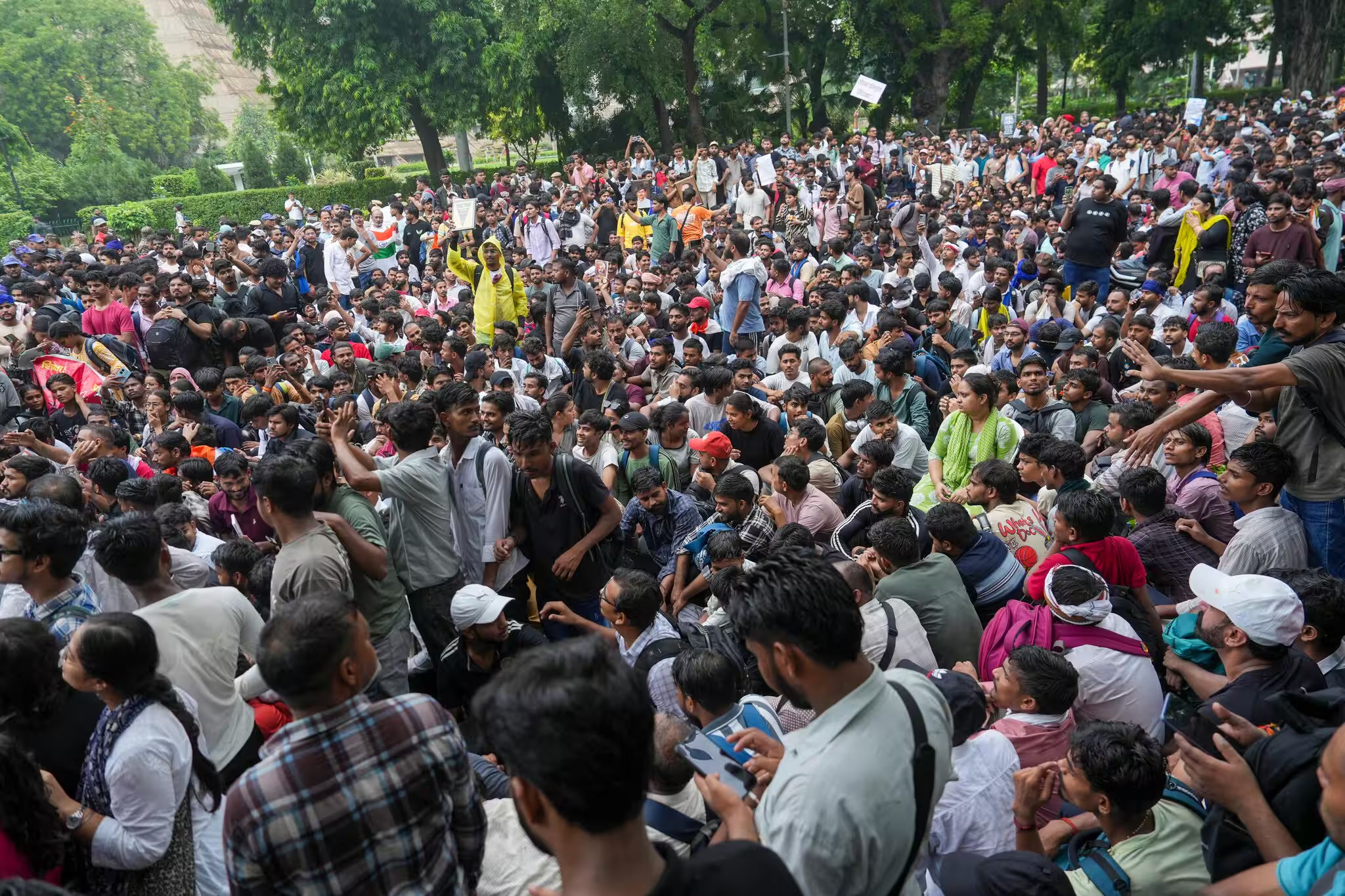
The rise of the Cockroach Janta Party (CJP) has triggered intense debate about youth discontent in India. While many see it as a reaction to examination scams such as NEET, the movement is, in reality, a symptom of a much deeper crisis. The rot extends far beyond paper leaks. It encompasses an education system that increasingly fails to reward merit, a recruitment process repeatedly tainted by corruption, and an economy unable to absorb the millions of graduates it produces every year.
>> A System Where Merit Is Increasingly Questioned
Over the past decade, India has witnessed repeated examination paper leaks, from school board examinations to recruitment tests. In many cases, those responsible have faced little more than brief arrests before securing bail, while prosecutions have dragged on for years without meaningful progress.
The recent NEET controversy once again exposed the vulnerability of the examination system. Allegations that money could influence outcomes have reinforced a growing public perception that merit alone is no longer sufficient. Such allegations are hardly new. Similar concerns have long surrounded recruitment by State Public Service Commissions, where bribery, political patronage and manipulation have periodically surfaced across different states.
For students, the consequences are devastating. Examination results are challenged, selections remain disputed and careers are delayed. Even candidates with outstanding academic records often find themselves competing for jobs requiring little formal education. It is no longer unusual to see postgraduates and PhD holders applying for posts such as cleaners, attendants or other low-skilled government jobs simply because secure employment has become so scarce.
The damage goes beyond individual disappointment. Every compromised examination erodes public confidence in institutions that are expected to uphold fairness and equal opportunity.
>> Slow Decline of Higher Education
The crisis does not end with examinations. India’s higher education system suffers from chronic structural weaknesses.
Faculty vacancies in many state-run institutions remain between 35 and 70 per cent, leaving universities and colleges unable to provide meaningful classroom engagement. Oversized classes have become the norm, making tutorials, assignments and individual mentoring increasingly impossible.
The University Grants Commission, once expected to safeguard academic standards, has steadily lost its autonomy, while appointments to universities and research institutions have become increasingly politicised. Allegations of irregularities involving senior academic administrators have further weakened public confidence.
Private higher education has expanded rapidly, but not always with corresponding improvements in quality. Institutions have proliferated despite inadequate faculty, laboratories, libraries and research facilities. In several cases, academic leadership has allegedly become vulnerable to political and corporate pressures, undermining institutional independence.
Recruitment of teachers has faced similar problems. Selection processes in several states have been marred by allegations of corruption, litigation and political interference, creating uncertainty for thousands of qualified candidates.
Even within Central universities, recruitment at the assistant professor level has stagnated. Many vacancies remain unfilled, while selection committees often face accusations of favouritism or ideological bias. Combined with compressed academic calendars and an overloaded semester system, these shortcomings have significantly reduced the quality of higher education.
Student admissions increasingly depend on centralised entrance examinations such as CUET, whose credibility has itself come under scrutiny. Yet the larger failure lies elsewhere. India continues to produce millions of graduates without creating adequate employment opportunities or meaningful vocational alternatives. Structured pathways into technical education, entrepreneurship and skilled trades after secondary school remain poorly developed despite repeated policy announcements.
The National Education Policy acknowledges many of these challenges, but implementation has yet to match the scale of the crisis.
>> Degrees Without Employability
The legal profession illustrates this disconnect between education and employability. Law colleges have expanded rapidly, producing large numbers of graduates every year. Yet employers, judges and senior practitioners frequently complain that many young lawyers lack basic professional skills. Drafting applications, interviewing clients, understanding court procedures and preparing petitions remain serious weaknesses for a significant section of new entrants.
The Delhi Bar Council has spent years attempting to verify the credentials of thousands of registered lawyers, highlighting wider concerns over professional regulation and accountability. Public criticism intensified after recent remarks by the Chief Justice of India regarding fraudulent law degrees, prompting renewed scrutiny of the Bar Council’s own verification processes.
The judiciary itself faces equally serious challenges. Vacancies in subordinate courts remain substantial, largely because state governments often delay notifying available posts. High Courts across the country continue to function with significant shortages of judges, resulting in mounting case backlogs and delayed justice.
The problem is not confined to law. It reflects a broader mismatch between higher education and labour market requirements. Universities continue to produce graduates faster than the economy can create quality employment.
>> When Education Loses Credibility
The deterioration of India’s education system is reflected not only in classrooms but also in its international reputation. A growing number of foreign universities subject degrees from several Indian institutions to greater scrutiny, while some have imposed additional verification requirements for applicants from particular states. At the same time, thousands of Indian families continue to mortgage homes, liquidate savings or take substantial loans in the hope that overseas education will provide opportunities unavailable at home.
That route, too, is becoming increasingly uncertain. Tightening immigration policies in many Western countries, stricter visa regulations and shrinking post-study work opportunities have narrowed what was once seen as a reliable escape route. For many young Indians, the promise that education guarantees social mobility is beginning to look increasingly hollow.
The perception—whether entirely accurate or not—that government jobs depend more on money, influence or political patronage than on merit has become deeply entrenched. Once that belief takes root, public trust in institutions begins to erode. No education system can thrive if students lose confidence that hard work will be fairly rewarded.
>> A Lesson from Iran
India’s experience stands in sharp contrast to that of Iran. Despite decades of sanctions, economic isolation and political turmoil, Iran invested consistently in scientific education and technical manpower. Possessing one of the world’s largest reserves of oil and natural gas, it recognised that natural resources alone could not guarantee national strength. Human capital became its principal strategic investment.
Over successive decades, Iran developed a strong base of engineers, scientists and technical professionals. It expanded indigenous capabilities in infrastructure, energy, defence technology and scientific research while maintaining a significant presence in international academia. Iranian scholars continue to contribute to universities across the world, and the country’s scientific output remains among the highest in the region.
Its leadership, despite its authoritarian character and ideological rigidity, placed sustained emphasis on education, research and technological self-reliance. Women today account for a substantial proportion of students in Iranian universities and increasingly participate across professional sectors.
Even after the assassination of several senior military and political leaders, Iran demonstrated remarkable institutional continuity. Replacement leaders emerged quickly, many possessing advanced academic qualifications and extensive administrative experience. Whatever one may think of Iran’s political system, it has invested consistently in building intellectual capacity alongside military capability.
India’s challenge is fundamentally different. It possesses a much larger economy, a younger population and democratic institutions. Yet unless comparable attention is paid to educational quality, scientific research, vocational skills and institutional integrity, the country’s demographic dividend risks becoming a demographic burden.
>> Why CJP Has Resonated
It is against this backdrop that the emergence of the Cockroach Janta Party must be understood. To dismiss it merely as another protest movement would be to misunderstand the depth of public frustration. CJP has gained traction because it speaks to an entire generation that increasingly believes the system is stacked against merit. Paper leaks, disputed recruitment processes, shrinking employment opportunities, political interference in universities and declining institutional credibility have together created a crisis of confidence among young Indians.
The government’s decision to block CJP’s social media accounts has done little to weaken that perception. If anything, it has reinforced the belief among many supporters that uncomfortable questions are being answered through censorship rather than engagement.
Generation Z, and many younger members of Generation X, face a labour market that is becoming more competitive even as technological change accelerates. Automation, robotics and artificial intelligence are expected to eliminate many routine jobs while demanding entirely new skills. Unless education policy evolves rapidly, millions of graduates may find themselves qualified on paper but unemployable in practice.
India’s electorate is also becoming younger. Nearly half of its voters are below the age of 35. Their aspirations are shaped less by ideology than by employment, opportunity and social mobility. They are likely to judge governments not merely by promises but by their ability to create credible pathways from education to meaningful work.
>> Reform or Revolution?
The rise of CJP should therefore be viewed less as the cause of India’s present anxieties than as their consequence.
Whether the answer lies in reform or more fundamental political change is a matter for citizens to decide. What is beyond dispute, however, is that India’s education-to-employment pipeline is under unprecedented strain. Restoring confidence will require more than tougher laws against paper leaks or occasional administrative reshuffles. It demands transparent recruitment, autonomous educational institutions, competent regulators, investment in vocational education, judicial reforms and an unwavering commitment to merit.
Buckminster Fuller once observed: “You never change things by fighting the existing reality. To change something, build a new model that makes the existing model obsolete.”
That observation captures India’s challenge today. The country does not merely need better examinations or more universities. It needs institutions that young people can trust, an education system that produces employable graduates, and a governance model that rewards competence over patronage. Without that transformation, movements such as CJP will continue to emerge, not because they create public discontent, but because they give voice to it.
