


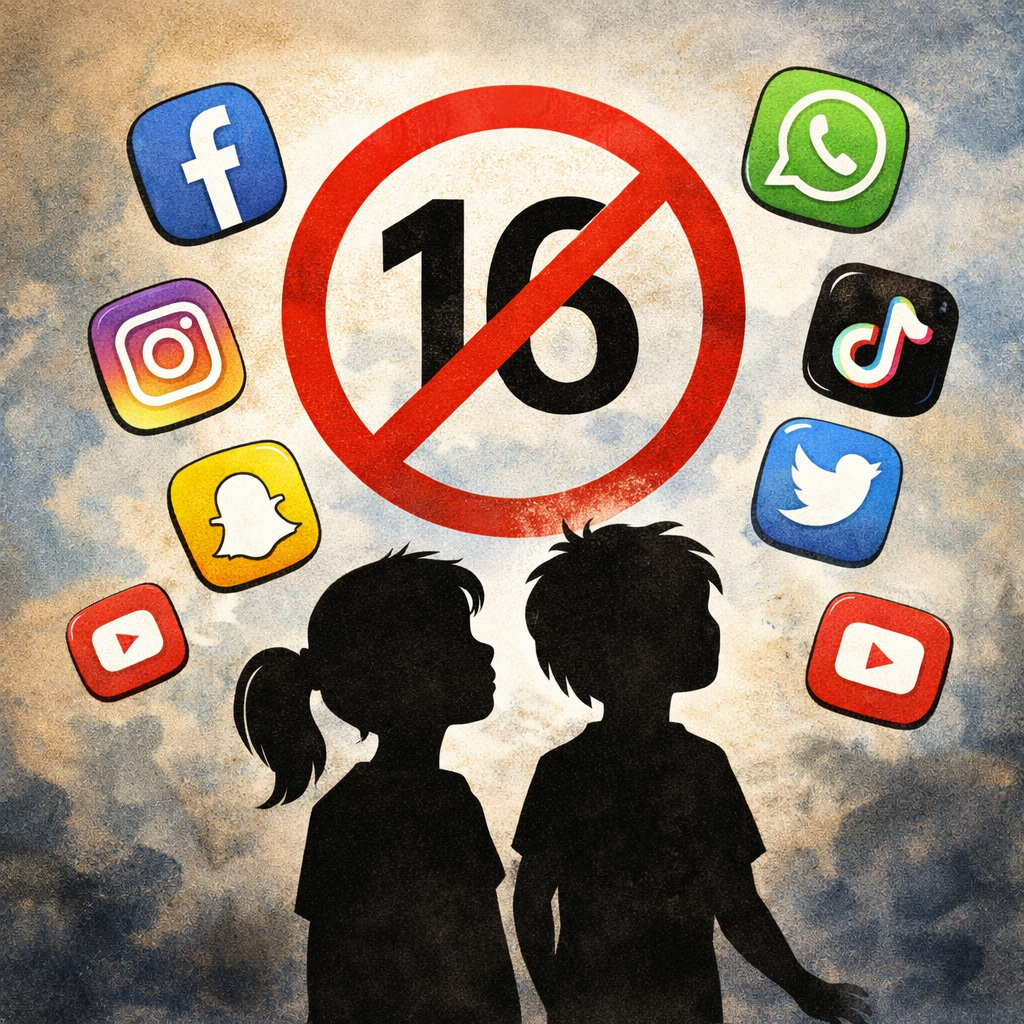
Karnataka Chief Minister Siddaramaiah dropped a legislative bombshell during the state’s 2026-27 Budget presentation: a proposed total ban on social media access for children under the age of 16. The announcement marks Karnataka as the first Indian state to take such a definitive stance against the “scourge of digital addiction”, effectively signalling that the era of unregulated scrolling for minors may be coming to a close.
Chief Minister Siddaramaiah framed the ban as a protective measure for the state’s most vulnerable demographic. “To prevent the adverse effects of increasing mobile usage on children, social media will be banned for those under 16,” Siddaramaiah declared.
Soon, the debate shifted from the economics of the budget to what this bold move could mean. Most kids and parents are left wondering why the Karnataka Government wants to go this far. Is the government within the legal purview to implement such a thing? Why does the Government want to play the “Net Nanny”?
While Karnataka may be the first state in India, the Karnataka proposal is a direct echo of the Online Safety Amendment (Social Media Minimum Age) Act passed in Australia in late 2025. It may be recalled that Australia became the first nation to legally enforce a minimum age of 16 for social media use late last year.
Umar, a 10-year-old in a leading school in Bengaluru, is visibly unhappy with the decision. “I don’t care what the government thinks”, said Umar in his first response when we asked him about it. Why should someone else monitor his online presence and his surfing patterns? While his parents try to reason with him, the young boy spills out the imminent threats that he and his classmates are already privy to. As he opened up, he shared how his own classmates are already into games like “Illuminati” and “Roblox”, with tasks and challenges that could be harmful to their critical thinking.
Karan, a 13-year-old gaming buff in Bengaluru, spends hours playing different challenges that Roblox offers. His parents got concerned when he shared details of a certain feature called “Selling the Soul” in the Roblox game. They panicked and sought help from the school management and a counsellor to find ways of bringing Karan back from the gaming world to the real world. “My son had stopped interacting with others in the family and apartment. Whenever and wherever he could find a corner, he would immerse himself in the gaming world. It is a challenge to get him away from the social media and gaming universe; he gets irritated and picks up fights or arguments,” shared Mamata Thadani, Karan’s mother.
Dr Angelo Michael D’Cruize, academic director of Presidency School, Bengaluru, is concerned about the growing addiction to spending time on social media. “Social media does not offer significant educational value for young children. It is primarily used for networking and social interactions with friends, which, while not entirely negative, often becomes a distraction during a critical phase of learning and development”, adds Dr D’Cruize.
Umar’s and Karan’s parents are among the few who now keep a close watch on their surfing patterns and have put restrictions on what could be harmful. Last month, several parents across India woke to news of a tragedy reported from an apartment complex in Ghaziabad, near Delhi. Residents were alerted around 2 am by three loud thuds as three sisters jumped hand-in-hand from their ninth-floor home, leaving behind a note that read: “True life story… Sorry, Papa.”
Investigations revealed that the suicides occurred shortly after a dispute with their parents, who had restricted their access to mobile devices. Preliminary police investigations suggest the girls were struggling with an intense addiction to online gaming and mobile phone usage. While “Roblox” has been specifically mentioned in media discourse on gaming safety, investigators found that the sisters were deeply obsessed with a task-based “Korean love game” and with Korean pop culture.
But why did the Karnataka Government take the lead in this proposal, which is now resonating across the country? While the state leads India in digital innovation as an “advanced digitaliser”, it is now the first to hit the “emergency brake”. The very infrastructure that built Bengaluru into a global tech hub is now being viewed as a public health risk for the generation born after 2010. Studies indicate that compared with the national average of 59 per cent, Karnataka has a 76.8 per cent social media usage rate, highlighting that nearly eight out of ten teenagers in Karnataka are currently active on these platforms.
Online classes, which started during the COVID period, have increased the dependence on smartphones for educational use. Studies show that around 57 per cent of students have educational usage of these phones, raising questions about what will happen once the ban is implemented. Even though most welcome the move, they concur that it will need support from all quarters.
Dr D’Cruize says, “Implementing such a policy will require cooperation from both schools and parents. In schools, we can reinforce responsible digital habits by educating students about mindful technology use and encouraging them to use the internet primarily for learning and skill-building. Parents also play a crucial role by monitoring device usage at home and guiding children towards more productive online activities.”
Sources indicate that, much like the Australian model, Karnataka’s proposal shifts the onus of proof onto social media platforms such as Meta, ByteDance and X, rather than placing the burden on parents or children. The move will likely require sophisticated age-assurance technology, possibly linked to DigiLocker or Aadhaar, similar to how Australia is experimenting with biometric and ID-based verification.
Many ask, why 16? And why now? Psychological experts and recent national reports suggest we are at a breaking point.
Dr Kapoor, a Bengaluru-based psychiatric counsellor, notes that the adolescent brain (ages 10-18) is uniquely vulnerable. The prefrontal cortex, the part of the brain responsible for impulse control, is still under construction. Meanwhile, the “reward centre” is fully active, making the dopamine hits from likes and notifications nearly irresistible. Constant exposure to curated, “perfect” lives leads to “snapshot dysmorphia” and chronic low self-esteem.
“When children today won’t eat a meal without their phone, often given to them by their own parents, a ban is a necessary shock to the system,” says Dr N. V. Vasudeva Sharma, executive director of the Child Rights Trust. “However, it must evolve into a social movement, not just a legal one.”
Critics argue that a state-level ban in a borderless digital world is nearly impossible to enforce. However, the move has sent ripples through India’s burgeoning creator economy. Karnataka, and Bengaluru specifically, is a hub for young influencers. A ban for under-16s would effectively eliminate a significant portion of both the audience and the “prodigy” creator class.
However, the government remains firm. IT and BT Minister Priyank Kharge has previously emphasised that “responsible AI and social media usage” is no longer optional, it is a matter of public health.
Karnataka’s proposed ban is more than just a law, it is a litmus test for the 21st century. It asks a fundamental question: Does a child have a “right” to a private digital life, or does the State have a “duty” to protect them from a digital world they are not yet equipped to navigate?
As other states like Andhra Pradesh and Goa weigh similar measures, the eyes of the world and the screens of millions of teenagers are fixed on Karnataka. Will the move succeed?
(Vijay Grover is a Karnataka-based journalist and political analyst)
