

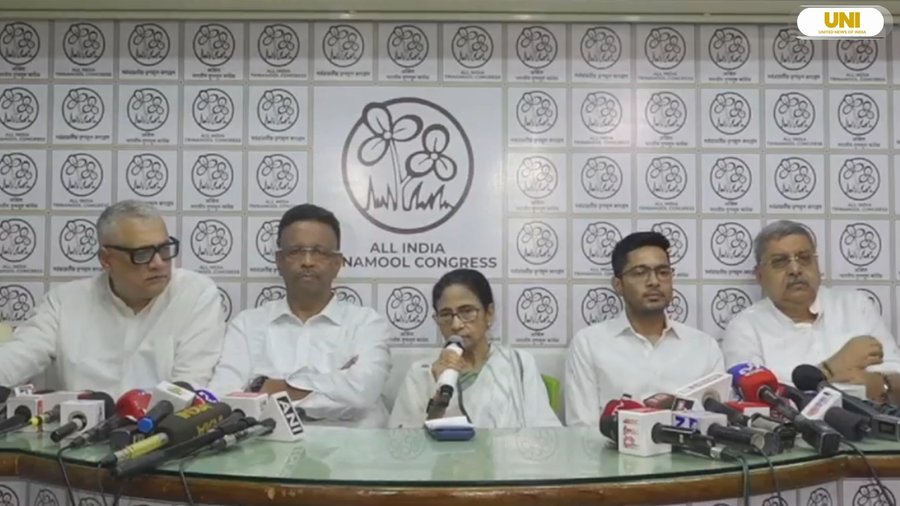
Mamata Banerjee has taken West Bengal into dangerous territory. By refusing to accept electoral defeat and continuing to hold on to the office of Chief Minister, Mamata has converted what should have been a routine democratic transition into a test of constitutional order. Her claim that the All India Trinamool Congress was “made to lose” by the Union government, the Election Commission of India, and central forces is not merely political rhetoric. It is a direct assault on the legitimacy of the electoral process.
This is not the first time an Indian politician has cried foul after defeat. But it is rare, and deeply troubling, for a sitting chief minister to refuse to acknowledge the verdict while remaining in office and mobilising the party apparatus to question the entire system. That shift, from disputing results to delegitimising the process, marks a serious rupture.
The Constitution leaves little room for ambiguity. Electoral outcomes are not negotiated through public posturing; they are determined by numbers on the floor of the Assembly. Under Articles 163 and 164, the Governor appoints the individual who commands a majority. If that majority is lost, the incumbent must either resign or prove it through a floor test. There is no constitutional category for “moral victory” or “manufactured defeat”. The test is simple and unforgiving.
If Mamata believes the election was compromised, the remedy is equally clear. The law provides for election petitions under the Representation of the People Act, to be examined by high courts with further appeal to the Supreme Court. Evidence is scrutinised, not slogans. By refusing this route and choosing instead to wage a public campaign of delegitimisation, she is bypassing the very framework she once relied upon to claim power.
What makes this moment more serious is the method she has chosen. Mamata’s politics has long been rooted in agitation, symbolism and street mobilisation. That approach helped her rise, dismantle entrenched structures and present herself as a fighter against authority. But governance operates on a different grammar. Institutions require discipline, restraint and acceptance of procedure. The instinct to take every political setback to the streets may serve agitation, it destabilises administration.
Her current posture is an extension of that same street politics, now directed against constitutional institutions. The slogan of “vote churi” is not an evidentiary claim; it is a rallying cry designed to inflame supporters. When such language comes from a chief minister, it carries institutional weight. It signals to the public that the referee cannot be trusted, that outcomes are suspect and that legitimacy can be contested indefinitely.
This is where the danger lies. Street politics thrives on perpetual mobilisation; constitutional democracy depends on closure. Elections are meant to produce finality. Governments change, power transfers, and the system moves forward. If every defeat is recast as a conspiracy and every transition resisted through agitation, the basic rhythm of democracy breaks down.
There is also calculation in Mamata’s stance. By framing the result as a conspiracy involving the Centre and its agencies, she seeks to convert electoral defeat into political grievance. It is a familiar populist tactic: shift the narrative from performance to persecution. The message is calibrated—this was not a rejection by the people but an injustice imposed from above. Such framing consolidates the core support base, but at a cost. It deepens mistrust, polarises society, and weakens institutional credibility.
This approach stands in sharp contrast to the idea of constitutional morality articulated by B. R. Ambedkar. Ambedkar warned that the success of the Constitution depends on adherence to its spirit as much as its text. That spirit demands restraint in victory and dignity in defeat. It requires those in power to respect processes even when outcomes are unfavourable. Mamata’s refusal to concede undermines that principle.
The Governor’s role now becomes critical. If the majority has shifted, the constitutional course is straightforward: invite the leader of the majority party, the BJP, to form the government. A floor test, if required, will settle the matter conclusively. Political speeches and street demonstrations have no bearing on this process.
The implications of Mamata’s stance extend beyond West Bengal. If such conduct is normalised, it sets a precedent where incumbents refuse to accept defeat and instead prolong power through narrative and mobilisation. Elections would cease to be decisive. Governance would be paralysed by continuous contestation. The damage would not be confined to one state; it would ripple across the federal structure.
For the BJP, the situation demands caution. A victory under dispute must be handled with procedural clarity and political restraint. Any display of triumphalism will only strengthen Mamata’s claims. Legitimacy must be demonstrated, not asserted.
At its core, this is a clash between two political instincts. One seeks validation through mobilisation and narrative control; the other rests on procedure, numbers and institutional order. The former may energise supporters, but it cannot substitute constitutional authority.
Mamata faces a stark choice. She can take the legal route, present evidence, and seek judicial remedy. Or she can persist with a strategy that may yield immediate political dividends but risks long-term institutional erosion. The Constitution does not recognise defiance as a substitute for proof.
Defeat is not an aberration in democracy. It is its corrective mechanism. The strength of a leader is measured not only by victories but by the ability to accept loss within the system’s rules. By refusing to do so, Mamata risks reducing politics to spectacle and governance to confrontation. She must understand that the verdict, however contested in rhetoric, remains the people’s mandate. To reject it without evidence is not resistance. It is a departure from constitutional responsibility.
(Bikash C Paul is a Delhi-based senior journalist and executive editor of ‘New Delhi Post’)