
Bangladesh, a peaceful, moderate Muslim country, is on the verge of crumbling. It became the 35th largest economy in the world from nowhere in just 15 years under the rule of the Bangladesh Awami League. The Yunus-led illegal government destroyed the achievements in just one year.
The Father of the Nation, Bangabandhu Sheikh Mujibur Rahman, other slain national leaders and 3 million martyrs of our War of Liberation deserve the deepest homage. Those who extended their support to the struggle to free Bangladesh from the occupation of the Pakistani forces also deserve profound respect. Although Bangladesh earned its independence through a massive bloodbath, its democratic and developmental journey was not smooth but rather treacherous and thorny. On August 15, 1975, my whole family was lost: the father of the nation, Bangabandhu Sheikh Mujibur Rahman; my mother; three brothers and two wives of my brothers. A total of 18 members of the family were brutally assassinated. My sister and I survived the carnage as we were in Germany.
Since 1975, we two sisters were in exile for six years. When I returned home to Bangladesh, all the killers of my family were present there and were given immunity. There was no right to ask for justice. All the war criminals were released from jail.
Under those circumstances, my return of home in 1981 was to serve the people. In my absence, the Bangladesh Awami League elected me as the party president. I was not ready to become president, but it was my party and people’s desire. My father and my family had sacrificed their lives for the nation, and fulfilling Bangabandhu’s dream was therefore a responsibility.
For a long time, the country was ruled by military dictators. Power changed not through a democratic process but through coup and counter-coup. That was the situation. The aim was therefore to establish democracy, regional harmony and economic emancipation for the people, which was also Bangabandhu’s aim. He wanted to establish Bangladesh as a poverty-free, prosperous country for its people.
The Awami League believes in secularism, non-communal politics, democracy and equal citizenship. The father of the nation, Bangabandhu Sheikh Mujibur Rahman, founded Bangladesh as a homeland for all people: Muslims, Hindus, Buddhists, Christians, indigenous communities and every citizen. After 21 years, in 1996, the Awami League formed the government for the first time. The priority was to assist the people. Food production was increased and Bangladesh became self-sufficient in food. Electricity generation was increased, and many steps were taken for healthcare and education. The conviction was to do something for the people. At the end of the five-year term in 2001, Bangladesh had attained sufficiency in food production, power generation had increased to 4,300 MW and the literacy rate to 65.5 per cent. Other socio-economic indicators marked huge improvement. But in the 2001 elections, the Awami League could not come to power for a second time.
Between 2001 and 2006, under the BNP-Jamaat government, Bangladesh became a breeding ground for terrorism and violent religious extremism. Harkat-ul-Jihad, Jamaat-ul-Mujahideen Bangladesh and other extremist networks gained space, shelter and confidence. This conflicted with the ideology of Bangladesh’s War of Liberation.
When the Awami League came to power through the people’s mandate after eight years, in the 2008 election, the government was formed in 2009 and counter-terrorism was made a national priority. The Anti-Terrorism Act was enacted in 2009, and the legal framework against terrorist financing, money laundering, militant recruitment and extremist networks was strengthened. Institutions were built, including the Counter Terrorism and Transnational Crime Unit, Anti-Terrorism Unit, Bangladesh Financial Intelligence Unit and others. Intelligence coordination was improved, the capacity of law enforcement agencies was developed, national coordination structures on militancy prevention were formed and anti-terrorism tribunals were created. Work was carried out with religious scholars, teachers, families, young people and community leaders, leading to the understanding that terrorism cannot be defeated by force alone. It must also be defeated through education, social awareness, religious counter-narratives, financial control, cyber monitoring and community resilience.
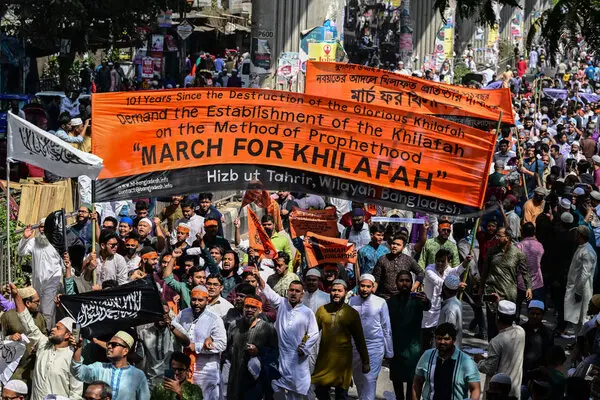
In July-August 2024, Bangladesh entered a dangerous phase. An elected government was overthrown through a meticulously designed movement by Muhammad Yunus, which was carried out under the cover of the quota issue. Violent extremists were used as active participants, organisers and beneficiaries. 460 police stations were burned down by these outlaws, leading to a collapse in law enforcement in many places. Police were brutally murdered and hanged from overbridges.
Prisons were attacked. Convicted and accused militants escaped or were released on bail. All the terrorists, killers and those who were in jail were released, including the leaders of banned terrorist organisations such as Ansarullah Bangla Team, Hizb ut-Tahrir, Harkat-ul-Jihad and Jamaat-ul-Mujahideen Bangladesh.
Religious institutions of Hindus, Christians, Buddhists, Ahmaddiyas and Sufi shrines and dargahs, as well as other minority religious sects and socio-cultural institutions, were attacked and destroyed. Not only institutions but people were also not spared. This was an assault on the historic religious harmony of Bangladesh.
Extremist leaders began to reappear in public life. Their logic was brutal: create dead bodies, create outrage, and the government will fall. Dr Muhammad Yunus, Tarique Rahman and Jamaat pursued the movement with that objective. It was a meticulously designed operation, not a spontaneous student protest.
On July 18, a Judicial Inquiry Commission was formed to investigate every death, every bullet fired and every act of violence and arsenal. If Dr Yunus and his regime truly wanted justice, why was that inquiry suspended? Why were they afraid of an independent investigation? Those who committed the killings were protected by the interim government. They were given indemnity. That indemnity itself tells the truth. If they had committed no crime, why did they need immunity? Giving them protection only proves who the real killers were. Tarique Rahman continues what his predecessor had started and denies the victims justice.
Since August 2024, there has been no law and order in the state. A former Chief Justice was implicated in false cases, handcuffed and taken to prison. The Chief Justice and other judges were attacked with machetes, Chinese axes, sticks and firearms and forced to resign.
In a country where lawyers, journalists, cultural activists and Bangladesh Awami League activists have been beaten to death, hacked with sharp weapons, arrested and tortured, an environment of terror has been unleashed. Women and girls have also been raped and killed.
A country that was developed from 2009 achieved graduation to a developing country in 2021. People’s lives were improved. The poverty level was reduced to 18.7 per cent and the extreme poverty level reduced to 5.6 per cent. People actually used to live a peaceful, secure and prosperous life. Unfortunately, in the last two years, this country has been shattered economically, and all the achievements have been destroyed. Poverty has been increasing; now people’s lives are in danger, and they have no security in their homes or on the streets. But those who are in power are enjoying the power, making money, and they don’t bother about the people. Even hundreds of children died because they could not get their vaccines.
The message is simple. Bangladesh does not need reinvention through extremism, violence or the destruction of its secular foundation. Bangladesh must be restored through democracy, constitutional order, religious harmony, development and security. A stable and democratic Bangladesh is good for South Asia and the world. A secular and peaceful Bangladesh is essential for global security.