


S. Krishnan and Mitali Kori
A footpath is one of the most basic components of urban infrastructure. It enables pedestrians to move safely, access public spaces, and participate in social and economic activities. Despite their importance, footpaths in many Indian cities remain encroached upon, damaged, poorly maintained, or altogether absent. The question, therefore, arises: Is there a fundamental right to a footpath under the Constitution of India?
Although the Constitution does not explicitly mention the “right to a footpath”, Indian courts have interpreted several constitutional provisions, particularly Article 21, to recognise the rights of pedestrians as an integral part of the right to life and personal liberty.
The Supreme Court of India answered this question emphatically in Maniyar Iliyaz @ Shaik Riyaz v. P. Ayyappan & Ors. (2026), declaring that the right to walk on safe and demarcated footpaths is a fundamental right. The ruling arose from a compensation dispute involving a five-year-old boy who died after being struck by a tanker while walking to school with his father.
Surge in Pedestrian Fatalities
Contextualising the urgency of the issue, official data reveal a catastrophic rise in pedestrian deaths. Pedestrian fatalities surged by nearly 163 per cent between 2015 and 2024, while their share of total road fatalities more than doubled from 9.5 per cent to 20.61 per cent.
The Court observed that the Motor Vehicles Act, 1988, primarily regulates drivers and vehicles but does not adequately protect pedestrian rights. It noted that the accident site lacked both a footpath and a pedestrian crossing, highlighting the systemic neglect of pedestrian safety. The Bench described this neglect as a long-standing “civilisational problem”.
Every year, thousands of people lose their lives on India’s roads, with children, senior citizens and economically vulnerable pedestrians paying the heaviest price. Behind every statistic is a child, a parent or a loved one whose life has been irreversibly altered. Against this backdrop, the Supreme Court’s declaration is both simple and transformative: where there is a road, there must also be a safe footpath.
Constitutional and Legal Foundations
Article 21 — Right to Life
The court grounded the right to walk in Article 21. A safe, unobstructed footpath is essential to the dignified exercise of the right to life and personal liberty.
Article 39(b) — Directive Principle of State Policy
Footpaths are part of the material resources of the community. Article 39(b) mandates that such resources be distributed to serve the common good rather than be monopolised by motorised traffic. Urban land allocated for roads must balance the needs of pedestrians and vehicle users.
The Tragedy of the Commons
The Court invoked this well-established concept from environmental law. Footpaths, like other shared public resources, deteriorate when they are repeatedly encroached upon without accountability. As a result, safe footpaths have become an increasingly scarce resource in Indian cities.
Walking and Constitutional Freedoms
The Court went further, linking walking with freedom of speech, peaceful assembly and the right to form associations. From Mahatma Gandhi’s Dandi March to contemporary political rallies, walking has long served as a powerful form of democratic expression in India.
Recognition of Pedestrian Rights
Olga Tellis v. Bombay Municipal Corporation (1985)
In the landmark case of Olga Tellis v. Bombay Municipal Corporation, the Supreme Court recognised the close relationship between public spaces and the right to livelihood. Although the case primarily concerned pavement dwellers, it underscored the constitutional significance of urban public spaces.
The Court acknowledged that public streets and pavements serve multiple social functions and must be regulated in a manner consistent with constitutional values.
Municipal Responsibility and Public Safety
Indian courts have repeatedly emphasised that municipal authorities have a duty to maintain roads and public pathways. Failure to provide safe pedestrian infrastructure can amount to negligence and a breach of constitutional obligations.
Several High Courts have directed municipal corporations to remove encroachments, repair footpaths and ensure pedestrian safety, recognising that citizens cannot be compelled to risk their lives simply by walking.
Rights of Persons with Disabilities
The enactment of the Rights of Persons with Disabilities Act, 2016, significantly strengthened the legal framework governing accessible public infrastructure. The legislation requires authorities to create barrier-free environments, including accessible sidewalks, tactile paving, ramps and safe pedestrian crossings.
Accordingly, the right to a usable footpath also derives support from disability rights legislation and the constitutional guarantees of equality and dignity.
Footpaths and Human Dignity
Human dignity lies at the heart of Indian constitutional jurisprudence. A city without safe footpaths effectively marginalises pedestrians, forcing them to walk alongside speeding vehicles and exposing them to unnecessary risks of injury and death.
The absence of footpaths disproportionately affects children, senior citizens, women and persons with disabilities.
Urbanisation and the Pedestrian Crisis
India’s rapid urbanisation has accelerated motorisation. Yet urban planning frequently prioritises flyovers, highways and parking infrastructure while neglecting pedestrian facilities.
This imbalance has contributed to:
- Rising pedestrian fatalities
- Increased traffic congestion
- Reduced walkability
- Environmental degradation
- Social exclusion
Road safety studies consistently show that pedestrians constitute a significant proportion of road accident victims in India. Many of these accidents occur because pedestrians are forced to share road space with motor vehicles owing to inadequate or non-existent footpaths.
International Human Rights Perspective
The right to safe mobility is increasingly recognised worldwide as an essential component of sustainable urban development.
The United Nations Sustainable Development Goals emphasise:
- Safe cities
- Inclusive infrastructure
- Accessible transportation
- Reduced inequalities
The concept of “walkable cities” has become central to contemporary urban planning, with countries across the world redesigning public spaces to prioritise pedestrians over vehicles.
India’s evolving constitutional jurisprudence can draw valuable support from these international principles.
Duties of Government Authorities
Local bodies must construct footpaths, remove encroachments, ensure regular maintenance and provide adequate lighting. Planning agencies should integrate pedestrian considerations into master plans and infrastructure projects. Effective enforcement against illegal parking and encroachments is essential to preserve pedestrian pathways. States must formulate comprehensive pedestrian policies and allocate adequate funding for non-motorised transport infrastructure.
Challenges Facing Pedestrians
Rampant occupation of walkways by street vendors and utility structures compromises the right to safe passage. Weak enforcement of parking regulations allows motor vehicles to occupy pedestrian spaces. Municipal authorities have historically equated wider roads with economic progress while overlooking pedestrian needs.
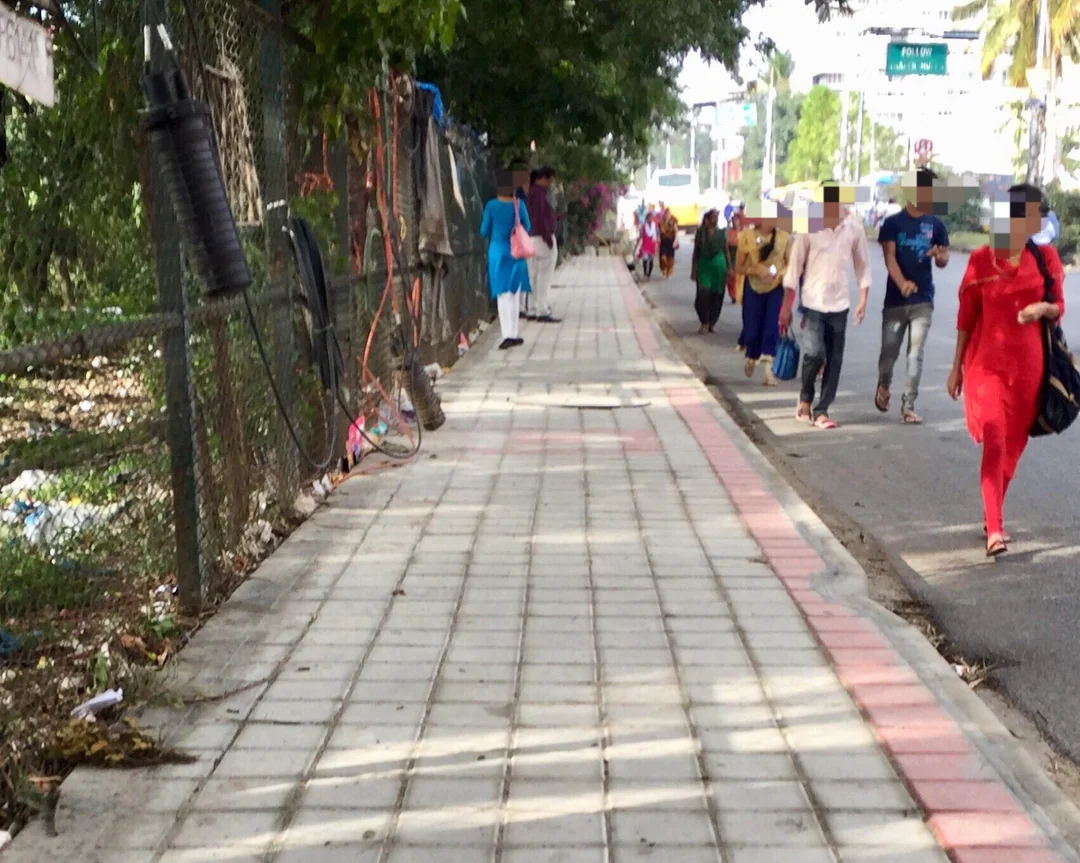
Discontinuous, poorly designed and broken footpaths, together with open drains, render many walkways unusable. Many also fail to accommodate wheelchair users and persons with visual impairments, despite statutory accessibility requirements. Urban infrastructure continues to prioritise automobiles rather than pedestrians.
Towards Recognition of the Fundamental Right to a Footpath
A compelling constitutional argument exists that the right to a safe and accessible footpath forms part of:
- Article 21 (Right to Life)
- Article 14 (Equality)
- Article 19(1)(d) (Freedom of Movement)
The judiciary has consistently expanded the scope of fundamental rights to respond to evolving societal needs. Just as environmental protection, privacy and education acquired constitutional recognition through judicial interpretation, pedestrian rights may similarly receive explicit constitutional recognition.
Such recognition would impose positive obligations on governments to create and maintain pedestrian-friendly infrastructure.
Way Forward
The right to a footpath is more than a matter of convenience; it is an issue of constitutional governance and human dignity. Safe pedestrian infrastructure enables citizens to exercise their rights to life, movement, equality and participation in public life.
Authorities should integrate footpath development and maintenance into the Smart Cities Mission. Local bodies must permanently remove obstructions to ensure barrier-free passage. States should mandate compliance with Indian Roads Congress (IRC) standards and adopt the Bombay High Court’s accessibility guidelines. Parliament should enact a “Right to Walk” law defining pedestrian rights, establishing a central regulatory authority and prescribing penalties for non-compliance.
In a democratic society committed to inclusive development, roads cannot belong exclusively to motor vehicles. Recognising and protecting the fundamental right to a footpath would represent a decisive step towards safer, more equitable and more humane cities in India.
(Dr S. Krishnan is an academician and experienced journalist based in Jaipur. Mitali Kori is a PhD research scholar at the Seedling School of Law and Governance, Jaipur National University, Jaipur)
