


By S. Krishnan and Shibika Gupta
In a democracy, institutions derive their legitimacy not only from constitutional authority but also from public trust. The judiciary, often regarded as the guardian of constitutional values, occupies a unique position in India’s democratic framework. At the same time, citizens possess the fundamental right to question, criticise, and even satirise public institutions. The recent controversy surrounding the emergence of the “Cockroach Janta Party” (CJP) has brought these two principles into direct conversation: judicial authority and democratic dissent.
What began as a controversial judicial remark soon transformed into a nationwide social media movement, sparking debates on freedom of expression, judicial accountability, public perception, and the limits of political satire. The episode raises an important constitutional question: How should democratic institutions respond when they become the subject of public criticism and satire?
Origin of the Controversy
The controversy emerged after remarks attributed to Chief Justice of India Justice Surya Kant during a court proceeding. The remarks were widely interpreted on social media as referring to unemployed youth as “cockroaches”. Although subsequent clarifications indicated that the observations were directed at individuals allegedly entering professions through fake or bogus qualifications, the initial interpretation had already gone viral.
The reaction was swift. Social media users, particularly young people frustrated by unemployment, examination irregularities, and governance concerns, transformed the phrase into a satirical political movement known as the “Cockroach Janta Party”. What started as a meme quickly evolved into a digital phenomenon attracting millions of followers and widespread online engagement.
The movement’s rapid growth demonstrated the power of digital activism. What made the phenomenon noteworthy was not merely the humour involved but the underlying frustration it reflected. Many young Indians viewed the movement as a symbolic expression of their concerns regarding employment opportunities, educational transparency, and institutional responsiveness.
Whether one agrees with the movement or not, its popularity suggests that satire often flourishes where citizens feel unheard.
Rise of Cockroach Janta Party
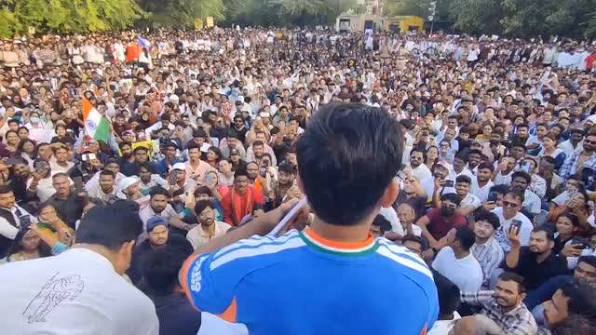
The Cockroach Janta Party emerged as a satirical platform expressing dissatisfaction with various social and political issues, including unemployment, examination paper leaks, educational reforms, and governance concerns. Founded by activist and communication strategist Abhijeet Dipke, the movement used humour, memes, and political satire to mobilise young citizens.
The movement’s rapid growth demonstrated the power of digital activism. What made the phenomenon noteworthy was not merely the humour involved but the underlying frustration it reflected. Many young Indians viewed the movement as a symbolic expression of their concerns regarding employment opportunities, educational transparency, and institutional responsiveness.
Whether one agrees with the movement or not, its popularity suggests that satire often flourishes where citizens feel unheard.
Judiciary’s Constitutional Position
The judiciary occupies a special constitutional status in India. Unlike elected branches of government, courts derive authority from constitutional legitimacy rather than electoral mandates.
The judiciary performs several essential functions:
• Protecting fundamental rights.
• Reviewing governmental actions.
• Resolving disputes.
• Preserving constitutional values.
• Safeguarding the rule of law.
Public confidence is crucial for judicial effectiveness. Courts lack the power of the purse or the sword; their authority largely depends upon public respect and acceptance of judicial decisions.
Consequently, concerns arise when judicial institutions become targets of ridicule, misinformation, or coordinated attacks. Critics argue that excessive mockery may erode institutional credibility and weaken public faith in the justice system.
Freedom of Speech and Democratic Criticism
At the same time, democracy cannot function without criticism. Article 19(1)(a) of the Constitution guarantees freedom of speech and expression. Citizens have the right to question public authorities, including judges and courts, provided such criticism remains within legal boundaries.
Historically, courts across democratic societies have accepted that public institutions are subject to scrutiny. Judicial accountability and public debate are essential components of constitutional democracy.
The distinction lies between:
• Fair criticism and abuse.
• Satire and defamation.
• Accountability and intimidation.
The Cockroach Janta Party controversy highlights the delicate balance between these competing concerns. It has been argued that its criticism is directed not against the judiciary as an institution but against remarks that supporters perceived as insensitive towards unemployed youth. From this perspective, satire becomes a legitimate form of democratic expression.
Satire as Political Expression
Political satire has long been recognised as a powerful tool of social commentary. Throughout history, writers, cartoonists, comedians, and activists have used humour to challenge authority and expose perceived injustices.
Satire serves several democratic functions:
• Encouraging public debate.
• Questioning authority.
• Highlighting contradictions.
• Simplifying complex issues.
• Engaging younger audiences.
The Cockroach Janta Party follows a global tradition of satirical political movements that use humour to communicate serious concerns. Its popularity demonstrates that contemporary political engagement increasingly occurs through digital culture, memes, and social media narratives.
However, satire also carries risks. When humour oversimplifies complex issues or spreads inaccurate information, it can distort public understanding.
Judicial Clarification and Public Perception
One of the most significant aspects of the controversy is the gap between judicial clarification and public perception.
Reports indicate that the Chief Justice later clarified that his observations were directed at individuals allegedly entering professional fields with fake qualifications rather than unemployed youth in general. Yet the clarification struggled to match the speed and reach of the original viral narrative.
This phenomenon reflects a broader challenge facing institutions in the digital era. Once a narrative gains momentum online, official explanations often fail to achieve comparable visibility.
As a result, institutions increasingly find themselves competing with social media interpretations rather than simply communicating official positions.
PILs and Judicial Response
The controversy eventually reached the courts through public interest litigation seeking investigations into activities associated with the Cockroach Janta Party and allegations regarding the misuse of courtroom observations. The petitions also sought inquiries into claims involving fake law degrees and the commercial exploitation of judicial proceedings.
The Supreme Court declined to grant urgent hearings in these matters. Chief Justice Surya Kant reportedly observed that the issue should not be taken “so sentimentally” and indicated that there was no extraordinary urgency requiring immediate intervention.
This response can be interpreted as an effort to prevent the controversy from escalating into a constitutional confrontation between online satire and judicial authority.
Social Media and Transformation of Public Discourse
The Cockroach Janta Party episode demonstrates how social media has transformed political and legal discourse.
Traditionally, judicial observations were primarily consumed by lawyers, journalists, and legal scholars. Today, courtroom exchanges can become viral content within minutes.
This transformation presents both opportunities and risks:
Opportunities
• Increased public engagement.
• Greater transparency.
• Wider legal awareness.
• Enhanced accountability.
Risks
• Misinterpretation of oral observations.
• Selective editing of courtroom exchanges.
• The spread of misinformation.
• Polarisation and institutional distrust.
The controversy underscores the need for responsible communication by both institutions and citizens.
Finding the Constitutional Balance
The real issue is not whether citizens should criticise the judiciary. Criticism is an essential democratic right.
Nor is the issue whether judicial institutions deserve respect. Respect for constitutional institutions remains fundamental to democratic stability.
The challenge is maintaining a balance where:
• Citizens can express dissatisfaction.
• Institutions remain accountable.
• Public discourse remains factual.
• Satire does not become misinformation.
• Institutional authority does not suppress legitimate criticism.
Democracy requires both strong institutions and an active citizenry. Neither can function effectively without the other.
Future Prospects
The conflict between the Cockroach Janta Party and the judiciary is about much more than a controversial remark. It represents a broader conversation about free speech, public accountability, institutional legitimacy, and the evolving nature of democratic participation in the digital age.
The judiciary must remain open to criticism, just as citizens must exercise their freedoms responsibly. Satire has a legitimate place in democracy, but so does respect for constitutional institutions. The challenge lies in ensuring that neither democratic dissent nor institutional dignity is sacrificed.
Ultimately, the controversy serves as a reminder that democracy is not merely a system of government; it is a continuous dialogue between institutions and the people they serve. The health of that dialogue depends not on silence or conformity but on the ability to engage in disagreement while preserving constitutional values, mutual respect, and public trust.
(Dr S. Krishnan is an academician and experienced journalist based in Jaipur. Shibika Gupta law student at the Seedling School of Law and Governance, Jaipur National University, Jaipur)
