


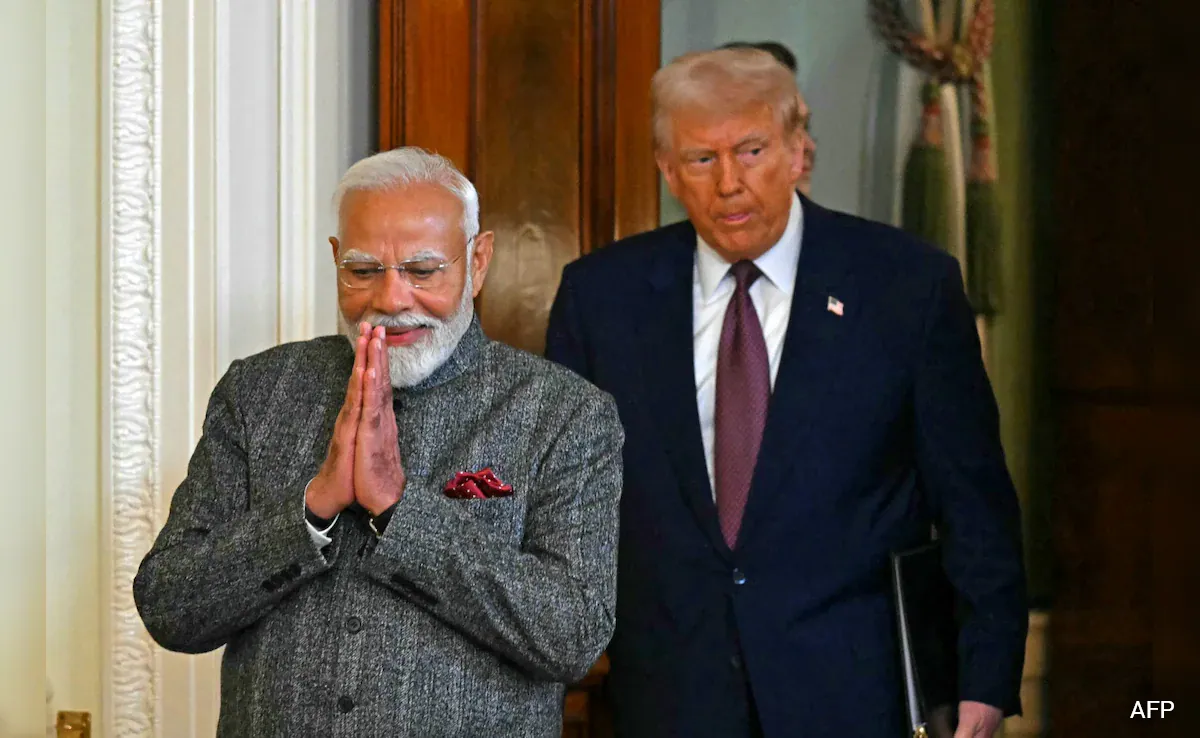
India’s trade agreement with the United States, under which Washington will cut tariffs on Indian goods to 18 per cent from levels that had effectively climbed to as high as 50 per cent, is being read in New Delhi, corporate boardrooms and global markets as far more than a routine trade reset. Economists and policymakers see it as a strategic inflexion point that reshapes India’s export outlook, strengthens its manufacturing push and subtly recalibrates its geopolitical positioning at a moment when the global trading system itself is fragmenting.
The agreement, announced by US President Donald Trump following a call with Prime Minister Narendra Modi, unwinds punitive duties imposed through 2025 and restores India’s cost competitiveness in its single largest export market, which accounts for roughly 21 per cent of India’s total goods exports. While the deal’s detailed legal architecture is still awaited, analysts agree that the direction of travel is clear: even the immediate tariff relief could add 20-30 basis points to India’s GDP growth over the next year, while catalysing a fresh cycle of investment in export-oriented, labour-intensive manufacturing.
“This is not just a tariff correction; it is a signal of strategic intent,” said Anil Talreja, Partner at Deloitte India. “Two major trade agreements in quick succession with economies representing more than $50 trillion in output underline that India is no longer sitting on the sidelines of global trade reordering. It is actively embedding itself into it.”
Export relief after months of strain
The tariff rollback comes after nearly six months of acute stress for Indian exporters, especially in sectors such as textiles, apparel, gems and jewellery, leather and marine products, which were disproportionately hit by the earlier duty regime. Data from industry bodies show that India’s gems and jewellery exports to the US fell 44.4 per cent year on year to $3.86 billion between April and December 2025, as higher duties eroded margins, delayed shipments and forced order renegotiations.
“The move from 50 per cent to 18 per cent gives exporters immediate breathing space,” said Krishan Arora, Partner at Grant Thornton Bharat. “More importantly, it restores predictability. Over the last few months, uncertainty, not just tariffs, was the biggest enemy of exporters.”
Moody’s Ratings echoed that assessment, saying the tariff reduction would “reinvigorate India’s goods export growth to the US”, with labour-intensive sectors such as gems and jewellery, textiles and apparel among the biggest beneficiaries. Pharmaceuticals and consumer electronics, it noted, were largely insulated, having been exempt from the steepest duties even during the punitive phase.
Despite these headwinds, India’s shipments to the US still rose about 9.7 per cent year on year in the first nine months of FY26, driven largely by electronics and smartphone exports. Economists say that resilience now provides a stronger base for a broader export recovery once tariff relief fully feeds through supply chains in FY27.
Manufacturing ambitions and supply-chain realignment
Beyond the immediate export boost, the agreement strengthens India’s pitch as a credible alternative manufacturing hub to China. With tariffs now at 18 per cent, India’s treatment by the US broadly matches that of regional competitors such as Vietnam, Indonesia and the Philippines, sharply narrowing the disadvantage that had opened up over the past year.
“This materially changes how global companies assess India in their supply-chain strategies,” said Shilan Shah, Deputy Chief Emerging Markets Economist at Capital Economics. “India combines tariff parity with advantages that are harder to replicate: low labour costs, political stability and a domestic market large enough to de-risk investment.”
The timing also dovetails with the Union Budget’s renewed emphasis on manufacturing incentives, logistics investment and MSME support. Analysts see this alignment as deliberate rather than coincidental. “Trade liberalisation without domestic capacity-building rarely works,” Talreja said. “Here, the sequencing is clear — open markets externally while strengthening competitiveness at home.”
Industry bodies have been quick to underline the potential spillovers. The Federation of Indian Export Organisations described the deal as a “game-changer” across sectors ranging from engineering goods and chemicals to textiles, apparel and agriculture, while the Confederation of Indian Industry said it would catalyse job creation and help build more resilient supply chains.
Energy, geopolitics and unresolved risks
The strategic dimension of the agreement extends well beyond trade. President Trump said India had committed to significantly increasing purchases of US energy and scaling down imports of Russian crude — a shift with far-reaching implications for India’s energy security calculus.
Ratings agencies and economists, however, have flagged execution risks. Moody’s warned that an abrupt halt to Russian oil imports would be disruptive and potentially inflationary for India, one of the world’s largest crude importers. Refining industry sources have indicated that a phased wind-down would be essential to honour existing contracts.
“There is sound logic in diversifying energy sources,” said an economist at a global ratings firm. “But a disorderly transition could tighten supplies and push up prices, undermining some of the macro gains from the trade deal.”
Geopolitically, the agreement is being interpreted as a subtle but meaningful recalibration. “India has sought to preserve strategic autonomy,” Shah said. “But if this rapprochement with the US proves durable, it nudges India closer to the US economic and strategic orbit, even if alignment stops short of formal blocs.”
Market reaction and the road ahead
Financial markets responded swiftly. Indian equities opened sharply higher, with the Sensex jumping more than 2,000 points, while the rupee strengthened on expectations of improved export earnings and stronger capital inflows.
Economists broadly agree that the deal removes a significant external drag at a time when global demand remains fragile and protectionist pressures are rising elsewhere. “For MSME-led sectors, this could mark the difference between prolonged stress and recovery,” said Manoj Mishra, Partner at Grant Thornton Bharat.
Uncertainties remain. The absence of detailed timelines, the continued applicability of Section 232 tariffs on steel, aluminium and automobiles, and the scope of India’s commitments on non-tariff barriers will shape the eventual impact. “The fine print will matter,” said one trade economist. “But the strategic direction is unmistakable.”
Taken together, the agreement signals a broader evolution in India’s trade posture, away from defensive caution and towards active integration with major markets. As Talreja put it, “India is no longer preparing for the global economic order. It is stepping into it.”

