
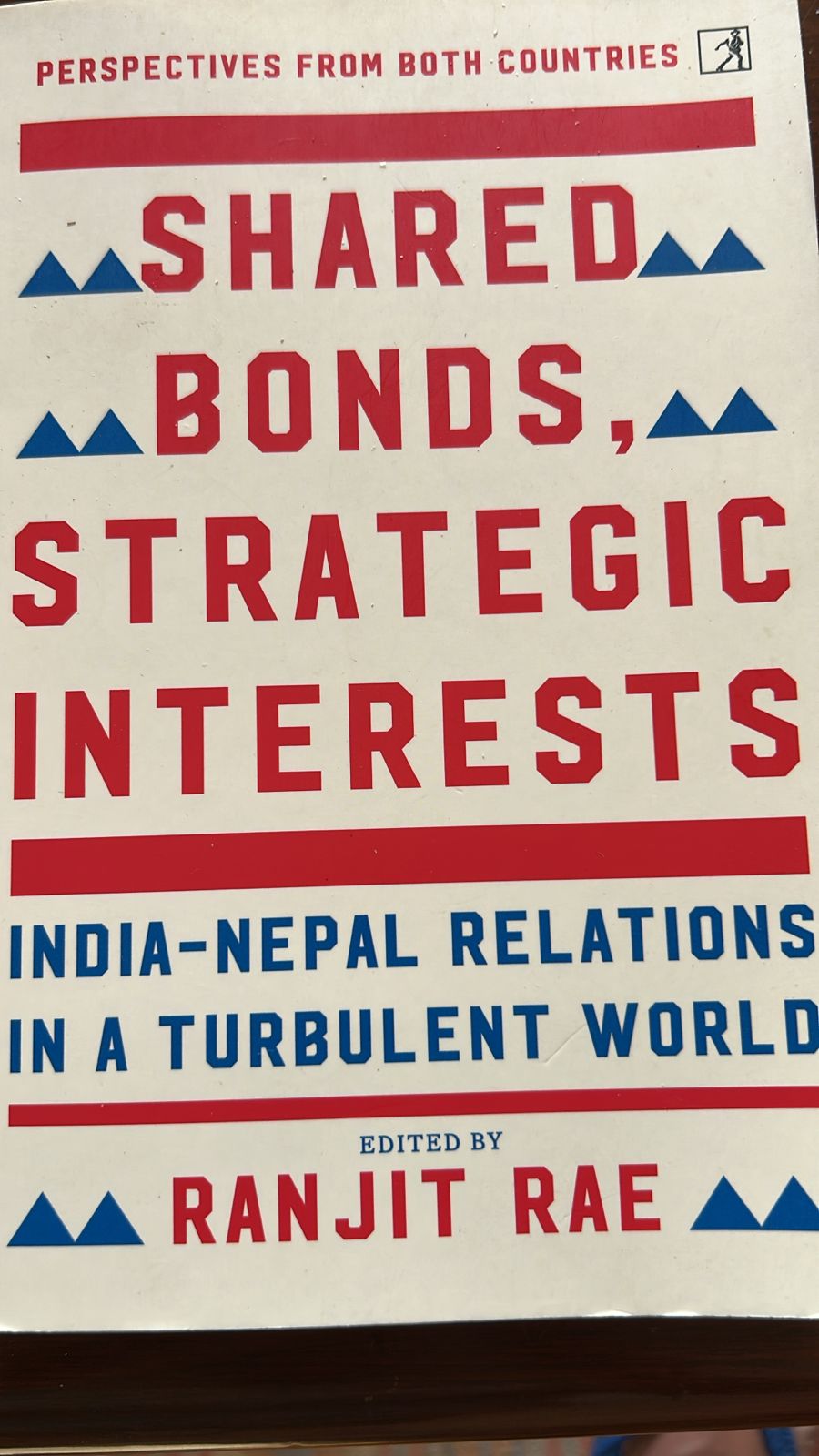
About the Book
Shared Rands, Strategic Interests: India–Nepal Relations in a Turbulent World is a concise and timely exploration of one of South Asia’s closest yet most complex bilateral relationships. Shaped by geography, history and dense human interaction, India-Nepal ties are marked by intimacy as well as periodic tension. This book addresses that reality with clarity rather than nostalgia.
The book brings together essays by scholars, diplomats and journalists from both countries, offering a balanced account of how the relationship has evolved and where it now stands. Historical perspectives are used to explain contemporary frictions, not to romanticise the past. The contributors place bilateral ties within a shifting regional and global environment, examining the implications of geopolitical flux, the India-China rivalry and the impact of India’s Neighbourhood First policy.
A central focus is the Gen Z-led protests of September 2025 in Nepal, which led to the fall of the K P Sharma Oli government. The volume analyses these events as more than a change of leadership, assessing their implications for domestic stability, the prospects of fresh elections and Nepal’s engagement with India in the near term. The discussion remains measured, identifying both risks and opportunities arising from the political transition.
The book also looks beyond high politics to areas of practical cooperation. It highlights scope for deeper economic partnership, especially in water resources and hydropower, and examines sensitive issues such as the Agniveer scheme and the recruitment of Gorkha soldiers into the Indian Army. Attention is also given to cooperation among the Himalayan border communities and strengthening of people-to-people ties.
By outlining concrete pathways for engagement, the volume offers valuable insights for policymakers, scholars and readers interested in India’s neighbourhood in an increasingly uncertain world.
Excerpts
Gen Z Uprising
The most significant rupture in recent memory is the Gen Z uprising of 8-9 September 2025 – in Nepal it is being referred to as a revolution – that overthrew the K P Sharma Oli led coalition government and unleashed death and destruction in Nepal. Virtually all institutional structures of democratic governance, the Parliament, the Singha Durbar- the Rana era seat of Government, Sheetal Niwas- the Presidential Palace, the Supreme Court and critical documents and archives were gutted. Newspaper offices of Kantipur and Annapurna Post, two major dailies as well as Hilton Hotel and a chain of supermarkets were burnt down. The arson extended to other towns of Nepal, including in the Terai. Apart from State property, homes of leaders were burnt down, some leaders were severely assaulted physically, the Rashtriya Swatantra Party (RSP) chief was forcibly freed from jail- in the process some 13000 criminals were also released- and stacks of currency, foreign and Nepali was found in the ashes and debris of burnt out residences.
Though the trigger for the uprising was the ban on several social media apps including You Tube, WhatsApp, Instagram, Messenger, among others, used by the vast majority of Nepalese in their lives and for their livelihoods, public discontent as mentioned earlier had been brewing and seething for a considerable period of time. The young generation was also angered by the luxurious lives of Nepo-Kids, those children of political leaders and power brokers, who constantly lived the high life on social media such as Instagram and Tik Tok, while ordinary people struggled to meet their daily needs. Gen Z youngsters used some of the social media apps that had not been banned, such as Viber and Tik Tok as a tool for social mobilization for protests on September 8, 2025.
##
That trouble was brewing in Nepal was evident, when several months ago this author visited Nepal after the Bangladesh uprising, a question often asked by several journalists and others was whether a similar situation could arise in Nepal. Of course, Nepali political leaders in power were in a state of denial.
To begin with the protests were peaceful with youngsters marching and singing on the streets in a folksy atmosphere. It is only after the mishandling of the protests by security forces that resulted in the killing of 19 youth in the evening of 8 September that a spasm of rage and fury engulfed the nation the following day when widespread arson, destruction and looting took place. It is only several hours after the mayhem had begun that PM Oli, after sustained pressure from the security forces, resigned; the Army took charge and brought a semblance of calm, thereby preparing the way for the appointment of an Interim Government led by former Chief Justice Sushila Karki. In response to criticism that the Army should have acted earlier to prevent the arson and looting on 9 September, the Army Chief has reportedly stated that he wanted to prevent bloodshed on the streets. Gen Z has also distanced itself from the mayhem and looting of September 9th raising questions about people that infiltrated the movement and took advantage of the situation.
The other significant fact is that there was considerable delay between the resignation of PM Oli on 9 September and the formation of the Sushila Karki Government on the evening of 12 September. The intervening period, extremely sensitive, was used by the Army for consultations with Gen Z and, somewhat inexplicably, some controversial royalists and the RSP; it was used by the President for consultations with political parties; and the Gen Z themselves, through the social media app Discord were engaged in the process of selecting their nominee for PM. There were rumours that the President was under pressure to resign and refused to do so. He, together with the Parliament remained the only tangible link to the 2015 Constitution. The President also did not want the Parliament to be dissolved; he wanted the new cabinet to include persons with high integrity from political parties to be appointed to the Karki Cabinet to ensure wider political ownership of the new political processes being adopted. This was not acceptable to Mrs Karki, the influential Mayor of Kathmandu Balendra Shah and elements of Gen Z. Meanwhile, a lot of rumours floated around in Kathmandu that martial law would be declared resulting in a takeover by the Army and/or reinstallation of the King. A former PM Madhav Nepal has suggested that the King conveyed that he would assume office only if endorsed by the political parties. It has also been suggested that the Nepalese Army was in touch with their Indian and, possibly, US counterparts and that this may have played a role in ensuing developments that helped preserved a republican Nepal. It is impossible to confirm the veracity of these rumours; eventually however, Nepal did find a way out of the political impasse without jettisoning the Constitution.
About the Author
Ranjit Rae is a former Indian Ambassador to Nepal and has also served as the head of the division dealing with Nepal and Bhutan in the Ministry of External Affairs. Over two tenures, he had a close, first-hand view of major political and social transformations in Nepal, from the royal coup of 2005 and the peace process between the Maoists and mainstream political parties to the devastating earthquake of 2015 and the adoption of Nepal’s new Constitution. He is the author of Kathmandu Dilemma: Resetting India–Nepal Ties.