


Independence in West Bengal was closely intertwined with the Partition of India, and the Partition itself was associated with several defining characteristics, including the refugee crisis, Muslim migration, and, later, the emergence of a Muslim vote bank.
Within a year of Independence, Mahatma Gandhi was assassinated by individuals associated with the Hindu Mahasabha. After Partition, when the Government of India delayed transferring Pakistan’s entitled sum of ₹55 crore, Gandhi began a fast unto death. This caused concern among leaders of the Hindu Mahasabha, who believed that Gandhi would become a major obstacle to their vision of India as a Hindu nation. Consequently, they resorted to assassinating Gandhi.
However, after Gandhi’s assassination, the Hindu Mahasabha gradually lost its importance in mainstream Indian politics. Liberal leaders such as Dr Shyama Prasad Mukherjee distanced themselves from the organisation, and, over time, it became a marginal political force.
Against this national backdrop, the Indian National Congress appointed Dr Prafulla Chandra Ghosh as the first chief minister of West Bengal in 1947, followed by Dr Bidhan Chandra Roy in January 1948. Dr Roy strongly supported a complete exchange of population between East Pakistan and West Bengal as a solution to the refugee crisis. However, Prime Minister Jawaharlal Nehru strongly opposed the transfer of Muslims to East Pakistan, reportedly keeping electoral considerations in mind.
As a result, West Bengal began to face the challenges of refugee rehabilitation, food shortages and unemployment. Until 1962, under Dr Roy’s leadership, the Congress government undertook several significant measures, including refugee rehabilitation, post-Independence industrialisation, and the development of industrial regions. Following Dr Roy’s death, severe internal conflicts emerged within the Congress over its leadership. Agitations over the food crisis intensified, and power eventually shifted to the United Front.
In 1970, the Naxalbari movement emerged, creating widespread unrest. At the same time, trade unions gained increasing influence. In 1972, the Congress returned to power for another five years.
In 1977, the Left Front came to power, gaining immense popularity through its land reforms. It introduced Operation Barga. However, during the implementation of these reforms, an unhealthy alliance developed between local administrative leaders and zamindars who had lost property. To prevent this alliance from becoming stronger, a three-tier Panchayat system was introduced in 1978 through elections, decentralising power and seeking to establish a direct connection between the government and ordinary people.
Gradually, the increasingly popular Left Front government built mass organisations across various sections of society and became highly successful in expanding its influence. A “party culture” emerged, with the party playing a decisive role even in resolving personal matters. The people of West Bengal became divided into two groups: those associated with the party and those who were not. Consequently, the influence of political leaders continued to grow.
At the same time, the Left Front allegedly transformed the Muslim community into a dependent vote bank and did not obstruct migration from Bangladesh or the settlement of migrants in the state. During this period, many madrasas received government recognition, and Aliah University was established. Towards the end of its tenure, in 2010, the Left Front Government accepted the recommendations of the Ranganath Misra Commission and approved a 10 per cent reservation in jobs for Muslims through the OBC quota.
No political system remains permanent. Salaried residents of West Bengal gradually sought greater self-reliance. At the same time, as the Left Front expanded, its organisational grip began to weaken. New groups emerged, including small business owners, contractors and moneylenders. Many of these shifted their allegiance from the Left Front to the Trinamool Congress, symbolically moving from red to green in 2011.
After coming to power in 2011, Mamata Banerjee did not emphasise building a cadre-based organisation. Instead, she established a highly centralised style of leadership while significantly expanding the Muslim appeasement policies inherited from the Left Front. She also introduced numerous welfare and subsidy-based schemes. Rather than strengthening the party organisation, she relied heavily on the bureaucracy. As a result, the Trinamool’s internal structure did not develop robustly; instead, deep personal loyalty to the leader emerged. The leader’s message and image became central to the party’s political narrative.
Large cut-outs of the leader became prominent at party events, in government advertisements and during public programmes. Mamata Banerjee conducted administrative meetings across West Bengal and organised public interactions throughout the state, increasing her visibility and outreach. However, opposition public representatives were reportedly not invited to these administrative meetings. Through direct engagement with ordinary people, she cultivated an image of compassion and reliability.
During her tenure, corruption, extortion and the so-called “syndicate culture” increased. The salaried middle class of the Left era gradually diminished and was replaced by a newly affluent class associated with small and medium-sized businesses. A circle of loyalists developed around Mamata Banerjee. As a result, ideology gave way to patronage, and party discipline evolved into leader-centric politics.
This newly affluent group became intermediaries between government projects and ordinary citizens, often benefiting through financial transactions. The concept of “cut money” gained prominence. In return, these intermediaries maintained political stability and local vote banks, acting as influential strongmen while enjoying the confidence and support of the leadership. Over time, they became indispensable within the party and increasingly influential in determining access to government benefits. The “party culture” gradually evolved into a “cut money culture”.
As corruption and exploitation allegedly intensified, public resentment began to grow. By 2019, as dissatisfaction with the Trinamool government was surfacing in rural Bengal, I-PAC entered West Bengal politics as a professional political consultancy on the recommendation of Abhishek Banerjee. It introduced several new initiatives, beginning with “Duare Sarkar”. The growing dependence on professional consultants, while sidelining senior party leaders, reportedly created internal tensions within the organisation.
The Trinamool Government failed to take effective measures to address industrial development, unemployment, the payment of long-pending dearness allowance arrears, problems in higher education, and the migration of workers and employees to other states.
From the beginning of its rule in 2011, the Mamata Government is described as having pursued visible appeasement policies towards Muslims and migrants from Bangladesh to consolidate its political support.
While the various welfare schemes introduced during the Trinamool era provided temporary relief to ordinary people, this weakened people’s sense of identity, leaving many to identify themselves primarily as beneficiaries of government subsidies.
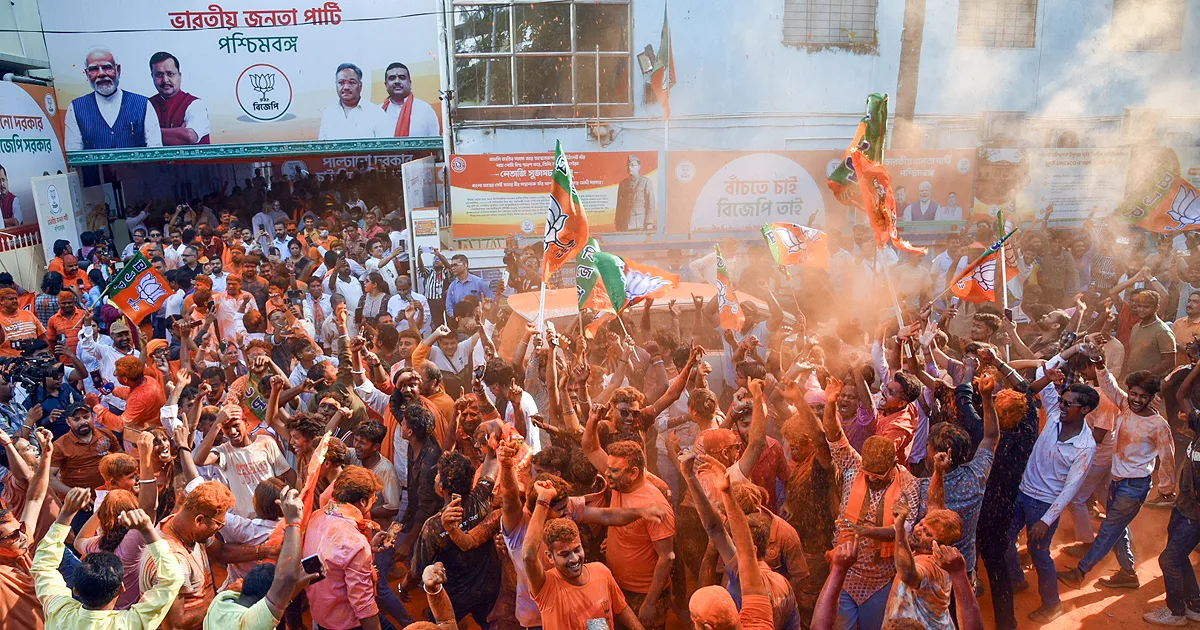
The cadre-based BJP capitalised on this perceived loss of identity. Rather than merely entering villages to seek votes, it sought to provide people with a renewed political and cultural identity. Excessive Muslim appeasement by the Trinamool generated resentment among Hindu voters. These sentiments developed quietly beneath the surface and eventually produced a major political shift that the Trinamool leadership allegedly failed to recognise. The BJP encouraged Bengal’s majority population to think differently and was able to consolidate the Hindu vote. The process had been unfolding since 2019 and culminated on May 4, 2026, when the BJP formed the government in West Bengal for the first time.
(Urmila Sen is an associate professor in economics at Surendra Nath Evening College, Kolkata. Her area of specialisation is econometrics and statistics)
