

When historians look back at the first quarter of the 21st century, they may well describe it as the period during which India rediscovered its confidence. Over the past 12 years, under the leadership of Prime Minister Narendra Modi, India has undergone a remarkable transformation. The nation has emerged stronger economically, more confident diplomatically, more capable technologically, and more ambitious in terms of development than ever before.
Prime Minister Narendra Modi has become India’s longest-serving continuously elected prime minister, completing 12 years and 27 days (4,411 days) in office on June 22, 2026. These 12 years have been defined by trust, development, public welfare, national pride, and inclusive growth. Guided by the philosophy of “Sabka Saath, Sabka Vikas, Sabka Vishwas, Sabka Prayas”, India has undergone a transformation that has touched every section of society and every corner of the nation.
Over the last 12 years, India has witnessed a governance model that has emphasised development, transparency, infrastructure creation, financial inclusion, social welfare, digital empowerment, and national security. India has built highways, railways, airports, waterways, digital infrastructure, and manufacturing ecosystems at an unprecedented pace. The country has emerged as a global leader in digital payments through UPI, expanded financial inclusion through Jan Dhan accounts, empowered entrepreneurs through Startup India, strengthened infrastructure through PM Gati Shakti, and modernised its defence sector through the Atmanirbhar Bharat initiative. This governance model has been centred on empowering the poor, strengthening the middle class, creating opportunities for young people, improving the lives of women, supporting farmers, modernising infrastructure, preserving heritage, and enhancing India’s standing in the world.
The scale of transformation is unprecedented. More than 81 crore citizens have benefited from free food grains under the Pradhan Mantri Garib Kalyan Anna Yojana. More than 4 crore houses have been sanctioned under the Pradhan Mantri Awas Yojana. Over 10.5 crore LPG connections have been provided through the Pradhan Mantri Ujjwala Yojana. More than 12 crore toilets have been constructed under the Swachh Bharat Mission, improving sanitation, health, and dignity for millions of families. More than 2 crore young people have received skill development training, and loans exceeding ₹40 lakh crore have supported entrepreneurship and self-employment through the Pradhan Mantri Mudra Yojana. India’s startup ecosystem has expanded dramatically, with more than 2.2 lakh registered startups and over 10,000 Atal Tinkering Labs fostering innovation among students.
Women have emerged as some of the greatest beneficiaries of this transformation. More than 32 crore Jan Dhan accounts have been opened in their name, strengthening financial inclusion and economic independence. Nearly 10 crore rural women have been empowered through Self-Help Groups, while more than 3 crore women have become Lakhpati Didis. The Modi Government has transformed women’s empowerment from a welfare programme into a development agenda.
Healthcare has also expanded at an unprecedented pace. Ayushman Bharat now provides healthcare coverage to more than 60 crore citizens. Affordable medicines are available through over 19,000 Jan Aushadhi Kendras, while medical education has expanded significantly, with MBBS seats increasing to nearly 1.3 lakh across the country.
India’s infrastructure revolution has reshaped the country’s development landscape. The operational airport network has expanded from 74 airports in 2014 to 164 airports today. More than 1,100 kilometres of metro rail now connect 26 cities. Vande Bharat trains have transformed railway travel, while iconic projects such as the Atal Setu, Sudarshan Setu, Chenab Rail Bridge, Bogibeel Bridge, and the New Pamban Bridge stand as symbols of India’s engineering excellence.
Yet the story of India’s resurgence is not merely one of national statistics, international rankings, or global recognition. It is also the story of states that have emerged as engines of transformation in their own right. Among them, Assam stands out as one of the most compelling examples of how visionary leadership, political stability, cultural confidence, and development-oriented governance can work together to create prosperity, opportunity, and renewed confidence in the future.
For decades, Assam was often defined by its many challenges. Today, however, it is increasingly recognised for its immense opportunities. Its achievements reflect the broader aspirations of a New India.
Assam today represents the broader story of a resurgent India. It demonstrates how economic growth, infrastructure development, cultural preservation, environmental sustainability, and social empowerment can reinforce one another. The state has shown that it is possible to modernise without losing its identity, pursue growth without compromising sustainability, and embrace globalisation while preserving local traditions.
Perhaps the most remarkable indicator of Assam’s transformation is its economic performance. According to assessments highlighted by the Reserve Bank of India, Assam has emerged as one of the fastest-growing economies among Indian states, recording economic expansion of approximately 45 per cent, from ₹4,10,724 crore in 2020–21 to ₹7,41,626 crore in 2025–26. With an annual growth rate of around 9 per cent, Assam today has the largest Gross State Domestic Product (GSDP) in the Northeast and contributes roughly 30–35 per cent of the region’s economy. The state’s revenue has grown by 53 per cent over the past five years, while per capita income has increased from ₹1,03,371 in 2020–21 to ₹1,59,185 in 2024–25, a rise of 54 per cent. The poverty rate has fallen from 36.97 per cent in 2013–14 to 14.47 per cent, with more than 80 lakh people escaping multidimensional poverty.
The state’s physical infrastructure has expanded rapidly. Roads, bridges, airports, railway connectivity, urban infrastructure, and digital networks have all witnessed significant growth. These investments have done more than improve transportation; they have fundamentally reshaped Assam’s economic geography. Connectivity has improved dramatically, with more than 20,000 kilometres of roads built or upgraded, while major bridges and transport corridors have strengthened mobility and economic integration across the state.
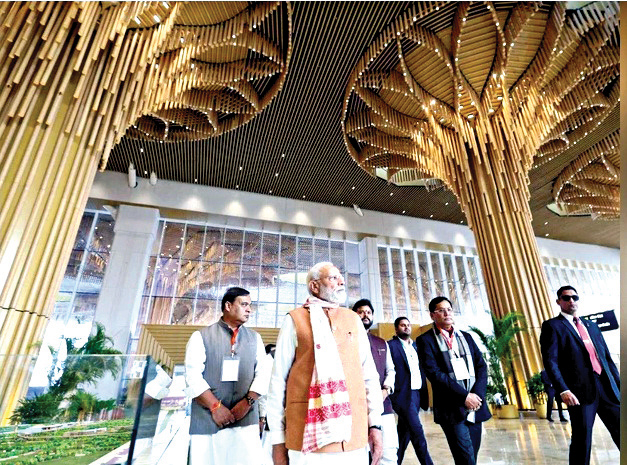
The confidence of a rising Assam is perhaps best reflected in the new Terminal 2 at Guwahati International Airport. Recently declared India’s Most Beautiful Airport for 2026 by the prestigious Prix Versailles architecture and design awards, the terminal has become a symbol of a new Assam. Inspired by the foxtail orchid and rooted in sustainable design principles, it celebrates Assam’s biodiversity, craftsmanship, and cultural identity while presenting a modern and globally competitive face to the world. It demonstrates that infrastructure can be both functional and an expression of cultural identity.
One of the most visible manifestations of Assam’s progress can be seen in its industrial landscape, which is undergoing a historic transformation. The semiconductor manufacturing facility at Jagiroad, for instance, is expected to produce 48 million semiconductor chips per day, positioning Assam at the forefront of India’s technological future. Likewise, the new Namrup Ammonia-Urea Complex, with an annual production capacity of approximately 12.7 lakh metric tonnes, is expected to strengthen agricultural productivity while reducing dependence on imports.
Together, these projects are expected not only to generate employment and accelerate industrial growth but also to enhance Assam’s strategic importance in India’s economic future. This renewed confidence is reflected in the investment commitments received at Advantage Assam 2.0, where projects worth ₹5.18 lakh crore have already been announced.
One of the most significant, yet often underappreciated, aspects of Assam’s transformation has been the restoration of peace. Over the past decade, insurgency-related incidents have declined by nearly 76 per cent. Civilian deaths have fallen by 97 per cent, while overall casualties have been reduced by around 90 per cent. Historic agreements, including the Bodo Peace Accord, the Karbi Anglong Agreement, and accords with eight Adivasi groups, have helped bring thousands of young people into the mainstream.
Several militant organisations, including the Dimasa National Liberation Army (DNLA) and the Dimasa People’s Supreme Council (DPSC), have laid down their arms and embraced peace. This return of stability has created an environment conducive to investment, tourism, economic growth, and long-term social stability. The establishment of Assam’s first Emergency Landing Facility at Moran, near Dibrugarh, further reflects both the Centre’s strategic priorities and the growing importance of the Northeast in India’s national security architecture.
These figures represent more than mere economic statistics. They signify expanding opportunities, rising aspirations, and growing confidence among the people. A strong and stable economy forms the foundation upon which every other aspect of development is built. Economic growth generates employment, attracts investment, strengthens public finances, improves infrastructure, and enables greater spending on education, healthcare, welfare, and public services.
As prosperity expands, entrepreneurs gain the confidence to invest, industries increase production, and young people find new employment opportunities. Higher government revenues, in turn, enable greater investment in roads, schools, hospitals, and other public infrastructure, creating a virtuous cycle of development.
(Mita Nath Bora is a researcher and public policy analyst with a focus on Assam and Northeast India)