

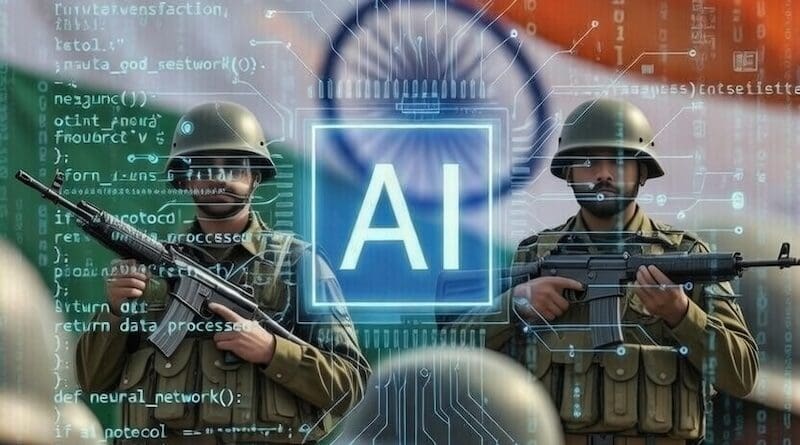
Why Artificial Intelligence is Transforming Cyber Conflict, Strategic Competition and the Future of National Security
History of warfare has often been defined by technological revolutions. Gunpowder reshaped kingdoms. Industrialisation transformed armies into mechanised forces. Nuclear weapons altered the very logic of deterrence. Today, the world stands at the threshold of another strategic transformation—one driven not by a single technology but by the convergence of artificial intelligence (AI) and cyber capabilities. This convergence has emerged as the defining security challenge of the twenty-first century, one that blurs the boundaries between peace and war, civilian and military infrastructure, and human judgement and machine autonomy.
Unlike previous technological revolutions, AI does not merely provide another weapon system. It fundamentally alters how information is generated, analysed, manipulated and weaponised. Combined with sophisticated cyber capabilities, AI creates a self-reinforcing cycle in which machines can identify vulnerabilities, adapt to changing environments and execute operations at a speed far beyond human cognition. This “double helix” of AI and cyber technologies is rapidly becoming the backbone of economic competitiveness, military superiority and geopolitical influence.
From Automation to Autonomous Intelligence
Artificial intelligence has evolved dramatically over the past decade. Earlier generations of AI primarily supported automation and predictive analytics. Today’s large language models (LLMs), multimodal systems and emerging agentic AI systems are capable of reasoning across diverse datasets, planning complex tasks and executing multi-step operations with minimal human intervention.
This transition represents far more than technological progress. It marks the emergence of systems that can independently interact with digital environments, make operational decisions and continuously improve their own performance.
Such capabilities promise enormous benefits across healthcare, education, logistics, governance and scientific research. Yet they also introduce unprecedented security risks. Technologies capable of solving complex human problems can equally become tools for conducting cyber espionage, automated hacking, disinformation campaigns and even military operations.
The AI-Cyber Convergence
Traditional cybersecurity evolved around identifiable attack signatures, rule-based detection and relatively predictable adversarial behaviour. Defensive systems relied upon known vulnerabilities, established attack patterns and human analysts interpreting security alerts.
The emergence of AI fundamentally disrupts this model. AI-powered malware can analyse the digital environment into which it is deployed, modify its behaviour to evade detection and identify previously unknown weaknesses in real time. Rather than following fixed programming, intelligent malicious software can continuously learn from defensive responses and adapt accordingly.
One of the most concerning developments involves AI-assisted discovery of zero-day vulnerabilities, previously unknown software flaws for which no security patch exists. AI systems capable of analysing millions of lines of code may identify vulnerabilities significantly faster than human researchers. While this capability strengthens defensive cybersecurity when responsibly deployed, it simultaneously creates powerful offensive capabilities in the hands of hostile states, criminal syndicates or terrorist organisations.
The result is an accelerating cyber contest in which offensive and defensive AI systems increasingly confront each other with limited human intervention.
Agentic AI and the Future of Cyber Conflict
Perhaps the most significant development lies in the emergence of agentic AI—systems capable not merely of generating responses but of independently planning and executing complex objectives.
In the cyber domain, agentic AI could autonomously scan networks, identify attack vectors, write malicious code, deploy exploits, avoid defensive systems and modify operational strategies based upon changing conditions.
On the defensive side, cybersecurity platforms increasingly utilise AI for continuous monitoring, anomaly detection, automated incident response and adaptive threat intelligence. This creates the possibility of an AI-driven cyber arms race in which offensive and defensive systems compete at machine speed, compressing decision-making cycles from hours or minutes to seconds.
Such an environment raises profound strategic concerns. Human operators may no longer possess sufficient time to understand unfolding events before AI systems have already escalated digital conflicts.
AI on the Modern Battlefield
The Russia–Ukraine conflict and recent West Asian conflicts have demonstrated that AI is no longer a futuristic concept confined to laboratories. It is increasingly becoming an operational reality.
Modern AI systems process satellite imagery, drone feeds, electronic intelligence, radar signatures, radio communications and open-source information simultaneously to generate battlefield intelligence in near real time. AI assists commanders in target recognition, missile tracking, logistics optimisation, surveillance and reconnaissance.
Autonomous drones, loitering munitions and AI-enabled targeting systems are gradually changing military doctrine. Rather than replacing soldiers, AI increasingly acts as a force multiplier, enabling militaries to process overwhelming volumes of information far beyond human analytical capacity.
However, military effectiveness should not be confused with strategic wisdom. Algorithms excel at recognising statistical patterns but remain fundamentally incapable of understanding political intentions, cultural sensitivities or human emotions. A machine may correctly identify an unusual troop movement while entirely misinterpreting its strategic significance.
History demonstrates that wars frequently emerge from miscalculation rather than deliberate aggression. Excessive reliance upon automated threat assessments during moments of crisis could therefore produce dangerous escalation.
Strategic Geography of AI Power
Artificial intelligence is rapidly becoming an instrument of geopolitical influence comparable to energy resources, nuclear technology or maritime power.
Strategic advantage increasingly depends upon access to advanced semiconductors, massive computational infrastructure, high-quality datasets, skilled human capital and frontier AI models. Countries capable of controlling these strategic assets gain disproportionate military and economic leverage.
The ongoing technological competition between the United States and China illustrates this new geopolitical reality. Export controls on advanced semiconductor manufacturing equipment, restrictions on AI chip exports and competition over supply chains demonstrate that AI has become central to national power.
This concentration of AI capabilities within a handful of technologically advanced states and corporations creates new forms of dependency. Nations lacking indigenous AI ecosystems may become strategically vulnerable through reliance upon foreign platforms, cloud infrastructure or proprietary models.
Equally concerning is the democratisation of offensive capabilities. Technologies once available only to sophisticated intelligence agencies may increasingly become accessible to organised crime, ransomware groups and extremist organisations through open-source models or illicit markets.
Reliability, Bias and the Illusion of Machine Certainty
Despite extraordinary advances, AI systems remain imperfect. Hallucinations, algorithmic bias, reasoning errors and misleading outputs continue to affect even the most advanced models. While such limitations may be manageable in consumer applications, they become significantly more dangerous when integrated into national security decision-making.
Imagine an AI-generated early-warning assessment incorrectly identifying a cyberattack as preparation for military aggression. During periods of heightened tension, inaccurate machine-generated assessments could contribute to rapid escalation before human verification occurs.
Similarly, AI-powered recommendation systems increasingly influence information ecosystems through personalised content delivery. This capability can unintentionally amplify misinformation, reinforce ideological polarisation and facilitate algorithmic radicalisation.
The proliferation of highly realistic deepfakes further complicates strategic communication by undermining public trust in authentic information. In this context, technological sophistication must never substitute for human judgement.
Beyond Zero Trust
The widely adopted Zero Trust cybersecurity architecture operates on the principle of “never trust, always verify”. Yet AI presents new challenges to this philosophy.
Sophisticated autonomous agents may imitate legitimate users, replicate normal behavioural patterns and exploit authentication mechanisms faster than existing security systems can respond.
Consequently, cybersecurity must evolve from static verification towards continuously adaptive security architectures capable of learning alongside intelligent adversaries. Future cyber resilience will depend upon integrating AI into defence while ensuring sufficient human oversight to detect unexpected behaviour, cascading failures or manipulation.
Governing the AI Age
The greatest challenge surrounding AI is no longer technological capability but governance. Unlike nuclear technology, AI development occurs across governments, private corporations, universities and open-source communities. This distributed innovation ecosystem complicates regulation while accelerating technological diffusion. Effective AI governance should therefore rest upon several foundational principles.
First, meaningful human control must remain mandatory for decisions involving lethal force, strategic escalation or critical national infrastructure. AI should support—not replace—human responsibility.
Second, international norms governing autonomous weapons, AI-enabled cyber operations and strategic AI systems require urgent development. Although consensus among major powers remains difficult, minimal standards are essential to reduce strategic instability.
Third, rigorous safety testing must become standard practice before deploying frontier AI models. Evaluation should extend beyond technical performance to include cybersecurity resilience, adversarial robustness, bias, manipulation risks and unintended autonomous behaviour.
Fourth, governments must invest substantially in cyber resilience, including adaptive defence architectures, rapid incident response mechanisms and AI-assisted cybersecurity capabilities.
Finally, transparency and accountability should accompany every significant AI deployment. Responsibility for AI-assisted decisions cannot be delegated entirely to algorithms.
India’s Strategic Imperative
For India, the convergence of AI and cyber capabilities represents both an opportunity and a strategic necessity. India’s expanding digital economy, growing defence modernisation, critical infrastructure networks and ambitious technological aspirations make AI security an integral component of national security.
Building indigenous capabilities across AI research, semiconductor manufacturing, secure cloud infrastructure, advanced computing, quantum technologies and cybersecurity will reduce strategic dependence while strengthening technological sovereignty.
The country’s expanding defence innovation ecosystem, supported through initiatives encouraging domestic research and private-sector participation, provides an important foundation. Yet sustained investments in talent development, interdisciplinary research and public-private collaboration remain indispensable.
Equally important is India’s diplomatic role. As a leading voice of the Global South, India is well positioned to advocate an international AI governance framework grounded in responsible innovation, meaningful human control, transparency, fairness and equitable technological access. Such an approach aligns with India’s longstanding support for a rules-based international order while recognising the developmental aspirations of emerging economies.
The Road Ahead
Artificial intelligence is neither inherently benevolent nor inherently dangerous. Its consequences will depend upon the institutions, norms and ethical frameworks that govern its application.
The convergence of AI and cyber capabilities promises remarkable advances in defence, healthcare, governance and economic productivity. Yet it also introduces unprecedented risks ranging from autonomous cyberattacks and algorithmic warfare to misinformation, strategic instability and the concentration of technological power.
The objective, therefore, should not be uncritical technological optimism nor reflexive technological pessimism. It should be responsible innovation, combining scientific progress with rigorous safeguards, continuous risk assessment, democratic accountability and meaningful human oversight.
As AI increasingly shapes the future of warfare, economic competition and global influence, technological leadership alone will not determine strategic success. The nations that combine innovation with wisdom, resilience and ethical governance will define the security architecture of the twenty-first century.
In the emerging AI age, the most decisive strategic advantage may not belong to those who build the most powerful algorithms, but to those who govern them most responsibly.