


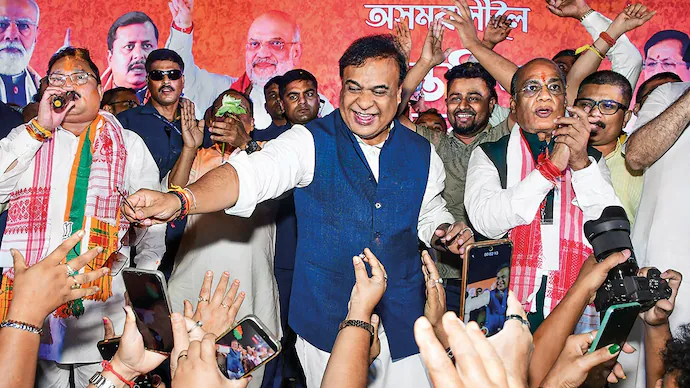
The 2026 Assam Assembly election has delivered more than a sweeping victory for the Bharatiya Janata Party-led NDA. It has produced a new political reality with implications that stretch far beyond seat arithmetic. The central question now is no longer who governs Assam. That question has been settled decisively. The more important question is what kind of Assam will emerge from this political consolidation.
For the first time in decades, Assam has moved towards a political order where one party dominates almost every axis of governance, narrative and electoral mobilisation. Such dominance brings stability and decisiveness, but it also raises uncomfortable democratic questions. The road ahead for Assam will therefore not merely be about development projects or election management. It will be about whether political consolidation can coexist with social balance in one of India’s most ethnically and religiously sensitive states.
The BJP under Himanta Biswa Sarma has undeniably altered Assam’s political landscape. The party has succeeded in constructing a broad coalition of Assamese nationalism, Hindu consolidation, welfare politics and administrative visibility. Unlike earlier governments that often appeared reactive and fragmented, the present dispensation has projected clarity with relentless political messaging. But large mandates carry large burdens.
The first and most immediate challenge before the government is economic credibility. Assam’s political discourse has increasingly shifted from agitation to aspiration. Young Assamese voters today are less interested in ideological rhetoric alone. They want jobs, industry, infrastructure and economic mobility. The BJP has carefully cultivated this aspiration through highways, bridges, semiconductor investments, urban projects and welfare expansion. Yet beneath the optics lies a difficult reality in which unemployment remains stubborn, private investment remains confined to select corridors, and the migration of educated youth continues unabated.
Assam cannot indefinitely survive on symbolic development. The next phase requires structural transformation. Industrial projects must translate into actual employment. Tea garden regions need economic diversification. Flood-prone districts require long-term ecological planning rather than seasonal relief politics. Guwahati’s urban expansion must not deepen inequalities between the capital and the rest of the state.
This is where the government’s third term becomes more difficult than its first two. Expectations are now far higher than before. Voters have rewarded delivery. They will now demand outcomes.
The second challenge concerns identity, the most volatile component of Assam’s politics. The BJP’s rise in the state has been built substantially on issues of demographic anxiety, illegal infiltration and indigenous insecurity. These themes have deep resonance in Assam because they are rooted in historical memory, particularly the trauma of migration and fears of cultural dilution.
However, identity politics is inherently unstable because it constantly creates new anxieties. Once one set of insecurities is politically addressed, another emerges. Tribal groups seek stronger constitutional safeguards. Indigenous communities demand land protection. Linguistic concerns remain alive in both Upper Assam and the Barak Valley. Citizenship politics continues to simmer beneath the surface despite the temporary exhaustion of the NRC debate.
The government, therefore, faces a paradox. The very political framework that helped consolidate support could also generate sharper expectations and deeper social fragmentation if not carefully managed.
This is where the composition of the new opposition acquires enormous significance.
One of the most striking and politically consequential outcomes of the election is the near-total Muslim character of the Congress legislative presence. A substantial number of Congress MLAs elected to the Assembly are Muslims, particularly from minority-dominated constituencies. Whether accidental or structural, the optics are politically explosive.
It allows the BJP to sharpen its long-standing argument that the Congress in Assam has effectively transformed into a minority-concentrated party with shrinking acceptability among larger Assamese communities, including Hindus and tribals. This perception, whether fully accurate or not, could fundamentally reshape Assam’s political discourse over the next five years.
The danger here is not merely electoral, it is civilisational too. If Assam’s ruling party increasingly becomes identified with Hindu consolidation, while the principal opposition becomes identified primarily with Muslim representation, the state risks sliding into a binary political framework unprecedented in post-Independence Assam. Such a transition would fundamentally alter the nature of Assamese politics, which historically revolved around language, ethnicity, regional identity and federal anxieties rather than overt Hindu-Muslim polarisation alone.
That shift could have long-term consequences, as Assam’s social fabric is uniquely fragile, with identities that overlap and intersect. A Bengali-speaking Muslim in Lower Assam, an Assamese Hindu in Upper Assam, a Bodo in Kokrajhar, and a Bengali Hindu in the Barak Valley all inhabit different political realities. Any political reduction of Assam into a simplistic Hindu-versus-Muslim binary would inevitably deepen mistrust between communities and weaken the broader Assamese civic identity that earlier movements tried to construct.
For the Congress, this represents an existential crisis. The party’s collapse is not merely organisational; it is sociological. It has steadily lost credibility among large sections of Assamese Hindus, tea tribes, urban middle classes and indigenous youth. Many of these groups now view the Congress not as a broad-based centrist force but as a party excessively dependent on minority arithmetic for survival.
This perception may help the Congress retain pockets of electoral relevance in minority-dominated belts, but it severely limits its ability to emerge as a statewide alternative. No opposition party can seriously challenge the BJP in Assam unless it reconstructs a wider social coalition cutting across ethnicity, language and religion.
The Congress, therefore, faces a historic dilemma. Should it continue relying on demographic consolidation in minority-heavy regions, or should it attempt the far harder task of rebuilding trust among Assamese nationalist and indigenous constituencies? The first path may preserve survival. The second alone offers the possibility of revival.
Yet the BJP too must exercise caution. A weak opposition can become politically convenient but democratically unhealthy. If the opposition space becomes overwhelmingly identified with one religious community, it may inadvertently strengthen hardline political instincts on both sides. Electoral polarisation can yield short-term gains, but prolonged polarisation often corrodes administrative neutrality and social cohesion.
Assam’s history offers enough warnings. The Nellie massacre, the Assam Movement, Bodo-Muslim tensions and repeated ethnic clashes all demonstrate how quickly identity politics can spiral beyond electoral control. Stability in Assam has always depended upon maintaining a delicate balance between assertion and accommodation.
The road ahead, therefore, is not simply about governance. It is about political maturity.
Can the BJP resist the temptation of permanent polarisation and evolve into a genuinely broad-based governing force? Can the Congress escape communal compartmentalisation and rediscover wider Assamese legitimacy? Can Assam preserve its composite regional identity while navigating intense demographic and political anxieties?
These questions matter because Assam today stands at an inflection point. The state has moved beyond the instability of earlier decades and entered an era of concentrated political power. But concentrated power can either stabilise society or deepen divisions, depending on how it is exercised.
The election verdict has given the BJP authority. It has not given any political force ownership over Assam’s future. That future will ultimately depend on whether the state chooses competitive development over competitive communalism.
