


By Shrabana Chattopadhyay and Prithwijit Chakraborty
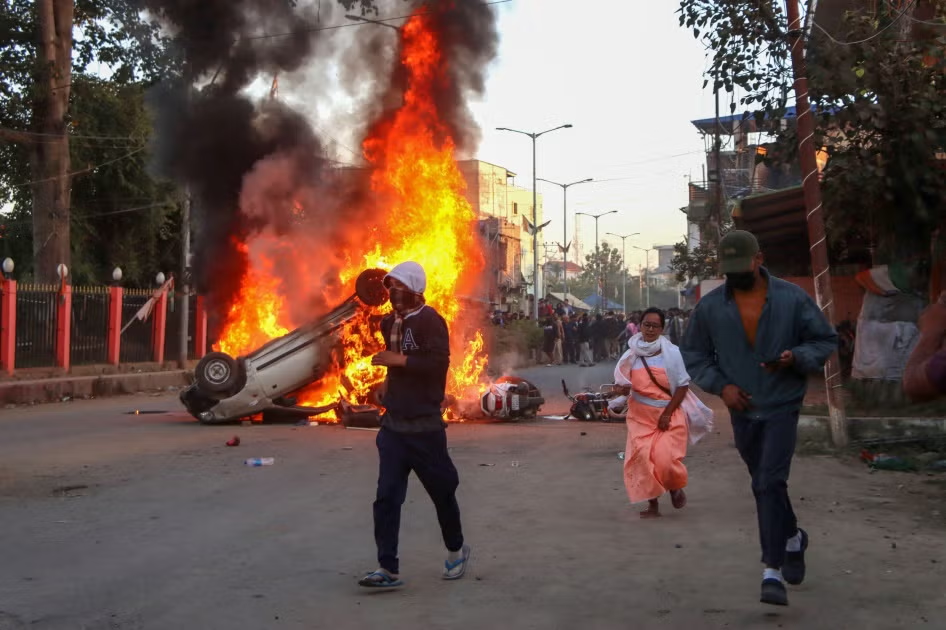
The crisis in Manipur is not merely a regional disturbance confined to India’s northeastern frontier; it is a complex conflict shaped by history, identity politics, governance failures and geopolitical anxieties. Often reduced to an ethnic clash, the crisis is actually a convergence of territorial, political, religious and economic tensions that reinforce one another. At stake is not only peace in a border state but also the credibility of democratic governance and the stability of a strategically significant region connecting South and Southeast Asia.
To understand the present conflict, it is essential to revisit Manipur’s historical trajectory. Before its merger with India in 1949, Manipur existed as an independent kingdom. Colonial administrators institutionalised a divide between the Imphal Valley and the surrounding hill regions through separate systems of governance. This administrative bifurcation deepened territorial and ethnic distinctions that continued after Independence. Over time, the Meitei community, concentrated in the valley, gained political dominance, while tribal groups such as the Kukis and Nagas retained land protections but remained socio-economically marginalised. These asymmetries created a lasting architecture of mistrust in which every policy decision is interpreted through the prism of historical grievances.
The recent demand by the Meitei community for Scheduled Tribe status must be viewed within this broader context. For the Meiteis, the demand represents a search for constitutional safeguards and recognition. For tribal communities, however, it is perceived as a direct threat to land rights and political protections. The issue has evolved into a zero-sum identity contest in which one community’s gain is viewed as another community’s existential loss.
Religion has further complicated the crisis. The Meiteis largely practise Hinduism and Sanamahi traditions, while many Kukis and Nagas follow Christianity because of historical missionary engagement in Northeast India. Although some narratives portray the conflict as religious, this simplification obscures deeper structural problems. Religion today functions more as a force multiplier than a root cause, amplifying existing grievances and transforming cultural identity into political mobilisation.
An important but frequently overlooked dimension is the economic undercurrent of illicit cultivation and trafficking. Manipur’s proximity to the Golden Triangle makes it vulnerable to drug trafficking networks. Poppy cultivation in hill regions has become both an economic survival mechanism and a security concern. For marginalised communities with limited livelihood opportunities, such cultivation is often viewed less as criminal activity and more as an economic necessity. Government crackdowns, while intended to restore law and order, have frequently been perceived as coercive, contributing to a nexus in which poverty, insurgency and governance failures reinforce one another.
Manipur’s geographical location further elevates its significance. Sharing a porous border with Myanmar, the state has been deeply affected by instability following Myanmar’s 2021 military coup. Refugee inflows, cross-border insurgency and trafficking networks have transformed Manipur into a frontier where enforcing national boundaries becomes increasingly difficult. These challenges are compounded by India’s Act East Policy, which seeks to strengthen connectivity with Southeast Asia through projects such as the India-Myanmar-Thailand Trilateral Highway. Persistent unrest threatens these ambitions, turning a strategic gateway into a geopolitical bottleneck.
At the heart of the conflict lies a structural dilemma within Indian federalism: the tension between centralised governance and regional autonomy. Northeast India has historically occupied a peripheral position within the national imagination. Policies framed in New Delhi often fail to resonate with local realities, creating a deep centre-periphery divide. In Manipur, this disconnect is reflected in delayed crisis responses, uneven administrative reach and perceptions of reactive governance. Such conditions weaken institutional trust and allow identity-based mobilisation to replace confidence in democratic structures.
Militarisation has also shaped the region’s political psychology. Laws such as the Armed Forces Special Powers Act have granted sweeping authority to security forces for decades. While justified by the state as necessary for maintaining territorial integrity, many local communities perceive militarisation as coercive. This creates a security paradox in which measures intended to ensure stability deepen insecurity and mistrust.
Geography itself plays an active role in the conflict. The densely populated Imphal Valley remains politically dominant, while the surrounding hill areas inhabited by tribal communities are geographically larger yet administratively underdeveloped. Land, therefore, becomes more than an economic resource; it symbolises sovereignty, identity and survival. Any policy affecting land rights inevitably becomes a flashpoint. These tensions are intensified by fears of demographic change, particularly following refugee inflows from Myanmar.
The crisis must also be situated within broader Indo-Pacific geopolitics. Northeast India has acquired strategic importance as global attention shifts towards the Indo-Pacific region. Manipur serves as a gateway for India’s regional connectivity ambitions. Instability in the state, therefore, disrupts not only domestic governance but also broader economic and geopolitical strategies. China’s expanding presence in Myanmar adds another layer of strategic complexity, even though there is no direct evidence connecting China to the conflict.
Another defining feature of the conflict is the battle of narratives. Social media platforms have accelerated the spread of information as well as misinformation, creating a post-truth conflict environment. Competing communities construct rival narratives, each reinforcing its own sense of victimhood and legitimacy. Viral misinformation often outpaces official clarification, fuelling anger and polarisation.
Beyond physical destruction, the crisis has caused profound psychological trauma. Children growing up amid violence internalise fear and mistrust, perpetuating cycles of hostility through memory and lived experience. Environmental degradation further intensifies tensions, as deforestation and changing ecological patterns increase competition over land and resources.
Resolving the Manipur crisis requires more than temporary security measures. Sustainable peace demands inclusive dialogue, equitable development, institutional trust-building and stronger regional cooperation with Myanmar. A purely security-centric approach may suppress violence briefly but cannot address the deeper structural causes.
Ultimately, Manipur is more than a conflict zone; it is a mirror reflecting the vulnerabilities of modern nation-states. Historical grievances, identity politics, economic marginalisation and geopolitical anxieties have converged into a crisis that defies simplistic solutions. The challenge is not merely to restore order but to transform the conditions that sustain instability. Manipur, therefore, stands both as a warning about the dangers of polarisation and as an opportunity to rethink how plural societies can coexist through justice, trust and a shared sense of belonging for generations.
(Dr Shrabana Chattopadhyay is an assistant professor of law (IIIJS) at University of Engineering and Management, Kolkata; Prithwijit Chakraborty is an assistant professor of English at the same institution)

