


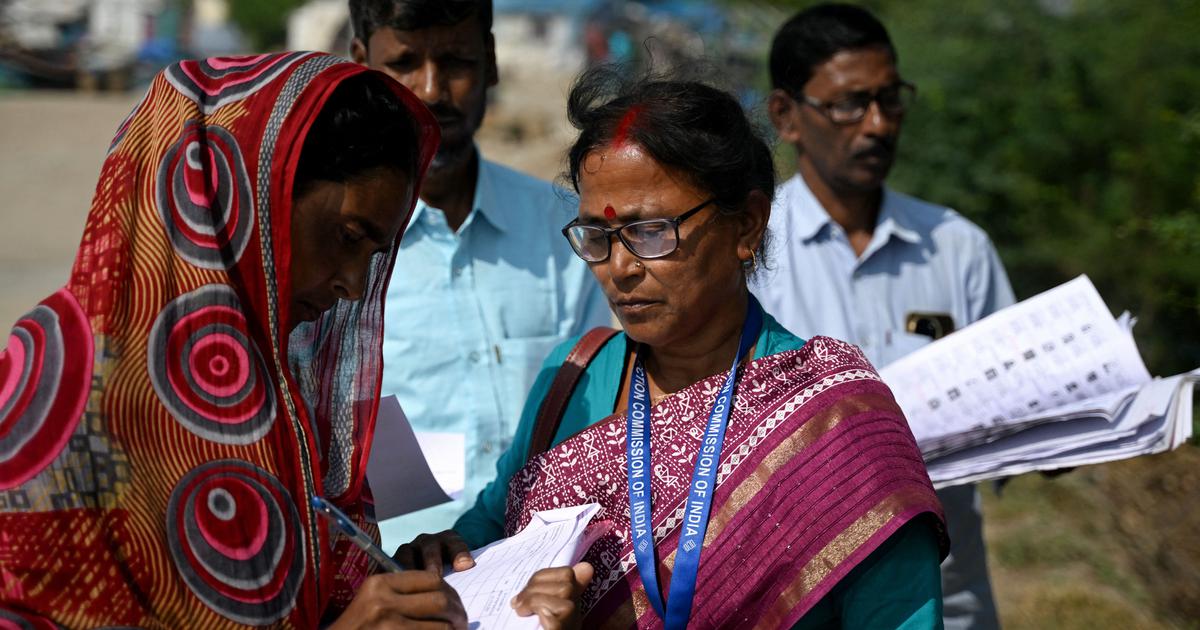
The Special Intensive Revision (SIR) of electoral rolls in West Bengal has exposed not merely administrative rot but a deeper, more disturbing truth: the systematic corrosion of democratic processes in a state where elections have long ceased to be a neutral civic exercise and have instead become a carefully choreographed spectacle of manipulation.
As the Election Commission of India (ECI) releases the draft electoral rolls, the findings are nothing short of grotesque. Minors listed as fathers. Underage mothers recorded as heads of households. Voters with implausible ages, duplicated identities, missing addresses and fictitious family trees. These are not clerical errors scattered at the margins. They are structural distortions—symptoms of an electoral machinery that has been deliberately bent out of shape.
In any functioning democracy, such revelations would trigger alarm, accountability and corrective urgency. In West Bengal, they have triggered something else entirely: denial, obstruction and political belligerence.
Voter List as a Political Weapon
Electoral rolls are meant to be neutral registers of citizenship. In West Bengal, they have become political instruments—sharpened, manipulated and deployed with ruthless efficiency. For years, opposition parties and civil society groups have alleged mass enrolment of illegal voters, selective deletions, ghost entries and cross-border additions, particularly in border districts and politically sensitive constituencies.
The SIR was meant to address precisely these concerns. Instead, it has laid bare how deeply compromised the system already was—and how fiercely the state government intends to protect that compromise.
The Trinamool Congress (TMC) administration’s response to the SIR has not been one of cooperation but confrontation. Booth-level officers have reportedly faced intimidation. Verification teams have encountered stonewalling. Political leaders have openly questioned the ECI’s motives, framing routine electoral hygiene as a sinister conspiracy against the state’s “federal rights”.
This is a dangerous inversion of democratic logic. When a government treats the cleansing of voter rolls as an act of political hostility, it inadvertently admits that electoral impurity is integral to its survival.
Bizarre Data, Sinister Implications
The bizarre statistics emerging from the draft rolls would be laughable if their implications were not so grave. A voter list that cannot distinguish between a child and a parent cannot be trusted to distinguish between a citizen and an impostor. A database riddled with biological impossibilities signals administrative collapse—or worse, wilful fabrication.
Such distortions do not occur accidentally, nor do they accumulate without protection. Electoral data is generated, verified and updated through layers of local administration. In West Bengal, that administrative chain has long been accused of functioning as an extension of the ruling party’s political machinery.
SIR has simply pulled back the curtain
What is particularly troubling is not that the ECI has found irregularities—irregularities exist in many states—but the scale, absurdity and defensiveness surrounding them in West Bengal. The louder the protest against scrutiny, the stronger the suspicion that scrutiny threatens entrenched interests.
Non-Cooperation as State Policy
The West Bengal government’s posture towards the ECI has crossed from scepticism into outright defiance. Public statements questioning the Commission’s authority, insinuations of partisan bias, and administrative foot-dragging have become routine.
This is not mere political rhetoric. It is institutional sabotage.
The ECI is constitutionally mandated to conduct free and fair elections. When a state government actively undermines that mandate, it is not protecting democracy—it is hollowing it out. Federalism does not grant states the right to manipulate voter rolls. Autonomy does not extend to manufacturing electorates.
The irony is stark: a government that routinely invokes democracy to legitimise its rule appears deeply uncomfortable with the basic democratic act of verifying who is entitled to vote.
ECI’s Toughest Test
There is little doubt that West Bengal represents the ECI’s most formidable challenge. Not because the state is uniquely complex, but because resistance to reform here is uniquely aggressive. Electoral reforms elsewhere face inertia; in West Bengal, they face organised opposition.
The credibility of the Commission itself is now on the line. If it retreats under political pressure, it will set a catastrophic precedent—not just for West Bengal but for every state where electoral manipulation has become electorally convenient.
A compromised voter list produces a compromised mandate. And a compromised mandate corrodes every institution that flows from it—legislatures, governments, courts and public trust.
Beyond Party Politics
This is not merely a TMC versus opposition issue. It is a democracy versus distortion issue. Today, it may benefit one party; tomorrow, it may be used against another. The principle at stake is foundational: elections must reflect the will of legitimate voters, not the arithmetic of manufactured electorates.
West Bengal’s political culture has already normalised post-poll violence, booth capture and administrative partisanship. Allowing a tainted voter list to persist would be the final surrender—accepting that electoral outcomes are predetermined exercises rather than expressions of popular will.
A Moment of Reckoning
The SIR has created a rare moment of reckoning. The data is out. The anomalies are documented. The excuses are wearing thin. What remains is the will to act.
If the ECI stands firm, cleans the rolls thoroughly and resists political intimidation, it may restore at least a measure of faith in the electoral process. If it falters, West Bengal risks becoming a cautionary tale, a state where democracy exists in form but not in substance.
The jigsaw puzzle is now complete. The question is whether the nation dares to confront the picture it reveals.
(Bikash C Paul is a Delhi-based senior journalist and executive editor of ‘New Delhi Post’)
