

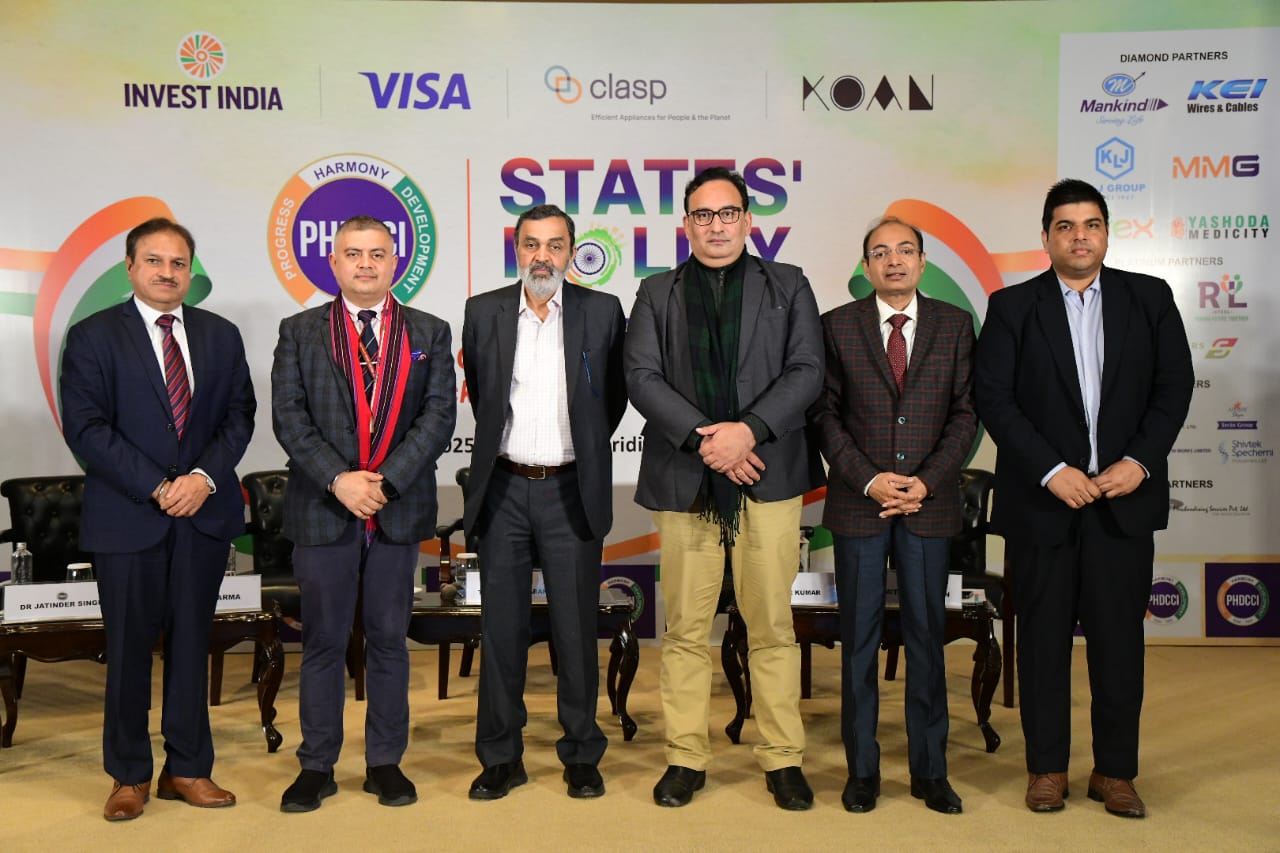
The States’ Policy Conclave 2025 was held under the theme “Navigating Global Challenges with a Fast-Tracked Indian Economy”, drawing senior policymakers, institutional leaders and experts from across the country to deliberate on India’s growth trajectory. The conclave placed strong emphasis on state-led reforms, decentralised governance and inclusive development as central pillars of the Viksit Bharat vision.
The discussions centred on strengthening local governance structures, advancing sustainability, and building resilient institutions capable of responding to both domestic priorities and global disruptions. Speakers repeatedly underscored the need for greater policy coordination between the Centre and states to unlock long-term economic momentum.
Tripurari Sharan, Chief Information Commissioner and former Chief Secretary, Government of Bihar, delivered the keynote address, calling for a decisive empowerment of the third tier of governance. He stressed that local self-government institutions such as panchayats and municipalities remain underpowered despite decades of reform rhetoric.
Drawing on his administrative experience, Sharan observed that urban governance continues to be a weak link across much of India. He argued that meaningful decentralisation requires not merely the transfer of funds, but the delegation of real authority supported by adequate financial and administrative resources.
Using Bihar as a case study, he highlighted how focused investments in infrastructure, particularly roads and rural electrification, along with education, transformed the state’s development trajectory. Bihar’s budget, he noted, expanded from ₹3,000-6,000 crore several decades ago to ₹3.5 lakh crore today, illustrating the impact of policy clarity and prioritisation.
Sharan concluded by emphasising that society ultimately shapes the quality of governance, and that intellectual and institutional capital must guide policymaking to ensure development benefits all sections of society.
Amitabh Ranjan, Registrar, Indian Institute of Public Administration, Government of India, placed India’s growth story within the context of a volatile global environment. He highlighted the challenges of a VUCA world, marked by geopolitical tensions such as Russia–Ukraine-related supply disruptions affecting petroleum, fertilisers and railway imports, alongside the OECD’s projection of global growth slowing to 3.2 per cent.
Despite these headwinds, Ranjan noted that India continues to outperform major economies, driven by Q2 growth of 8.2 per cent and the ADB’s FY26 growth forecast of 7.2 per cent, reinforcing confidence in the Viksit Bharat roadmap towards 2047.
He attributed this momentum to a $1.35-trillion infrastructure push, including Bharatmala’s 34,000-km highway network, with more than half already completed, near-100 per cent rail electrification, and collateral-free MSME credit of up to ₹10 lakh.
On energy security, Ranjan highlighted that 51 per cent of India’s installed capacity is now non-fossil, amounting to 256 GW out of a total 509 GW, comprising 128 GW of solar power and 52 GW each from wind and hydro. He also outlined green hydrogen targets of 5 MT by 2030 and 125 GW by 2047, alongside a nuclear capacity expansion from 8.8 GW to 100 GW under a ₹20,000-crore mission.
India’s digital public infrastructure, he said, has emerged as a global benchmark. UPI is now operational in nine countries, while Direct Benefit Transfers totalling ₹47 lakh crore have yielded savings of ₹3.8 lakh crore by eliminating fake beneficiaries, including 4.15 crore LPG connections and 5.03 crore ration cards, and cutting subsidy leakages to 9 per cent.
Platforms such as DigiLocker, with 61.27 crore users, and DigiYatra further exemplify this digital transformation. Highlighting human capital, Ranjan pointed to India’s 1.44 billion population, with a median age of 29 rising to 37 by 2047, supported by one crore PM internships, large-scale skilling initiatives and 1,000 industry-led ITIs.
“Degrees are for recognition; skills define character,” he remarked, noting that this shift is reflected in defence exports reaching ₹25,000 crore.
Amit Sharma, Director, Census Operations and Citizen Registration, Ministry of Home Affairs, Government of India, shared on-ground experiences from Jammu & Kashmir, Ladakh and Mizoram. He highlighted how digital governance reforms have translated into measurable administrative efficiencies.
He cited the rollout of the e-office system, which enabled 24/7 paperless secretariats in Jammu & Kashmir, eliminated costly file movement between capitals, and ensured 100 per cent paperless operations in Mizoram. Bhashini AI, he added, is helping bridge linguistic barriers amid expanding rail connectivity.
Sharma also made a strong case for launching an “India Lithium Mission”. He highlighted 5.9 million tonnes of high-grade lithium reserves and three additional sites on par with South America’s Lithium Triangle, arguing that these resources could eliminate total import dependence on China, power India’s EV manufacturing push and hasten its ascent to the world’s third-largest economy well before 2028-29.
Highlighting global admiration for UPI, DigiLocker and DigiYatra, Sharma underlined the importance of the first-ever digital, paperless Census, with pre-tests planned in Jammu & Kashmir by 2026, supported by extensive public outreach through local influencers. Accurate post-2011 data, he said, would be critical for evidence-based policymaking.
Rajinder Kumar, Economic Adviser, Ministry of Textiles, Government of India, reaffirmed India’s sustained high-growth performance over the past eight to ten years, as recognised by the IMF, World Bank and ADB, despite geopolitical volatility affecting core sectors such as steel and oil.
He observed that the Monetary Policy Committee has successfully balanced inflation control with interest-rate stability. Turning to textiles, the second-largest employer after agriculture, providing 4.5 crore jobs, nearly 60 per cent held by women, Kumar outlined a series of major policy reforms.
These included GST rationalisation through the removal of inverted duty structures, effectively bringing rates down to 5 per cent and 18 per cent, a move that, despite costing the exchequer lakhs of crores, significantly improved working capital availability for handlooms and handicrafts.
He also highlighted the withdrawal of seven obsolete Quality Control Orders, the reduction of the PLI threshold from ₹300 crore to ₹100 crore, and the establishment of PM MITRA Parks across seven states, including Telangana, Uttar Pradesh and Gujarat, offering integrated infrastructure for farm-to-fibre value chains.
The SMART scheme, Kumar noted, has achieved 82-83 per cent post-training employment, supported by industry-aligned skilling. Export diversification across 40 priority markets, a UK FTA nearing ratification by June, and the guiding principle of “Inform, Perform, Transform” were identified as key growth drivers.
Dr Jatinder Singh, Deputy Secretary-General, PHDCCI, highlighted India’s emergence as the fifth-largest economy, with its global share doubling to 3.4-3.5 per cent since 2000, while sustaining 6.5–7 per cent growth as the world’s fastest-growing major economy, according to the IMF and World Bank.
Despite pandemics, supply-chain shocks, geopolitical tensions and climate disruptions, he emphasised that empowered states remain central to India’s development story. Leveraging federal diversity, competitive patriotism and performance-linked incentives, alongside reforms in infrastructure, labour, energy and ease of doing business, states form the foundation of a resilient and inclusive Viksit Bharat by 2047.
He described this approach as building a “Silk Road” of policies, stitched together through cooperation, reform and state-led innovation.
During the conclave, PHDCCI, in collaboration with Koan Advisory Group, released the “Tech Readiness Index of States” knowledge report, benchmarking states on digital infrastructure, AI adoption and innovation readiness to drive technology-led growth.
As deliberations continue, the conclave has set the stage for deeper discussions on decentralised governance and sharper policy execution at the state level. The emphasis on inclusive growth, institutional capacity-building and targeted resource allocation offers a clear roadmap for states seeking to navigate global uncertainty while accelerating India’s fast-tracked and equitable development journey.