

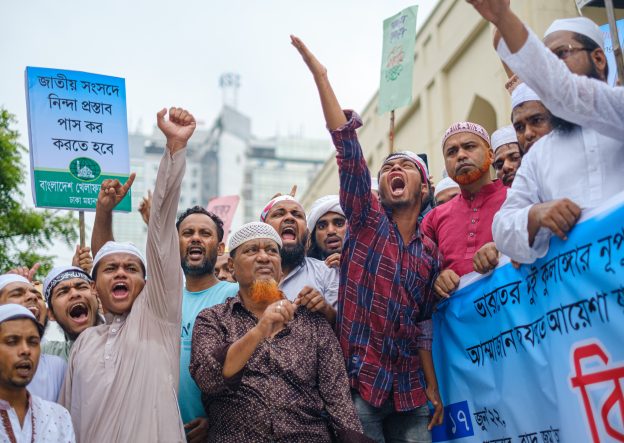
In the aftermath of the July 2024 uprising that toppled the Sheikh Hasina government, Bangladesh has become a volatile tinderbox.What began as a street revolt has left behind a fractured nation: politically adrift, ideologically combustible and increasingly infiltrated by Islamist forces. Beneath the chaos, foreign powers — from Pakistan and Turkey to China and the United States — are testing the waters, each seeking a foothold in a country now teetering between instability and radical transformation. For India, the implications are a growing security nightmare.
- Borders of Deceit
Indian dossier exposes terror networks using Bangladesh as a safe rear
The unheralded arrival of an Indian Military Intelligence (MI) team, led by Major General Kundan Kumar Singh, in Bangladesh last month was no routine courtesy call. The team’s mission: forge deeper ties on intelligence sharing and counter-terrorism, amid inputs that Bangladeshi soil is once again breeding threats to Indian borders. According to sources within regional security circles, the delegation arrived carrying credible evidence of extremists’ activities originating from Bangladesh.
The MI team conveyed urgent concerns over the resurgence of extremist cells in the border zones, emphasising the need for proactive surveillance and cross-border collaboration. On the ground, the team toured fortified military perimeters in Lalmonirhat and Thakurgaon districts that border West Bengal, underscoring the tangible risks in these porous areas. At Lalmonirhat, the team reportedly inspected an old airfield being upgraded — complete with a new aircraft hangar and fortified perimeter walls. Defence insiders say the work suggests preparation for advanced aircraft, potentially replacing Bangladesh’s aging J-7 fleet. “This is no longer a sleepy frontier,” a senior Indian officer observed. “It’s becoming an arena of strategic signalling.”
At the centre of the exchange lay a 58-page intelligence dossier, a chilling account of shadowy terror networks spreading in Bangladesh. The dossier identified 12 Islamist outfits active in or from Bangladesh, detailing their finances, recruitment patterns and links to Pakistan-based handlers and global jihad networks. Maps and satellite images traced the flow of arms, madrasa networks, online channels and terror financing links to Pakistan and the Middle East.
Per Indian assessments, these groups weave a “multi-layered ecosystem” to harm India: from radicalising students and migrant workers to laundering funds via religious charities and digital wallets. The dossier outlined how these networks provide safe houses and forged documents to separatist groups in India’s Northeast, while funnelling weapons through the Bay of Bengal, Chattogram port and Myanmar’s conflict zones. It also warned that these groups, rooted either in Bangladesh or tied to Pakistan-based networks, are waging “low-intensity destabilisation” campaigns rather than open warfare.
Sources said New Delhi’s advice to Dhaka was blunt: intensify cyber-surveillance, monitor madrasas and charities and launch joint intelligence missions. Dhaka pledged renewed vigilance against cross-border militancy, vowing to prevent anti-India activity. Yet, the Indian tone carried an undercurrent of steel: no direct threats, but a firm reminder that “negligence” could force unilateral Indian action to secure its frontiers. This was less a sabre-rattling and more a calibrated nudge: India expects results, not rhetoric.
- The New Jihad Belt
Post-Hasina, Pakistan-Turkey-Bangladesh proxies exploit Dhaka’s chaos to build an eastern terror corridor
Since Sheikh Hasina’s exit in 2024, power in Bangladesh has fragmented between a nominal interim government led by Nobel laureate Muhammad Yunus and a swelling tide of Islamist assertiveness. The balance of power in Bangladesh is shifting, not only politically but also ideologically.
The first and most visible arena of change is religious infrastructure. Mosques, madrasas and Islamic charities have multiplied across Bangladesh. Many play benign social roles; others have evolved into quiet hubs of radical preaching and silent recruitment. Select preachers weave anti-India, anti-West narratives, posing secularism as an existential threat to Islam.
The second layer of penetration lies within education. Islamist student groups now exert significant influence over unions, faculty and curricula in universities. A generation of students is being brainwashed into an ideology that rewards religious identity over national pluralism. Campuses are now a training ground for ideological alignment, based on religious outrage and paranoia.
Digital platforms have emerged as the third theatre of ideological expansion, where YouTube clerics, Facebook influencers, and TikTok preachers fuse politics with faith, spreading messages of Muslim persecution, Western hypocrisy, and Indian domination.
At the grassroots, Islamist consolidation is even more alarming. In rural and semi-urban Bangladesh, imams, madrasa heads and local clerics control the local power structure and increasingly hold greater moral authority than elected leaders. This silent transfer of grassroots legitimacy, from political to religious leadership, is gradually eroding Bangladesh’s democratic core.
The result is obvious: local franchises of Al-Qaeda and ISIS have resurfaced, while the banned Hizb ut-Tahrir has reappeared in public spaces. Jamaat-e-Islami, Bangladesh’s oldest Islamist organisation, is expanding its reach across campuses, mosques, and Rohingya refugee camps.
Compounding this threat is the steady inflow of arms and explosives through porous borders, maritime routes and criminal smuggling networks occasionally linked to regional actors, including Pakistan-based suppliers. Documented arms seizures inside Bangladesh point to foreign supply lines and organised trafficking syndicates spanning South and Southeast Asia.
Small arms and explosives are entering through the Bay of Bengal, a long-standing smuggling corridor. Intelligence sources and port authorities have flagged suspicious shipments near Chattogram, with some reports suggesting consignments from Pakistan, disguised as legitimate cargo or fishing vessels, later distributed inland through intermediaries.
To the southeast, Myanmar’s lawless borderlands have become key supply points. Smuggling networks tied to the Arakan Army and other armed groups use remote hill tracts and border villages inside Bangladesh for storage and transit. These operations often involve local criminal groups and extremist intermediaries, adding a dangerous dimension to regional security.
Arms from Myanmar’s conflict zones are repackaged and moved through the Chittagong Hill Tracts, Cox’s Bazar, Bandarban, and the Naf River corridor, feeding the domestic black market. The result is a transnational network linking Pakistan’s proxies, Myanmar’s militias, and Bangladesh’s traffickers, creating a potential jihadist conduit on India’s eastern flank.
No player understands this better than Pakistan’s Inter-Services Intelligence (ISI), said a Dhaka-based analyst. Since the 1980s, the ISI has viewed political Islam in Bangladesh as a strategic lever to undercut India’s influence. ISI networks, operating through Jamaat-linked charities and NGOs, have revived old channels to fund and coordinate these groups.
Security agencies report a surge in cross-border recruitment, funding inflows and ideological mobilisation. The ISI has cultivated ties with radical clerics, financed Islamist student bodies and spread propaganda via sympathetic media. Intelligence sources in Dhaka and Delhi cite regular fund transfers from Pakistan-based charities and front organisations.
The ISI’s tactics involve grooming local intermediaries, exploiting religious grievances and fuelling anti-India sentiment. Intelligence reports indicate that ISI-linked Bangladeshi handlers are recruiting Rohingya refugees and ARSA militants, turning UNHCR-run camps in Cox’s Bazar into potential jihadist incubators.
The situation is further complicated by the entry of a new external player: Turkey. Under President Recep Tayyip Erdogan, Ankara has sought to project itself as the political and moral leader of the Muslim world. In Bangladesh, this ambition manifests through religious NGOs, cultural diplomacy and defence cooperation. Intelligence reports suggest that Ankara’s powerful spy agency, the Milli İstihbarat Teşkilatı (MIT), has been quietly funding and aiding Islamist groups, most notably Jamaat-e-Islami. Also, the cooperation is being increasingly militarised. Bangladesh today ranks as the fourth-largest buyer of Turkish weapons, importing Bayraktar TB2 drones, TRG-300 rockets, and Otokar Cobra-II armoured vehicles. More significantly, two Turkish-funded defence complexes are under construction in Chittagong and Narayanganj, backed by soft loans, tax exemptions and investment guarantees. Officially, these are joint ventures for technology transfer and industrial modernisation; unofficially, they serve as beachheads for Turkey’s strategic entrenchment in South Asia.
Security experts warn that an Islamist axis of Pakistan, Turkey and Bangladesh is reshaping South Asia’s strategic order. Pakistan’s ISI provides the operational core, Jamaat-e-Islami the ideological base, and Turkey the diplomatic and financial cover. Their shared goal: challenge India’s influence and revive a narrative of “Islamic resurgence” across the Bay of Bengal. Ankara’s sophisticated propaganda machinery, combined with the ISI’s covert networks, is amplifying pan-Islamic narratives that resonate deeply in Bangladesh’s volatile political landscape.
For India, long reliant on Dhaka as a regional stabiliser, Bangladesh’s transformation poses a looming security challenge. The threat is not of conventional warfare but of an emerging “ideological corridor” of Islamist radicalisation along the eastern frontier. This shift carries serious strategic implications for New Delhi, demanding vigilance beyond traditional defence frameworks.
The real battle now unfolds in classrooms, mosques, and digital spaces where Pakistan’s covert networks intersect with Turkey’s neo-Ottoman ambitions. China hedges with ports; the army, spooked by “Indian coercion” whispers, courts all comers sans invasion panic. Washington’s playbook? Strategic perch in the Indo-Pacific, garment leverage, and “democracy” as dipstick.
Bangladesh is no longer merely facing a domestic political churn but witnessing the construction of an ideological bridgehead capable of reshaping South Asia’s strategic landscape. Bangladesh isn’t just unstable; it’s a “geopolitical laboratory,” where powers experiment at India’s expense.
As one analyst warned, “This is not about troops or tanks. It’s about minds.” If left unchecked, the ideological seepage from Dhaka’s shifting landscape could open a new frontier of hybrid warfare — one fought through belief, identity, and influence rather than military might. In this volatile tableau, India’s MI dossier is a clarion: vigilance now, or regret later. As borders blur and ideologies ignite, South Asia’s peace hangs by threads of trust—threads Dhaka and Delhi must weave together, lest extremists unravel them all.
Inside the Files: How Indian Military Dossier Maps Bangladesh’s Rising Radical Web
Homegrown Cell
Jamaatul Mujahideen Bangladesh (JMB)
-Bangladesh’s most notorious terror group
-Behind coordinated nationwide bombings
-Operates along the north-western border with India
Neo-JMB
-ISIS-inspired splinter group of JMB
-Recruits and radicalises youth through social media, apps
Harkat-ul-Jihad-al-Islami Bangladesh
-Veteran jihadist outfit
-Long-standing links to Afghan, Pakistani groups
Ansar al-Islam
-Al-Qaeda proxy
-Urban-centric, ideologically driven
-Responsible for assassinations of secular bloggers, activists
Hizb-ut-Tahrir Bangladesh
-Part of transnational Islamist movement
-Deep presence in universities and professional circles
Allahr Dal
-Smaller but vocal extremist group
-Active in anti-state, anti-India propaganda through underground sermons
Shahadat-e-al-Hikma
-Previously engaged in subversive activities
-Now dormant but under close watch
Jama’atul Ansar Fil Hindal Sharqiya
-New militant outfit
-Runs training camps and local terror cells
-Active in the Chittagong Hill Tracts, now a key hotspot for Indian agencies
Cross-Border Conduits
Lashkar-e-Taiba
-Funds and trains South Asian terror cells
-Maintains covert networks in Bangladesh
Jaish-e-Mohammed
-Engages in cross-border recruitment and anti-India propaganda
-Shapes jihadist discourse in the region
Tehrik-i-Taliban Pakistan
-Active in Pakistan frontier
-Influences Bangladeshi extremists through online radicalisation
Islamic State (IS/ISKP)
-Global jihadist brand
-Propaganda-driven, inspires self-radicalised micro cells across Bangladesh
Nature of Activities (As Reported by Indian Agencies)
- Recruitment & Indoctrination: Via social media, online sermons, encrypted chat rooms
- Financing & Logistics: Through hawala networks, sympathetic NGOs, informal trade routes
- Operational Footprint: North-western Bangladesh, Dhaka outskirts, Chittagong Hill Tracts
- Targets: Secular voices, minorities, Indian interests, security forces
(Abul Hasnat Milton is a Bangladeshi-born Australian political analyst and author)