

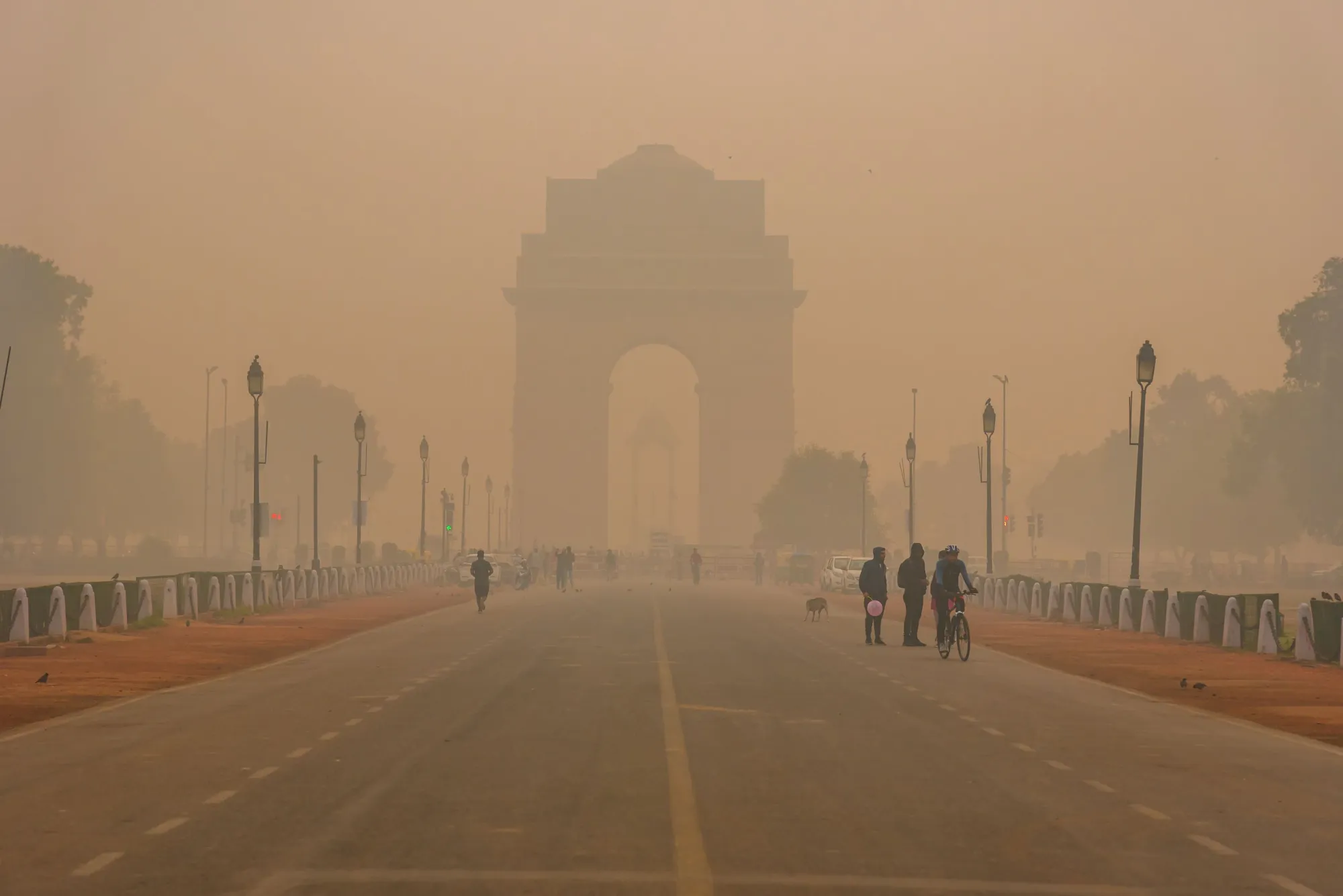
Delhi and the National Capital Region (NCR) experienced the season’s first severe smog episode during Diwali in October this year. Since then, the air quality trend has remained consistently high in the poor to very poor category of the air quality index. Pollution is rising even when the contribution of seasonal farm fires to Delhi’s air quality has stayed below 1-2 per cent. This signals an overpowering influence of local and regional sources of pollution that require urgent control.
Every winter, when cool and calm weather conditions trap dangerous levels of air pollution close to the ground, policy discourse shifts into temporary and emergency combat mode to seek short-term relief by stopping old vehicles and trucks, closing construction, sprinkling water and sweeping roads, dousing waste fires, or resorting to wasteful and ineffective solutions like outdoor air purifiers and artificial rain that do not work.
What gets neglected in the process is the year-round action needed in each sector to cut emissions at the source for a more durable improvement in air quality over time.
Delhi’s battle with air pollution is complex. It is not a simplistic narrative to say nothing has been done so far. On the contrary, Delhi’s fight against air pollution is more than two decades old and has led to significant interventions from the Supreme Court and governments.
A range of actions has been taken to cut the use of toxic diesel fuel in vehicles while simultaneously leapfrogging to more advanced emission standards of Bharat Stage VI to clean up tailpipe emissions. The entire public and local commercial transport fleet has moved from diesel to compressed natural gas, and environmental compensation charges have been imposed on each truck entry, the purchase of large diesel cars, and on every litre of diesel fuel sold in the city. In Delhi, the efforts have reduced diesel fuel consumption by about 46 per cent between 2014 and 2022.
Also, all thermal power plants have been closed, and the use of natural gas in legal industrial areas has expanded substantially. Delhi’s approved fuel list has banned all dirty fuels, including coal, furnace oil, and pet coke, across all sectors.
All these measures together have bent the long-term pollution curve in Delhi. Yet, despite this downward trend, the annual average levels of PM2.5 still require a further 60 per cent reduction to meet the National Ambient Air Quality Standards.
There is little clarity about what it will take to achieve a significant reduction in pollution to meet clean air benchmarks. Emission source inventories and source apportionment studies have identified vehicles, industry, waste burning, construction, household use of solid fuels, and dispersed dust sources, among others, as key contributors to the pollution load.
Clean air action plans are in place, including the one directed by the Supreme Court in 2018 and the Clean Air Policy of the Commission on Air Quality Management (CAQM) in 2022. They lay out a detailed roadmap and clear guidelines for sectoral interventions to strengthen infrastructure, upgrade systems, and enhance service levels for sustained emission reduction.
Yet, every winter, when temporary measures hog attention, there is barely any assessment of progress against the stated sectoral targets, or whether adequate strategies and resources have been planned for systemic reforms. Clean air solutions offer an opportunity not only to mobilise additional resources for pollution control but also to enable convergence of sectoral schemes and investments to deliver on clean air objectives. But this mainstreaming of action across all sectors and departments has remained far from adequate.
Going forward, clean air targets require a massive clean energy transition in transport, industry, and households, including the move towards zero tailpipe emissions. It requires a mobility transition to scale up integrated public transport systems to reduce the explosive growth in vehicle numbers, and a circular economy approach to close the loop around all waste streams through recycling and material recovery to prevent burning and emissions. However, the targets for each of these sectors need to be adequately defined to assess infrastructure requirements and to reform systems and policies for adequate investment.
Therefore, major gaps in action remain across key sectors. For instance, in the transport sector, the current level of fleet electrification for zero tailpipe emissions is very low; public transport services and walking and cycling infrastructure are still grossly inadequate to meet the Master Plan target of 80 per cent of travel demand by public transport. The city has continually shied away from adopting vehicle restraint measures.
The industrial sector requires a clear strategy to control the use of polluting fuels and technology in a large number of industrial units in the periphery and non-conforming areas.
Similarly, despite the Swachh Bharat Mission’s target to attain 100 per cent waste segregation, recycling, and remediation of legacy waste by 2026, action continues to fall short. On the other hand, a large number of poor and migrant households still rely on solid fuels for cooking and heating.
Often, the “action taken reports” submitted by state governments are little more than loose listings of activities, without an assessment of the gaps between action and targets. This limitation shows up every winter when the city is forced to resort to only emergency measures.
Delhi cannot wage this battle against pollution in isolation, as each winter the entire Indo-Gangetic Plain (IGP) turns dark red when cool, still weather conditions trap a dense blanket of pollutants. Atmospheric changes, slower wind patterns, and intense emissions from regional sources lead to massive pollution build-up in this vast, landlocked region of northern India.
This demands upscaling action across the region to minimise the regional influence on local air quality through interstate coordination, multi-sectoral interventions, and committed implementation to meet clean air targets.
(Anumita Roychowdhury is the executive director, research and advocacy, at the Centre for Science and Environment)