


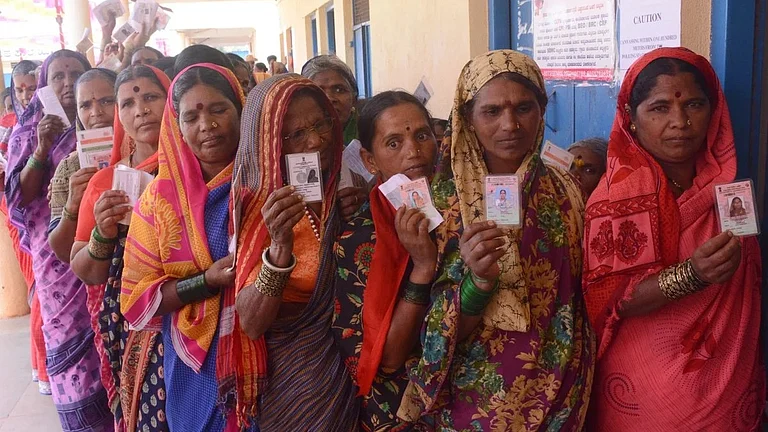
Bihar is heading into yet another election that looks less like a contest of ideas and more like an auction of promises. This time, the bidders are chasing the state’s most decisive constituency: its women.
In recent years, women in Bihar have quietly altered the state’s political arithmetic. They vote in greater numbers than men, carry the memory of state-backed self-help groups, and weigh the price of everyday essentials far more seriously than the slogans that fill the airwaves. Every major political alliance knows it. The result is an election narrative built almost entirely around the language of subsidies, cash transfers, and instant relief.
But beneath the drumbeat of welfare lies a harder truth: Bihar, like much of India’s federal system, is running out of fiscal space to pay for this generosity.
The great welfare race
The ruling NDA, led by Nitish Kumar and the BJP, has framed its campaign as one of empowerment, not entitlement. Its flagship pledge — to create one crore ‘Lakhpati Didis’ — aims to lift women into the small-enterprise economy through self-help groups and credit support. The idea is noble: income through work, not dependency.
The alliance’s manifesto reads like a social compact — free education for girls up to post-graduation, free electricity up to 125 units, ₹5 lakh in health coverage, and 50 lakh new homes, most of them earmarked for women-headed families. It is the familiar Nitish model, built on microfinance, welfare plumbing, and bureaucratic discipline.
The opposition Mahagathbandhan — the INDIA bloc led by Tejashwi Yadav’s RJD and the Congress — has chosen a different path. It is offering cash now. Its Mai Bahin Maan Yojana promises ₹2,500 a month to vulnerable women, a one-time ₹30,000 transfer on forming the government, and permanent jobs with ₹30,000 monthly salaries for Jeevika Didis. Add subsidised ₹500 gas cylinders, free plots for landless women, and interest-free loans, and you get a welfare architecture that would make even Tamil Nadu look frugal.
Each alliance has found its vocabulary. The NDA talks of empowerment. The Mahagathbandhan speaks of dignity. But both are communicating through the same medium: subsidies.
The fiscal backdrop no one talks about
The State of State Finances 2025 report by PRS Legislative Research paints a sobering picture. Indian states, it says, collectively spend 62% of their revenue receipts on salaries, pensions, and interest payments, and another 9% on subsidies. That leaves little for capital investment.
The same report notes that the number of states running unconditional cash transfers for women has jumped from two in 2022–23 to twelve in 2025–26, with a combined bill of ₹1.68 lakh crore — roughly half a per cent of India’s GDP. Six of those twelve states already report revenue deficits. In plain language, they are borrowing just to keep paying for their welfare schemes.
Bihar’s fiscal base is among the narrowest in India. Its dependence on central transfers — more than half its total revenue — leaves it exposed to political discretion in Delhi. It also means that every rupee spent on freebies eats into future investment. The Reserve Bank of India’s 2024 report was blunt: “The sharp rise in expenditure on subsidies and cash transfers to farmers, youth, and women can cause stress to state finances.”
Those words could well have been written with Bihar in mind.
When economics meets politics
If the Mahagathbandhan’s ₹2,500 monthly cash promise reaches even half of Bihar’s adult women, the cost would exceed ₹60,000 crore a year. That is nearly a fifth of the state’s entire budget. The NDA’s own welfare commitments — free ration, power subsidies, healthcare, and SHG financing — would add several more percentage points to revenue expenditure.
And yet, both camps see the gamble as worth taking. Bihar’s per capita income remains about a third of the national average. Formal employment opportunities are scarce. For millions of women managing households on uncertain daily wages or remittances, ₹2,500 a month is not politics; it is survival.
Economists may call it fiscal imprudence; politicians call it empathy. And between those two words lies the emotional core of this election.
Nitish Kumar insists that his Lakhpati Didi scheme is about creating capacity. “Permanent income comes from skills, not from cash that disappears in a month,” he told a rally recently. Tejashwi Yadav sees that as moral posturing. “Women don’t need lectures; they need respect,” he said, promising that his government would “put money directly into their hands.”
Both are right — and both are wrong. Bihar does need to empower women through skills and work. It also needs to recognise the unpaid care burden they carry. But the way the debate has been framed — one side offering loans, the other cash — misses the larger question of how to build lasting fiscal and social foundations for women’s advancement.
A shrinking space for real development
The PRS report’s deeper warning is not about subsidies themselves but about what they displace. States are spending more on maintaining welfare schemes and less on building roads, irrigation systems, and schools. In Bihar, the share of capital outlay in total spending has fallen even as welfare allocations have ballooned.
The danger is not theoretical. Once a benefit is announced, it becomes politically impossible to roll it back. Tamil Nadu’s decades of free electricity and rice subsidies began in the same spirit — to uplift the poor. They have since hardened into entitlements that no government dares touch, even as fiscal deficits swell.
Bihar risks walking the same path — without the industrial or revenue base that sustains southern welfare models. The difference between an investment and a handout is not always moral; it is mathematical.
The representation paradox
Ironically, even as women dominate the manifestos, they remain marginal on the candidate lists. The NDA has fielded 35 women (about 14% of total seats) and the Mahagathbandhan 29. The Jan Suraaj Party, founded by Prashant Kishor, is the lone exception — pledging 40% of tickets for women and focusing on governance reforms rather than new subsidies.
It is a lonely, long-term bet. Political empowerment rarely yields instant votes. But structural representation, if sustained, can do more for women than cash transfers ever will.
Between compassion and credibility
There is no denying the moral case for supporting women in a state where labour participation among them is below 10%. But compassion cannot replace credibility. A government that borrows to fund its giveaways ends up eroding the very development it claims to protect.
The tragedy is that Bihar’s debate on women’s empowerment has been reduced to arithmetic — ₹2,500 versus ₹2 lakh loans, 200 units of free power versus 125. Lost in that accounting is the idea of creating real agency: quality education, safer workplaces, and institutional equality.
Empowerment built on subsidies is like a house built on borrowed bricks — solid for a season, unsustainable for a generation. Bihar has seen enough of those houses collapse before.
A closing thought
When a woman in Begusarai says, “Pehle hum vote dete the, ab vote maangne wale humein dete hain” — earlier we gave votes, now those seeking votes give to us — it captures more than irony. It captures a quiet assertion of power that India’s politics can no longer ignore.
The challenge for whoever wins Bihar next week is not to end subsidies overnight, but to use them as stepping stones to something sturdier. Women’s empowerment should not have to live or die with every manifesto. It deserves a permanent place in policy, not merely in campaign poetry. (5WH)

