


K V Rajan
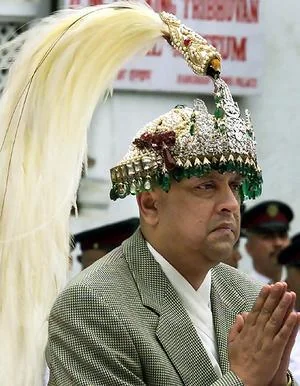
In recent months, Nepal has been witnessing growing public sentiment for the revival of monarchy and restoration of its formal Hindu identity–thereby challenging the historic transformation that followed the end of the 10-year long Maoist insurgency and mainstreaming of the Maoists into the democratic polity, which culminated in the declaration of Nepal as a secular federal democratic republic.
As of now, this agitation is driven entirely by public frustration. People are disillusioned with the collective failure of political parties to meet even the minimum expectations of governance and inclusive development. There is widespread anger over rampant corruption and blatant displays of greed for power among a handful of ageing political leaders who have been taking turns to become the prime minister in unstable coalition governments.
Despite the growing signs of nostalgia for the monarchy, its return currently appears somewhat unlikely. However, this could change, given the evolving geopolitical trends in the region.
Three countries would be following developments on this front with special attention: India, China and Pakistan.
Traditionally, China has been a supporter of monarchy because it perceived the institution as being wedded to strategic autonomy and opposed to being in India’s sphere of influence.
India’s fluctuating relationship with the monarchy was largely shaped by that very perception. In addition, India frequently expressed support for a healthy multi-party democracy–something neither King Mahendra nor his successors favoured.
India did not sufficiently account for the fact that the monarchy’s posture, particularly its frequent use of the ‘China card’, was largely a response to India’s aggressive promotion of democracy. Instead, India somewhat misread this behaviour as a strategic and irreversible anti-Indianism, which it was not. The Kings of Nepal, due to deep religious, familial and cultural ties with India, were incapable of being anti-India in the way that the Maoists and far-left parties have often demonstrated. At the same time, the monarchy failed to grasp a core reality: that India, despite its size and power, was a highly insecure country. It tended to interpret Nepal’s displays of strategic autonomy as tilting towards China, often incorrectly, as a threat to its regional advantage.
In other words, many of the misunderstandings that periodically strained India-Nepal relations could have been avoided with better mutual understanding between New Delhi and the Nepali monarchy.
When King Birendra gave up absolute power and agreed to become a constitutional monarch following an India-backed mass agitation against him in the late 1980s (Janandolan 1), China was left confused as the pro-India Nepali Congress party emerged as the most popular party and came to power with a clear majority.
But within a few years, the opposition Communist Party of Nepal (Unified Marxist-Leninist), or CPN (UML), stirred a wave of anti-India sentiment over the Tanakpur barrage. Although the barrage was built on Indian territory, it used a small portion of Nepali land–an issue the UML capitalised on politically. The China card was back in play. In the 1994 election, the UML won the most seats and formed a minority government. Prime Minister Manmohan Adhikari signalled a shift in foreign policy by expressing a desire to end Nepal’s special relationship with India, and, breaking with tradition, expressed a desire to visit China before India on his first official trip.
The Maoist insurgency, which began in 1996, was inspired by China but not favoured by it, as it continued to back the monarchy. It watched while India’s relations with the monarchy and Nepal improved dramatically under India’s twin-pillar policy of supporting both the monarchy and democracy.
Nepal-Pakistan relations during this phase grew strained because the Pakistan Deep State (Army, ISI, government and the smuggling-terrorism nexus) began large-scale systematic use of the open border with India and the mosques and madrasas along the border for activities aimed against New Delhi. The monarchy had deep misgivings about possible moves to dilute Nepal’s Hindu identity, and the Pakistan Deep State, in turn, felt uncomfortable at the repeated exposures of its activities relating to the smuggling of counterfeit currency and arms, with the monarchy discreetly using its influence to curb them.
Today, the overall situation has become even more complex and serious in terms of challenges to India’s security. China is no longer a passive spectator feigning neutrality in, for example, India’s relations with Nepal or Pakistani mischief against India.
In the post-Pahalgam situation, India must contend with the sobering reality that a prolonged two-front conflict with Pakistan and China may already be underway. Within this strategic context, regional developments, such as the theoretical possibility of the restoration of Nepal’s monarchy and reasserting its identity as a Hindu state, take on renewed significance. While India’s official stance of non-interference is prudent, Nepal, as a Hindu Monarchy, even with the King as constitutional monarch, may be a more reliable and reassuring factor than Nepal as a fragile democracy amenable to Chinese influence and with a laissez-faire attitude to China’s proxy Pakistan. The Maoist and UML leadership have sometimes indulged in a kind of reckless nationalism that conveniently aligns with Chinese strategic interests, particularly by fueling anti-Indian sentiment. A striking example is the Kalapani border dispute, during which the Nepalese Parliament passed a unanimous resolution asserting territorial claims over the disputed areas, including some never claimed before. This expanded territorial map has since been printed on 100-rupee banknotes, effectively embedding a mechanism for generating anti-Indian feelings amongst the populace at will. The action has rendered the border dispute politically intractable and now stands as a persistent source of bilateral tension.
In the emerging context, China may be less enthusiastic about the revival of Nepal’s monarchy, while India may become increasingly ambivalent about supporting a monarchy-less democracy mired in an endless transition, marked by chronic political instability and dominated by extreme leftist leaders. It is hardly reassuring that, even as India and Pakistan exchanged sharp words in the wake of the Pahalgam terror attack, Nepal was hosting a high-level delegation of the Pakistani army.
India should maintain open channels of communication with all parties in Nepal, including those advocating for the restoration of the monarchy and a Hindu state. It must also be prepared to adapt its twin-pillar policy if the people of Nepal opt for the return of the monarchy in some form.
(The author is a former Secretary in the Ministry of External Affairs and former Ambassador to Nepal)
