

The group’s aluminium ambitions collide with tribal rights and forest protection
Early in July this year, the Adani Group announced the broad contours of its ambitious plans to develop a greenfield aluminium project in Odisha. As per the announcement, the conglomerate will jointly develop its project with International Resources Holding, which is a part of the Abu Dhabi-based IHC Group, and channel an investment of more than Rs 1 lakh crore. The company described it as “India’s largest foreign direct investment in the metallurgy sector”.
The unprecedented scale of investment will go towards setting up, among other facilities, a 4 million metric tonne per annum (MMTPA) alumina refinery, a 2 MMTPA aluminium smelter and a 1 MMTPA downstream manufacturing park.
The Adani Group said Odisha is already “home to some of India’s largest bauxite reserves” and a major producer of alumina and aluminium. The new investment, it said, would “reinforce the state’s position as a global aluminium manufacturing hub” by integrating the entire aluminium value chain, from mining to downstream manufacturing.
The statement did not disclose the source of bauxite, the raw material used to produce aluminium, that would feed the proposed greenfield project. But multiple company documents reviewed by New Delhi Post indicate that, even before the formal announcement in early July, the conglomerate had zeroed in on two bauxite mines under its control in Odisha, at Ballada and Kutrumali, as potential sources for the project.
Mines Behind Adani’s Aluminium Push
Adani Enterprises Limited’s annual report for the financial year 2023 provides an important clue to the significance of the Ballada and Kutrumali mines. The company said that, through its subsidiary Kalinga Alumina Limited, it was “foraying into the aluminium business” by setting up integrated alumina facilities comprising bauxite mines with a combined capacity of 12 MTPA and a 4 MTPA alumina refinery, along with the necessary infrastructure, utilities and off-site facilities.
As the “first step” towards this ambitious plan, the report said, Kalinga Alumina won two bauxite blocks in auctions conducted by the Odisha government. The blocks are located at Kutrumali and Ballada.
“Winning these blocks has not only secured raw material requirements for the refinery,” the annual report said, “but provides a significant cost advantage in producing metallurgical grade alumina, in view of the qualitative composition of the bauxite.” The two mines, along with other bauxite deposits that the conglomerate is seeking to acquire in Odisha, are expected to provide the raw material needed to achieve its targeted 12 MTPA mining capacity.
In July 2026, however, the Adani Group’s top management was less forthcoming about the role of the two bauxite mines in its ambitious aluminium plans. Speaking to Business Standard a day after the announcement, Karan Adani, managing director of Adani Ports and Special Economic Zone (APSEZ), said: “The Odisha government has substantial bauxite resources. We are working with the government on long-term bauxite linkages. We will also work closely with the Odisha Mining Corporation Limited to ensure raw material security, although the exact operational model is still being worked out.”
Karan Adani did not clarify whether the group would source bauxite from Kutrumali, Ballada or both. However, the two mines are among the group’s most obvious potential sources of the raw material: they are ultimately owned by the Odisha government and have been allotted to a company controlled by the conglomerate for bauxite extraction. Kutrumali has already commenced production, while the group has been seeking to operationalise Ballada, which has faced substantial opposition from local residents.
Ballada Protests Echo Niyamgiri
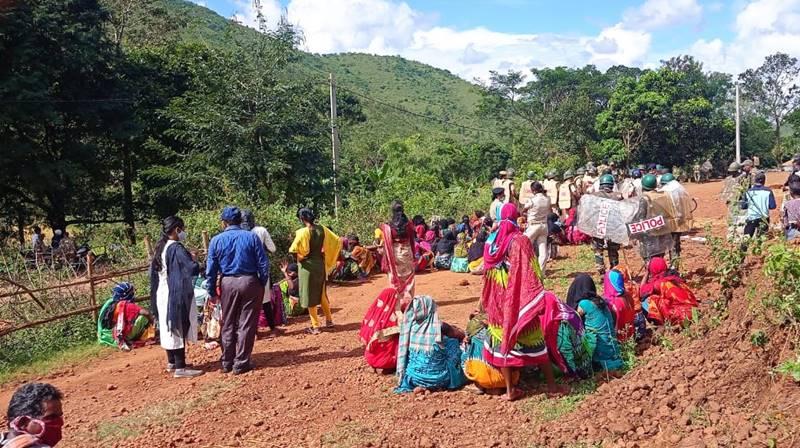
Indeed, protests by locals against the Adani Group’s efforts to mine bauxite at Ballada appear to have persisted and recurred over the past several years. Reported by both local and national media, the protests have revived memories of the agitation against the Vedanta Group’s controversial bid to mine bauxite in the Niyamgiri hills more than a decade ago. The concerns raised by local communities in the two cases are strikingly similar.
The site where the Adani Group company plans to extract bauxite lies atop Ballada hill. For forest-dwelling communities in villages around the hill, the site is a sacred abode of Adivasi deities. Two of them, Nageswari and Mauli Ma, are housed in a cave near the hilltop and are worshipped daily.
The Niyamgiri hills are similarly regarded as the sacred abode of Niyam Raja, an Adivasi deity. Alongside concerns over their legal rights to forest land, spiritual beliefs have been a major factor in the opposition to bauxite mining. Since 2013, the Dongria Kondh communities living around Niyamgiri have successfully resisted attempts by Vedanta and other companies to mine bauxite in the hills. The opposition continues to this day, combining grassroots mobilisation with legal challenges.
Ballada Mine Under Legal Scrutiny
A similar strategy appears to have been adopted by communities opposing the Adani Group’s plans to mine bauxite at Ballada.
Previously unreported official documents and media reports reviewed by New Delhi Post reveal significant details about the resistance. The Adani Group has faced not only protests on the ground but also a series of legal challenges to the forest and environmental clearances granted by the state and Union governments for the Ballada mining project.
Among those who have challenged the clearances are several Adivasi residents of Koraput district, including Ajaya Muduli, Sunadhar Muduli, Rajendra Khara, Gana Limikia, Subhash Sisa and Gora Sisa, as well as Prafulla Kumar Samantra, the Odisha-based activist and Goldman Environmental Prize winner. The local petitioners are grassroots activists involved in campaigns concerning environmental protection and community rights. Ajaya Muduli has also researched conservation issues.
The legal challenges have raised, among other issues, allegations that the forest rights of local communities were violated when forest land was transferred for bauxite mining. The outcome of these proceedings could have implications for the Adani Group’s plans in Odisha, particularly its proposed mining operation at Ballada, for which the estimated investment is Rs 23,000 crore.
The project’s vast financial ambitions carry equally significant environmental and social consequences. The legal challenges therefore offer an important window into the contest over Ballada, and could determine how easily the Adani Group can turn its bauxite reserves into an operating mine.
A detailed examination of previously unreported official documents by New Delhi Post reveals that the Adani Group company involved in the project, along with various arms of the Odisha and Union governments, has been challenged in multiple legal proceedings in eastern India.
At the Odisha High Court in Cuttack, petitioners alleged that forest land was diverted for the Ballada mine without first settling the forest rights of Adivasis and other traditional forest dwellers in several villages. They further alleged that the consent of local communities was not obtained before the diversion of forest land for bauxite mining, as required under the Scheduled Tribes and Other Traditional Forest Dwellers (Recognition of Forest Rights) Act, 2006. Some of these allegations have received attention in sections of the media.
Separately, residents of Koraput filed appeals before the Eastern Zone Bench of the National Green Tribunal in Kolkata challenging the environmental and forest clearances granted to the mining project. Both proceedings raise detailed questions about the alleged failure of government authorities to recognise and settle the rights of forest-dwelling communities.
The appeals, however, go beyond forest rights. They contain a series of serious allegations concerning the potential impact of specific activities associated with the Adani Group’s mining project on local biodiversity. Several of these claims are supported by documentary material and appear to have received little or no public scrutiny before being placed on the official record.
These documents therefore offer a previously unexplored account of the environmental and legal challenges surrounding the Ballada project, with potentially significant implications for the Adani Group’s plans to develop the mine.
Ballada’s Hidden Forest Story
New Delhi Post reviewed official records containing these previously unreported allegations and is publishing some of the most significant ones in this report. We also examined responses filed by the Adani Group company and various arms of the Union government. Their responses to the key allegations are included below.
Among the most significant allegations made by residents and currently before the NGT are:
- Kalinga Alumina Limited, the Adani Group company seeking to mine bauxite at Ballada, “suppressed the presence of the Jeypore Ground Gecko and other endangered species in the area” and “committed fraud on the process” of obtaining forest clearance. The Jeypore Ground Gecko is a lizard endemic to the Eastern Ghats and is classified as endangered by the International Union for Conservation of Nature (IUCN).
- The discovery of the Jeypore Ground Gecko on Ballada hill in recent years is “monumental”, the petitioners alleged, arguing that its habitat must be protected because the species is “entitled to the same protection in law as the tiger”.
- The presence of 120 bird species, including “ground-nesting threatened birds”, on Ballada hill was allegedly “suppressed” during the forest-clearance process.
- The potential impact of diverting forest land for mining on local biodiversity was allegedly “suppressed” during both the forest and environmental clearance processes.
- Ballada Hill was described as an “undisturbed repository of biodiversity” that is “critical to the survival of endangered species” such as the Jeypore Ground Gecko. The petitioners also said the forest is vital to tribal communities not only for “sustenance” but for preserving their “traditional religious, cultural practices and their way of life”.
- The “religious, cultural and livelihood significance” of the forest to local communities was allegedly “suppressed” during the clearance process.
- The Odisha and Union governments allegedly “failed to apply their minds” and granted forest clearance “in a mechanical fashion”, accepting the company’s submissions as “gospel truth”.
- Diverting forest land for mining on Ballada hill “would sound the death knell” for endangered species inhabiting the affected forests and for tribal communities dependent on them.
- The Environment Impact Assessment (EIA) report should have been rejected, the petitioners alleged, because it failed to assess or mention the adverse impact of bauxite mining on Adivasi communities dependent on the forest and did not provide accurate baseline data for the area.
- The EIA process was allegedly “vitiated” because it failed to assess “seasonal variation in biodiversity” and “meteorological conditions”.
These are distilled versions of some of the most significant allegations against the Adani Group company and the Ballada project. They remain allegations before the Eastern Zone Bench of the NGT and have yet to be adjudicated.
Their significance lies in what they allege about the potential consequences of mining on Ballada hill, where the interests of tribal communities and wildlife converge around the same forest ecosystem.
The NGT has allowed the two appeals to proceed. In separate orders, the tribunal found no grounds to dismiss them at the preliminary stage and admitted them for hearing. It directed the Odisha and Union governments, as well as the Adani Group company, to respond to the allegations raised by the appellants.
Evidence Cited to Support the Allegations
In detailed submissions to the NGT, the applicants placed on record a range of documents and other material that they say support their allegations.
To establish the presence of the endangered Jeypore Ground Gecko within the Ballada mining lease area, formerly a reserved forest, one of the applications cites two research papers based on field studies and published in academic journals.
The most recent, published in June 2026 in the German journal Sauria, provides an updated account of the forest in which Ballada hill is located and confirms the presence of the endangered lizard, which has attracted international scientific attention for its distinctive characteristics.
“In 2025, we discovered in three groups after heavy rainfall only one specimen in the Balda Hills, marking the third known location in Odisha,” wrote Mirza Shahzad Alam Baig, the paper’s author. He also warned of the potential impact of mining on the species’ habitat. “The Balda Hills, where the species was recently found, remain relatively undisturbed, providing a safe habitat. However, planned bauxite mining projects pose a significant risk to the area’s biodiversity,” he wrote.
The NGT applicants cited these findings, along with findings from a second paper published in June 2012 in Hamadryad, to support their allegations against the Adani Group company and government authorities.
The applicants also submitted a geotagged photograph of a Jeypore Ground Gecko, taken on March 27 this year on the Balda Cave Road. They cited the photograph as evidence that the area around the proposed mining site provides habitat for the endangered species, which they argue is entitled to the same legal protection as the tiger. On that basis, they have sought a prohibition on bauxite mining in the area.
The applicants further cited the continued use of the cave housing the local deities Nageswari and Mauli Ma as evidence of the Ballada hill’s spiritual and cultural significance to surrounding communities.
What Government Agencies Said in Defence
The Ministry of Environment, Forests and Climate Change (MoEF&CC), representing the Union government before the NGT, told the tribunal that its experts had assessed the Adani Group company’s proposal for diversion of forest land in accordance with the Van (Sanrakshan evam Samvardhan) Adhiniyam, 1980, and the rules and guidelines framed under it.
After the Advisory Committee granted conditional Stage-I forest clearance, the ministry granted Stage-II clearance only after the Odisha government confirmed that the company had complied with the conditions attached to the first-stage approval. The ministry did not, however, respond specifically to the individual allegations made by the appellants concerning the forest and environmental clearances.
The ministry said it had imposed a specific condition requiring compliance with the Forest Rights Act, including settlement of the forest rights of eligible local residents before diversion of the forest land. If any dispute over the settlement of forest rights remained, it said, the matter fell within the jurisdiction of the state government under the law.
The State Environment Impact Assessment Authority (SEIAA), Odisha, which processes proposals for environmental clearance, also informed the tribunal about the procedure followed in examining the Adani Group company’s application for the Ballada mining project. It did not respond individually to all the allegations raised by local residents in their appeal.
The authority did, however, make one significant observation. It told the tribunal that, according to the regulatory documents prepared during the appraisal process, neither the Forest Rights Act nor a Rehabilitation and Resettlement Plan was required for the project because there was “no habitation” in the area and the land was government-owned forest land.
That position appears to directly address the appellants’ contention that the forest rights of local communities had not been fully settled before the mining project received its clearances.
The NGT has yet to rule on these competing claims. Its decision could have significant implications for the Adani Group’s plans to mine bauxite at Ballada, as well as for the forest-dependent communities whose rights, livelihoods and cultural practices are tied to the area.