


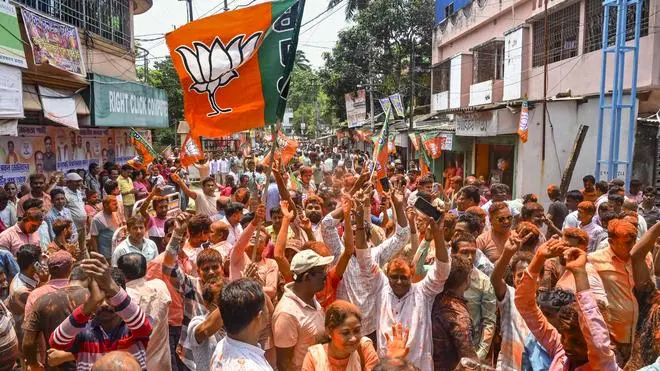
An election story normally ends with the counting of votes. The winners are declared, the margins are recorded, the number of seats won by each party becomes part of the political record, and the contest gradually recedes into history. The 2026 West Bengal Assembly election, however, may not fit that familiar pattern. There is a figure emerging from the revision and adjudication of the electoral rolls that raises questions extending well beyond the result itself: 70.2 per cent.
According to the available data, 2,705,162 voters were considered “not eligible” in the SIR adjudication process. Of these, approximately 18.98 lakh were Muslim voters, meaning that Muslims accounted for around 70.2 per cent of the names removed. At the same time, Muslim voters constitute approximately 23.6 per cent of West Bengal’s total electorate. The disparity is difficult to overlook. A community representing roughly one-fourth of the electorate accounted for an estimated seven-tenths of those classified as “not eligible”. The obvious question is whether this was merely a statistical coincidence or whether there was something structural in the SIR process that disproportionately affected a particular social group.
That question cannot yet be answered conclusively, and the limitations of the 70.2 per cent figure need to be stated clearly. The Election Commission’s published lists do not contain a separate column identifying the religion of voters. The 70.2 per cent figure has been derived through surname-based classification, and the research itself acknowledges the possibility of error. It would therefore be wrong to present the figure as an official religious classification or as conclusive proof that all the Muslim voters removed were legitimate. But the methodological limitation does not make the disparity irrelevant. If a community constituting approximately 23.6 per cent of the electorate accounts for an estimated 70.2 per cent of those classified as “not eligible”, the disparity is substantial enough to demand an explanation.
The difference between the two figures is approximately 46.6 percentage points. That does not, by itself, establish a conspiracy or demonstrate discriminatory intent. Nor can every difference between the composition of the electorate and the composition of removed voters be assumed to be improper. Electoral-roll exercises can produce geographical and demographic variations for legitimate administrative reasons. But a disparity of this magnitude cannot reasonably be treated as an ordinary statistical fluctuation without examining why it occurred, where it occurred and what happened to the people affected by it.
Disparity is Not Evenly Distributed
The geographical pattern makes the issue more difficult to dismiss. According to The Wire’s analysis of 43 Assembly constituencies in Malda, Murshidabad and Uttar Dinajpur, approximately 94.4 per cent of the names removed were Muslim. These districts lost approximately 7.63 per cent of their total voter base during the SIR, compared with about 3.53 per cent for the state as a whole. In other words, the impact on the electoral rolls in these areas was more than twice the state average.
That becomes significant when placed against the electoral geography of these districts. They contain several constituencies in which the Muslim population and the Muslim share of the electorate are considerably higher than the state average. If an electoral-roll exercise affects voters in such constituencies disproportionately, the consequences cannot be regarded simply as an administrative matter. The electoral roll determines who is entitled to participate, and therefore any substantial change in its composition inevitably has implications for representation.
Samserganj provides perhaps the most striking illustration. The published “not eligible” list contains 71,985 names, of which more than 71,500 have reportedly been identified as Muslim, or approximately 99.5 per cent. The election was decided by a margin of 7,587 votes. Yet the more important issue is not whether the number of deletions exceeded the victory margin. It is that thousands of people were still awaiting a decision on the status of their names as late as August, while 80,234 people were awaiting disposal of appeals and only 12 appeals had been decided at that stage.
Across Bengal, 49 Assembly constituencies have been identified where the number of voters removed after the SIR was greater than the margin of victory. In these constituencies, a total of 9,02,667 names were removed, with approximately 85.4 per cent of them reportedly belonging to Muslims. These figures should not be used to claim that the results of those constituencies would necessarily have been different. There is no basis for knowing whether every deleted voter would have turned out to vote, whom each would have voted for, or when an appeal would have been accepted and a name restored. The fact that deletions exceeded the victory margin is therefore not evidence that an election result was overturned or would have been overturned.
But it does raise a legitimate question about the timing of the process. In Rajarhat New Town, for example, the victory margin was only 316 votes, while 24,132 names were reportedly removed. In Satgachhia, the corresponding figures were 401 and 8,785; in Raina, 834 and 11,284; and in Jangipara, 862 and 5,432. The figures cannot determine the electoral outcome, but they do highlight the importance of resolving voter-eligibility disputes before an election rather than leaving thousands of such cases undecided while the electorate goes to the polls.
What Happened When Voters Appealed?
The appellate record makes the question more significant. According to The Wire, among the cases decided by the appellate tribunals, 91.13 per cent resulted in the voter being retained on the electoral roll. That does not establish that the original decisions were wrong in every case, but it does show that, among the cases that actually reached a decision, an overwhelming majority resulted in the voter remaining on the roll.
This raises a straightforward question. If such a high proportion of the cases that were heard resulted in voters being retained, what does that tell us about the millions of cases that had not yet been decided? More importantly, if a citizen’s appeal remained unresolved until after the election, what remedy could restore the opportunity to vote that had already been lost?
That is the point at which the issue moves beyond the technical language of electoral-roll revision. A voter whose name is removed in March, who files an appeal, and whose appeal remains undecided when the election takes place in April may eventually have the name restored. But a restoration months later cannot recreate the voting opportunity that existed on polling day. An administrative correction after an election is not the same thing as the exercise of the franchise during that election.
The 97% Question
The scale of the unresolved appeals is therefore crucial. In September, the Election Commission told the Supreme Court that 38,20,683 appeals relating to the SIR had been filed. Only 1,02,231 had been disposed of, leaving 37,18,452 appeals pending. That means more than 97 per cent of the appeals were still awaiting a decision.
The Commission has also not yet provided the Supreme Court with a complete bifurcation showing how many of these appeals were filed by voters who had been removed and were seeking restoration of their names, and how many challenged the inclusion of names in the electoral roll. The court has sought this information because the distinction is fundamental to understanding the nature of the dispute.
In August, the Supreme Court was told, on the basis of RTI information, that approximately 31 lakh appeals challenged the inclusion of a person in the electoral roll, while around 7 lakh appeals were filed by people who had been excluded following the SIR. That information needs to be treated with appropriate caution because it is an RTI-based claim and not a final bifurcated classification certified by the Election Commission. Nevertheless, it underlines the scale of the unresolved dispute and the importance of obtaining a definitive breakdown.
The Question Behind the Numbers
There is an understandable temptation in an election controversy to move immediately from numbers to political conclusions. That would be premature. The more important task is to understand how the numbers came about and whether the patterns revealed by them can be explained through objective, consistently applied criteria.
If two figures, 23.6 per cent and 70.2 per cent, are placed side by side, the first question for any serious investigation should be how such a gap arose. Did the process of mapping voters from previous electoral rolls disproportionately affect particular geographical areas? Did the ability to produce the required documents vary among different social groups? Did verification operate differently in border districts? Was there a common pattern in the cases that came before judicial officers? And, perhaps most importantly, do the characteristics of the cases in which voters were restored to the electoral roll resemble those of the millions of cases that remained pending?
Those questions require evidence rather than political assumptions. They also require complete data. The public needs to know how the deletions were determined, how appeals were processed, how many names were ultimately restored, the geographical and demographic distribution of those restorations, and whether the high proportion of Muslim names among those classified as “not eligible” can be explained by identifiable administrative factors.
The accuracy of an electoral roll is often described as a technical responsibility of the Election Commission. It is certainly that, but it is also something more fundamental. The electoral roll is the mechanism through which the constitutional promise of political equality is translated into the practical right to participate in an election. The state therefore has a responsibility to exercise particular care before removing a citizen from that roll, especially when the dispute over eligibility has not been conclusively resolved.
Was the Roll Really Final When Bengal Voted?
This is why the central question surrounding the Bengal election should not be confined to how many seats each political party won. The results are known. The more fundamental question is whether the electoral roll was genuinely final at the moment the election took place, when the claims of millions of citizens removed from that very roll were still awaiting adjudication.
There is a second question that is equally difficult to avoid. When Muslims constituted approximately 23.6 per cent of West Bengal’s electorate, why did their estimated share among those classified as “not eligible” in the SIR reach 70.2 per cent?
The figure does not, by itself, establish that the election was invalid. It does not prove that any political party benefited from the deletions. It does not establish discriminatory intent. It does not show that the results of any particular constituency would have been different. But it does establish a statistical disparity large enough to warrant a complete, transparent and independent explanation.
Ultimately, the issue is not simply who won the election. It is whether everyone who was entitled to participate had a genuine opportunity to do so when the election took place. If millions of voter-eligibility disputes were still unresolved at that point, and if a substantial proportion of those whose cases were subsequently heard were retained on the electoral roll, the question of whether the electoral process was fully settled before polling cannot simply be left to administrative arithmetic.
West Bengal has a declared election result. But the democratic process has another account to settle: how many people who were entitled to vote were actually on the electoral roll when the votes were cast. Until that question is answered fully, transparently and with all the relevant data in the public domain, the SIR story remains unfinished.
And that is why 70.2 per cent is not simply another election statistic. It is the starting point for a much larger examination of what happened to the electoral roll before Bengal went to the polls.

