

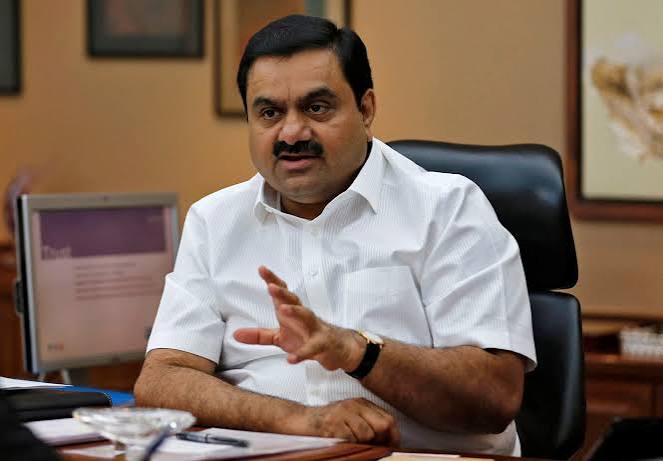
If finally selected under the ₹37,500 cr coal gasification scheme, Adani could get up to ₹12,000 cr in government subsidy
K. Ashish
The Centre’s ₹37,500 crore coal and lignite gasification incentive scheme has produced a striking first-round result: seven proposals have been received, three of them from Adani Enterprises Limited alone.
The number, by itself, establishes neither irregularity nor preferential treatment. But it raises questions about how a scheme involving substantial public financial support will operate in practice, particularly when viewed against earlier concerns raised by Coal India Limited (CIL) over the scheme’s rules and continuing questions about the commercial viability of coal gasification projects.
The government’s next step, evaluating the proposals and deciding which projects qualify for financial assistance, will therefore be more consequential than the application count itself.
From ‘no takers’ to seven proposals
The developments unfolded quickly. On September 4, Economic Times and some other media outlets reported, citing sources, that no applications had been received at that stage under the scheme. The reports raised questions over the viability of coal gasification and the government’s ambitious expansion plans.
The coal ministry rejected the description as premature the following day, pointing out that the application window was still open. It said large projects required extensive preparation, including technical studies, arrangements for coal or lignite, technology assessment and financial planning.
On September 8, the ministry announced that seven applications had been received in the first round:
NTPC — 1 project
Adani Enterprises — 3 projects
Talcher Fertilisers — 1 project
Gallantt Ispat — 1 project
Shyam Sel & Power — 1 project
Adani’s three proposals account for almost 43 per cent of the total applications. All three are for urea production. That makes the composition of the applications more significant than the headline figure of seven might suggest. This simply means three of the four urea proposals are from Adani. Four of the seven proposals are for urea. Adani Enterprises has submitted three of them; the fourth is from Talcher Fertilisers. The other proposals relate to synthetic natural gas, synthesis gas and DRI.
Thus, while Adani accounts for almost 43 per cent of all applications, its presence is even more concentrated in the urea segment.
The significance lies in what happens next. If these proposals qualify for government assistance, the selection and subsidy decisions will determine how much public support flows into projects promoted by one company and on what basis. That makes the evaluation criteria critical. The subsidy changes the equation.
The government is seeking to develop about 75 million tonnes of new coal gasification capacity and take total national gasification capacity to 100 million tonnes by 2030.
It estimates that the programme could attract ₹2.5 lakh crore to ₹3 lakh crore of investment and reduce dependence on imported products such as LNG, urea, ammonia and methanol.
But coal gasification is capital intensive. The scheme therefore provides financial incentives, with a selected project eligible for up to 20 per cent government subsidy. The subsidy is intended to reduce the initial risk for companies undertaking projects that require large investments.
That immediately raises the central policy question: how much risk should the government absorb, and what safeguards ensure that projects receiving public support remain economically viable in the long term?
Dastur Energy CEO Atanu Mukherjee, speaking to Business Standard, has said that the success of gasification projects will depend on factors including technology, project size, long-term product buyers, competitive financing and carbon management.
Government support may help projects cross the initial investment barrier. It cannot, by itself, establish that their underlying economics are sustainable.
Coal India’s objections
The issue of competitive neutrality had already surfaced before the seven applications were announced. On August 29, Economic Times reported that Coal India Limited had raised concerns with the government over the scheme’s rules. The company had argued that the short application window and the exclusion of certain costs from the incentive calculation could disadvantage or favour private competitors relative to government companies.
Coal India had also sought an extension of the initial application period to six months. The ministry did not accept the demand. Importantly, Coal India did not allege that Adani had received preferential treatment. Its concerns related to the design of the scheme and its potential competitive implications.
The subsequent disclosure that Adani accounts for three of the seven applications nevertheless makes those concerns relevant to the scrutiny that will now follow.
The question is not whether Adani should be allowed to submit multiple proposals. It is whether the same evaluation parameters and incentive rules will be applied transparently and uniformly to every applicant, public or private.
Real test begins now
The coal ministry has described the seven applications as a “vote of confidence” in the scheme. The more important test, however, lies ahead. The government will have to determine which projects are technically and economically viable, what their costs are, whether there is adequate long-term demand for their output and how much financial assistance each should receive.
In the case of the Adani proposals, the scrutiny will inevitably focus on the same questions that should apply to every applicant:
Why should a particular project receive public support? How much subsidy does it require? What are the underlying cost and return assumptions? How does it compare with competing proposals? And are the same standards being applied across private and public-sector applicants?
These questions matter because the government is not merely facilitating private investment. It is using public money to reduce the risks associated with that investment.
The stated objective is to create national capacity, reduce import dependence and catalyse large-scale industrial investment. The eventual beneficiaries, however, will be the individual project developers that receive the incentives.
The credibility of the scheme will therefore depend on whether the government can demonstrate that public support is being allocated to the most viable projects on transparent and competitive terms, rather than simply to those capable of making the largest or most numerous proposals.
A test of the scheme, and its safeguards. The seven applications have settled the immediate question of whether the scheme attracted industry interest. But they have opened a more consequential one.
Three of the seven proposals, and three of the four urea proposals, are from Adani Enterprises. That is not, in itself, evidence of anything improper. It does, however, put the government’s selection process under greater scrutiny.
The critical information will now be the decisions that follow: which proposals are selected, how they are ranked, how much subsidy each receives, on what terms and whether the same criteria are demonstrably applied to all applicants.
The success of the ₹37,500 crore scheme will ultimately be judged not by the number of applications but by whether the projects it supports can deliver the promised industrial benefits without turning public financial support into a permanent substitute for commercial viability.
The first round has produced seven proposals. The real test is how the government chooses among them, and how much of the risk and how much of the reward ultimately rest with the public.
==
GFX 1
ADANI’S ₹12,000 CR SUBSIDY OPPORTUNITY
If all three Adani projects qualify for the maximum assistance permitted under the scheme, the group could access up to ₹12,000 crore in government financial assistance.
Coal gasification is a highly capital-intensive business. The government has therefore provided financial assistance to eligible projects, covering up to 20 per cent of the cost of plant and machinery.
For general projects, the assistance is capped at ₹5,000 crore per project. For synthetic natural gas (SNG) and urea projects, however, the ceiling can rise to ₹9,000 crore. Across all projects of a single company or entity group, the maximum government assistance is capped at ₹12,000 crore.
This makes the Adani application particularly significant. Of the seven applications received in the first round, Adani Enterprises has submitted three — all for urea projects.
That does not mean Adani is assured of ₹12,000 crore. The applications are still to be evaluated, and the actual assistance will depend on eligibility and the conditions prescribed under the scheme. But the rules do establish a potential ceiling of up to ₹12,000 crore in government financial assistance for a single entity group.
The larger question, therefore, goes beyond why Adani Enterprises has submitted three proposals. It is this: how much of the risk in private companies’ coal-gasification projects is the government prepared to absorb with public money, and which companies stand to gain most from that support?
GFX 2
WHAT IS ACTUALLY HAPPENING?
- The Centre put ₹37,500 cr behind a scheme to kick-start coal/lignite gasification in India
- Coal gasification is expensive and risky. The scheme offers government financial support to make projects viable
- At one point, reports suggested there were no takers for the scheme, raising questions over its commercial appeal
- The government disputed that claim, saying the application window was still open
- When the window closed, 7 proposals had been received
- Adani Enterprises submitted 3 of them, nearly 43% of the total
- And the concentration is even sharper in urea: 3 of the 4 urea proposals are from Adani Enterprises
- A scheme once portrayed as struggling for applicants has ended up with Adani accounting for nearly half the proposals — and three-fourths of the urea bids