

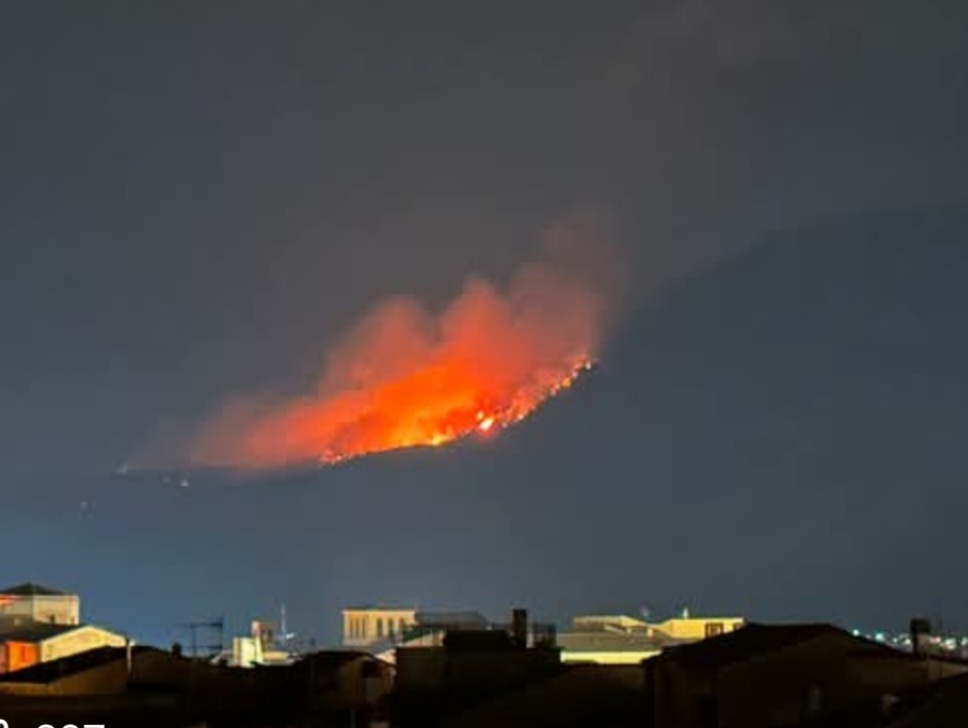
Five heatwaves from late May to mid-August, hundreds of thousands of people evacuated.
Europe’s Record Heat Wave
The summer of 2026 is proving to be one of the most difficult seasons ever recorded in Europe, marked by an increasingly clear and direct link between rising temperatures and the proliferation of wildfires
According to data from 3bmeteo, a digital company specialising in weather forecasting, climate analysis, and atmospheric monitoring, Western Europe experienced five distinct heatwaves between late May and mid-August 2026, a remarkable sequence notable not so much for individual records as for its precocity, frequency, and persistence. The first heat surge arrived as early as late May, even before the meteorological start of summer. June became the hottest ever recorded in Western Europe, and July followed suit with new phases of extreme heat, growing drought, and wildfires.
The fifth and most recent heatwave, culminating between August 13 and 15, pushed temperatures above 43°C in France, over 42°C in Spain, 40°C in Portugal, and surpassing 40°C across much of Italy, with intense heat extending as far as Germany. More concerning to observers than the absolute peaks is the continuity of the season: the lulls between heatwaves were relatively short, favouring a progressive buildup of heat, the parching of soils, and conditions increasingly conducive to fire.
A historical comparison helps measure the scale of the phenomenon. The deadliest summer ever recorded in Europe remains 2003, when a subtropical anticyclone trapped over the continent for weeks caused over 70,000 deaths across sixteen countries, according to estimates by the French national health institute Inserm. While 2026 has not yet reached that death toll, scientists warn that the fastest-warming continent on the planet is only at the beginning of this phase of the climate crisis.
The most extensive blazes of the season struck France and Spain, where by late July over 320,000 people had already been evacuated. France witnessed a phenomenon never before observed in the country: the formation of a pyrocumulonimbus cloud,
a true “fire cloud” generated by the heat of the wildfires, capable of triggering thunderstorms that make blazes even more unpredictable and difficult to tame. A similar event had previously been recorded in Australia during the 2019-2020 summer and in California in 2021, but
for France, it was a first.
In Spain, one of the most challenging situations occurred in the province of Madrid, where a late-July wildfire devastated the El Encinar del Alberche area, destroying properties and land. Fires in both countries reached unprecedented levels, with the climate crisis fundamentally altering the duration and intensity of blazes compared to the past.
Italy is also paying a heavy price. According to the report È stata la mano dell’uomo (“It was human agency”) published by WWF Italy on August 5, approximately 70,000 hectares have already gone up in smoke across the country, the equivalent of 100,000 football fields. This represents a 133 per cent increase compared to the average of the last twenty years, with nearly a third of the fires hitting protected areas. Over the same period, approximately 435,000 hectares burned across Europe as a whole, 100,000 more than in 2025, a year that was already the worst of the past two decades. Active fronts remain numerous and widespread throughout the Italian Peninsula.
Extreme heat has also heavily impacted public health and agriculture: on the most critical days in August, nearly twenty cities were placed on “red alert” for heatwave risks, while Confagricoltura reported a crisis in the fruit and vegetable sector, demanding emergency interventions for damage caused by drought and, in some areas, violent hailstorms.
While the Mediterranean region remains the hardest hit, 2026 has shown that the wildfire risk is no longer confined to Southern Europe. The United Kingdom experienced one of its most dramatic seasons ever: according to the Met Office, 2026 is only the second year the country has reached at least 38°C on two separate days, following 2022, alongside a record four consecutive days at or above 36°C during the fifth heatwave.
On August 13, the hottest day of the year in the UK, a vast brush fire broke out near a golf course in Stourbridge, West Midlands, quickly spreading to residential areas. The flames destroyed several homes (estimates range from at least four completely lost properties to as many as nineteen) and scorched roughly 16 hectares of land. Around a hundred firefighters spent hours battling what West Midlands Fire Service Commander Simon Tuhill
described as one of the “most significant” situations the corps has ever faced. The total casualty toll from the various blazes hitting the country during those days rose to 54 injured, bruised, or smoke-intoxicated individuals, including at least one child and several firefighters.
Visiting the West Midlands, British Prime Minister Andy Burnham described the country as having been turned into a “tinderbox” by the
dry weather, explicitly pointing to climate change and the need to prioritize cleaner energy sources.
From Greece to Portugal, and from Italy to Scandinavia, intense wildfires have struck much of the continent this season. Italy is among roughly ten European countries that dispatched firefighting aircraft or teams to support France and Spain, even while simultaneously battling blazes on its own soil, a sign of how heavily the European emergency response strategy, based on resource-sharing among member states, is currently pressured.
According to the European Commission, the 2026 wildfire season began as early as April and could stretch into the first days of November: a significant extension compared to the past, when the risk was concentrated in mid-summer. The phenomenon is not limited to Europe; in Canada, over 2.8 million hectares have already burned since the start of 2026, surpassing the total tally of the entire previous season.
Finally, the economic impact cannot be understated. This year’s cost of wildfires in Europe confirms that financial consequences go far beyond simply restoring burned land: calculating the true cost of blazes remains a complex exercise that must account for infrastructure damage, agricultural losses, and impacts on public health and tourism.
Scientists have long agreed that Europe is warming faster than the global average, making the continent particularly vulnerable to increasingly early, frequent, and persistent heatwaves. The accumulation of heat from one wave to the next, combined with reduced summer precipitation and parched soils, creates ideal conditions for the rapid ignition and spread of fires—even in regions like the UK or Germany that have traditionally been less exposed to this type of risk.
Towards a New Strategy
Addressing a structural crisis like the one that emerged in the summer of 2026 requires moving beyond mere emergency management. This is not, however, a problem confined to European borders: the dramatic sequence of wildfires and heatwaves reflects a staggering global climate crisis that is striking the Americas, Asia, and Africa with equal intensity, transforming into an unprecedented planetary threat.
While the energy transition remains the only way to curb global warming over the long term, climate urgency demands that it be paired with immediate strategies for active territorial prevention.
This means safeguarding the health of green areas through forward-looking forest management—removing accumulated dry biomass and creating strategic firebreaks—alongside protecting water resources with new storage reservoirs and digital drought-monitoring
networks. These measures fit into the broader framework of sustainable development: a model in which ecosystem preservation, economic decarbonization, and community resilience are not ethical options, but essential conditions for survival.
The sequence of five heatwaves and the devastating blazes stretching from Madrid to the British moors deliver an unequivocal message: the climate crisis is no longer a seasonal emergency, but a new global structural normal to which the planet must learn to adapt through radically revamped economic and territorial choices.