


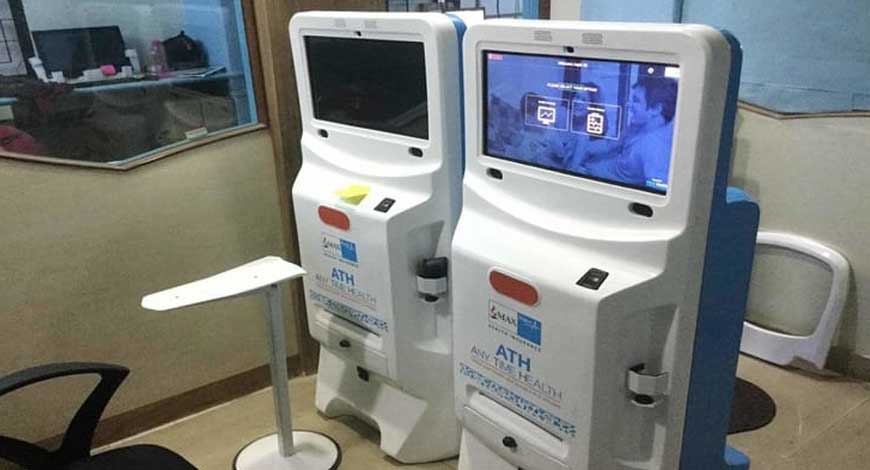
In a remote village in Maharashtra’s Gadchiroli district, an elderly diabetic farmer once spent nearly an entire day travelling 18 kilometres for a routine medical consultation, only to discover that the doctor at the government facility was unavailable. Today, he walks to a small digital kiosk installed near the village centre, where a health worker checks his blood sugar, blood pressure and ECG before connecting him to a doctor through video consultation. Within minutes, he leaves with a prescription and follow-up advice.
Scenes like this are beginning to redefine healthcare access across rural India.
From Uttar Pradesh to Karnataka, from Telangana to Mizoram, Health ATMs or digital health kiosks are rapidly emerging as one of the most visible attempts to repair India’s deeply unequal healthcare system. Installed inside primary health centres, gram panchayat offices, railway stations and village clinics, these machines are being projected as the bridge between India’s crumbling rural health infrastructure and its ambitious digital-health future.
The speed of expansion reflects the scale of the crisis they are attempting to solve.
India’s healthcare problem is no longer merely about the number of doctors the country possesses. It is increasingly about where those doctors are located. Officially, India’s doctor-population ratio stands at roughly 1:811, close to the World Health Organization benchmark. But the national average conceals a massive rural-urban imbalance. In many parts of rural India, there is barely one doctor for 20,000 to 30,000 people. Around 70 per cent of specialist posts at Community Health Centres remain vacant.
For millions of villagers, the nearest functional doctor, pathology laboratory or ECG machine often lies several hours away. Basic illnesses become medical emergencies simply because the diagnosis comes too late. A diabetic patient may ignore symptoms for months because routine tests require expensive travel. Pregnant women often depend on overstretched primary health centres lacking specialists. Elderly patients with hypertension or heart disease frequently abandon treatment altogether because follow-up visits consume an entire day’s wages. It is within this healthcare vacuum that Health ATMs are flourishing.
These kiosks are essentially compact digital diagnostic centres equipped with touchscreen systems, telemedicine connectivity and medical devices capable of conducting multiple health tests. Depending on the model, they can measure blood sugar, blood pressure, oxygen saturation, BMI, haemoglobin and ECG readings, while some advanced systems claim the capacity to conduct over 100 diagnostic assessments. The patient’s data is digitally recorded and, when required, linked to remote consultations with doctors through telemedicine platforms integrated with the Ayushman Bharat Digital Mission and eSanjeevani services.
The appeal of the model lies in its simplicity. Instead of building a full hospital network in every remote district, an enormously expensive and slow process, governments can establish decentralised diagnostic access points at a fraction of the cost. That logic is now driving rapid state-backed expansion.
Uttar Pradesh has emerged as one of the largest adopters, with more than 1,000 Health ATMs reportedly installed across Primary Health Centres and Community Health Centres. The state is also developing a central monitoring system in Lucknow to supervise kiosk operations. Karnataka’s Kalaburagi district installed 25 Health ATMs to improve rural diagnostic access, and local reports noted significant public uptake, with one kiosk reportedly serving more than 200 people within a month.
Telangana has piloted advanced kiosks in government hospitals capable of conducting over 130 tests linked to telemedicine systems. Mizoram has introduced Health ATMs under its “Healthy Lunglei Initiative”, while Punjab and Maharashtra are increasingly integrating kiosk-based healthcare into rural outreach programmes.
Yet despite the growing footprint, India still lacks a transparent national database documenting the exact number of operational kiosks across states. Estimates remain fragmented because deployments are spread across government schemes, district administrations, CSR-funded projects and private initiatives. What is clear, however, is that this is no longer a purely private-sector experiment.
The Health ATM boom is increasingly being fuelled through public-private partnerships. Governments typically provide space inside public-health facilities, electricity, internet connectivity and procurement funding, while private health-tech companies supply the machines, software infrastructure and maintenance services.
The arrangement has created a rapidly expanding ecosystem of digital-health companies competing for government contracts. Firms such as Clinics on Cloud, YoloHealth, HealthATM India and Onyx Health Plus are aggressively marketing kiosks as the future of affordable healthcare delivery. Clinics on Cloud claims deployment of more than 3,000 Health ATMs across India and overseas markets.
For governments, the attraction is obvious. Health kiosks provide visible, technology-driven healthcare infrastructure without the enormous costs involved in constructing and staffing fully equipped hospitals in remote areas. They also align perfectly with the Centre’s larger digital-health ambitions.
By the end of 2025, more than 1.82 lakh Ayushman Arogya Mandirs had become operational, while eSanjeevani telemedicine consultations crossed 43 crore. Government health expenditure rose to 1.84 per cent of GDP in 2021-22, and out-of-pocket healthcare expenditure fell to 39.4 per cent of total health expenditure.
Prime Minister Narendra Modi has repeatedly championed digital-health expansion, saying he dreams of “a Digital India where quality healthcare percolates right up to the remotest regions powered by e-Healthcare.” Union Minister Jitendra Singh has similarly described telemedicine as “the main pillar of India’s future healthcare system.”
But the rise of Health ATMs also reflects a more uncomfortable reality: India is turning to technology partly because its traditional rural healthcare model is struggling to survive. In many districts, primary health centres continue to suffer from doctor absenteeism, specialist shortages, weak diagnostics and poor referral systems. Health kiosks are effectively becoming substitutes for infrastructure that the state has failed to adequately build over decades.
Public-health experts say the machines are succeeding because villagers often have little alternative. For a labourer earning daily wages, losing an entire day to travel for a routine blood-pressure check can mean sacrificing household income. A village kiosk offering immediate screening and teleconsultation therefore becomes enormously attractive, even if it cannot provide comprehensive treatment.
“In rural India, access itself is healthcare,” says a public-health specialist working in tribal regions of Chhattisgarh. “People are using these kiosks because they reduce delay, distance and uncertainty.”
Health workers say chronic disease patients form the largest group of regular users. Diabetes, hypertension and heart disease require frequent monitoring, but rural patients often discontinue treatment because repeated travel to towns becomes financially unsustainable. Health ATMs are changing that equation by decentralising routine diagnostics.
Still, the technology is far from a perfect solution. Ground-level reports from several states reveal recurring operational problems. Internet connectivity failures frequently disrupt teleconsultations. Maintenance delays render diagnostic equipment unreliable. In some centres, ECG sensors malfunction or consumables run out within months. Elderly villagers unfamiliar with digital systems often require assistance from frontline health workers to navigate the process.
Critics warn that the enthusiasm surrounding Health ATMs should not obscure the larger structural crisis confronting India’s healthcare system. “A touchscreen machine cannot replace doctors, nurses, ambulances or district hospitals,” says a senior rural physician in Maharashtra. “Diagnostics alone do not constitute healthcare.”
Yet even sceptics concede that Health ATMs are addressing a genuine and urgent gap in access. They are not flourishing because India’s healthcare system is strong, they are flourishing because the system remains deeply unequal.
For decades, healthcare infrastructure in India has been concentrated in cities while rural populations have struggled with chronic neglect. Health kiosks are now emerging as the state’s attempt to digitally compress that inequality to place at least a basic diagnostic gateway within reach of villages long excluded from dependable medical care.
Whether this experiment ultimately transforms rural healthcare or merely creates a technologically sophisticated patchwork over deeper institutional failures remains uncertain. But one reality is already clear: in large parts of India, the first doctor a villager now encounters may no longer sit inside a hospital chamber. It may stand inside a machine. The crucial question remains: Can Health Kiosks Solve India’s Last-Mile Care Crisis?
(Dr Anish Desai is a healthcare entrepreneur. He is leading IntelliMed Healthcare Solutions)
