

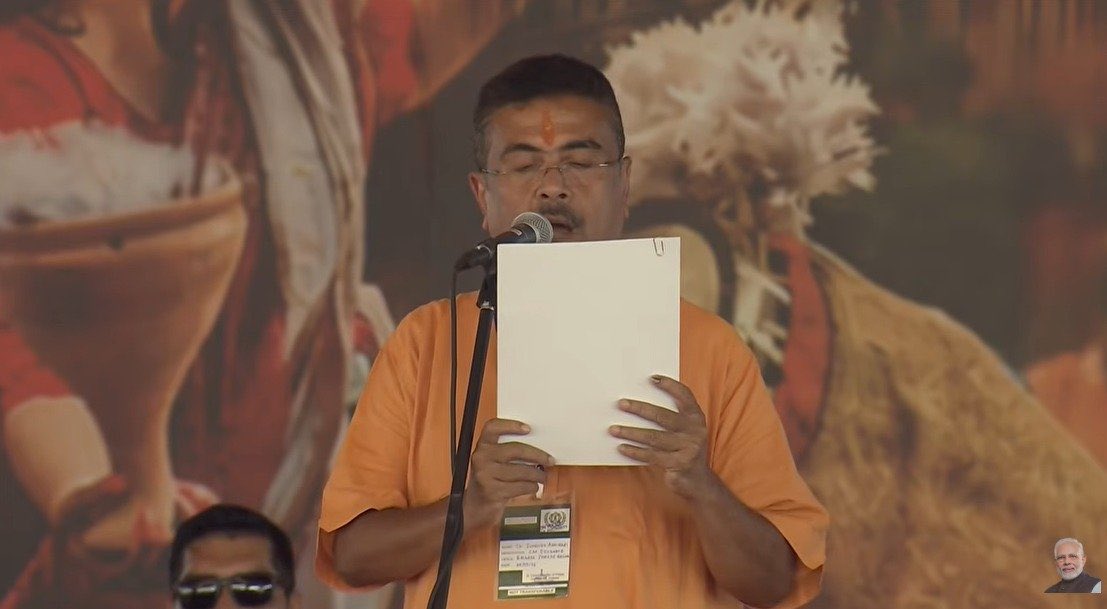
The formal assumption of office by Suvendu Adhikari and his cabinet marks not merely a transfer of power in West Bengal, but the possible beginning of a civilisational correction within the state’s political life. Governments change in democracies all the time. What is far more difficult to change is political culture. Bengal’s tragedy over the last five decades is that while regimes changed, the underlying political culture remained disturbingly intact.
That culture, rooted in cadre dominance, ideological intimidation, politicisation of institutions and the normalisation of political violence, is the single greatest obstacle to Bengal’s economic and social revival today. If the new BJP government truly wishes to leave a historic legacy, its success will not ultimately be measured by slogans, welfare announcements or electoral arithmetic. It will be measured by whether it can dismantle the deeply entrenched ecosystem of fear, hooliganism and the ruling party’s (whoever is in power) pervasive control that has penetrated everyday life in Bengal. For too long, politics in Bengal ceased to be a democratic exercise and became a parallel administrative structure.
The rot did not begin with Mamata Banerjee, though her regime institutionalised many of its worst excesses. The foundations were laid during the 34-year rule of the Left Front. The CPI(M), despite its early land reforms and organisational discipline, gradually transformed governance into a party-centric apparatus. The distinction between party and state steadily disappeared. Access to jobs, education, local administration, contracts, trade unions, colleges and even cultural spaces increasingly depended on political proximity.
The consequence was devastating. An entire generation in Bengal slowly internalised the idea that merit mattered less than connections, productivity mattered less than loyalty, and institutions existed not as neutral public mechanisms but as instruments of political patronage.
The tragedy is that many Bengalis no longer even recognise how abnormal this became. The neighbourhood “dada” emerged as a more powerful figure than the civil servant. The local party office became more influential than the police station. Industrial projects required not merely government approval but approval from informal political syndicates. Recruitment processes became suspect. Universities became ideological battlegrounds rather than centres of scholarship. Violence during elections became so routine that it ceased to shock the public conscience.
When Mamata Banerjee’s All India Trinamool Congress replaced the Left Front in 2011, Bengal expected liberation from this suffocating structure. Instead, the system largely changed colours while retaining its methods. The cadres changed. The slogans changed. The political grammar did not.
Indeed, under the TMC era, the culture often became more decentralised and more informal, making it even harder to challenge. Syndicate networks flourished in every nook and corner of Bengal. Construction, local commerce, municipal contracts and real estate increasingly came under politically protected networks. Fear became hyper-localised. Many ordinary citizens discovered that their immediate survival depended less on law and more on local political equations.
This had profound economic consequences. No serious industrial investor wishes to enter an environment where informal extortion systems dominate commercial activity. No high-skilled professional wants to remain in a state where political identity overshadows professional competence. No efficient bureaucracy can function if transfers, postings and investigations are seen through partisan lenses.
Bengal’s decline was therefore not merely economic. It was psychological.
The state that once produced some of India’s finest administrators, intellectuals, scientists and industrial pioneers gradually acquired a reputation for endless agitation, bureaucratic paralysis and political confrontation. The work culture weakened. Government dependency increased. Private enterprise became hesitant. Talented youth migrated in extraordinary numbers.
This is the inheritance that Suvendu Adhikari now confronts. His challenge is not simply administrative. It is sociological.
The BJP government may build roads, expand infrastructure or attract investment summits. But unless Bengal’s political culture changes fundamentally, such efforts will remain cosmetic. Investors study social behaviour as much as policy documents. They observe whether contracts are protected, whether police neutrality exists, whether bureaucratic decisions are predictable and whether political intimidation dominates local economies.
The real question, therefore, is whether the new regime can resist the temptation to inherit and operate the very same machinery under a different flag.
History offers little comfort here. In India, opposition parties often promise institutional neutrality before elections but inherit the same coercive instruments once in power. Bengal’s citizens have seen this cycle repeatedly. They are justified in their scepticism. If the BJP truly wishes to distinguish itself historically, it must consciously reject the politics of revenge and partisan capture. That means several uncomfortable but necessary steps.
First, the administration and police machinery must visibly regain neutrality. Bengal’s bureaucracy has long operated under immense political pressure. Officers became accustomed to anticipating partisan expectations rather than following institutional norms. Restoring professional confidence inside the civil service is essential.
Second, local syndicate networks must be dismantled not selectively but comprehensively. If new political intermediaries merely replace old ones, public cynicism will deepen irreversibly. Bengal has suffered enough from informal extortion economies masquerading as political organisations.
Third, educational institutions must be depoliticised. Bengal’s campuses have historically produced extraordinary intellectual traditions, yet decades of party interference have damaged academic culture severely. Universities cannot become recruitment centres for political foot soldiers.
Fourth, political violence must cease absolutely. Bengal’s normalisation of electoral violence is among the darkest stains on its democratic culture. A society constantly mobilised for political confrontation eventually loses the habits necessary for economic growth and civic trust.
Most importantly, Bengal needs cultural de-escalation. For decades, political identity in the state consumed every sphere of life. Families are divided politically. Neighbourhoods fragmented politically. Employment networks operated politically. Even cultural expression became politically coded. This perpetual politicisation exhausted the social fabric. A mature society cannot survive permanently in campaign mode.
Suvendu Adhikari’s greatest opportunity lies precisely here. If he can create an atmosphere where ordinary citizens no longer fear political retaliation for private choices, where business can function without local intimidation, where police stations operate without partisan calculations and where administration regains predictability, Bengal could witness a transformation far deeper than electoral change.
But that requires restraint, a quality rarely rewarded in Indian politics. The temptation for triumphant governments is always to demonstrate power visibly. Yet Bengal today requires the opposite. It requires the state to step back from everyday coercive intrusion. It requires institutions to become impersonal again.
The irony is that Bengal’s cultural temperament historically favoured intellectual freedom, debate and cosmopolitanism. The state that gave India the Bengal Renaissance eventually became trapped in hyper-partisan rigidity. Recovering that older civilisational confidence may be Bengal’s most important political project now. This moment, therefore, is larger than the BJP or the TMC. It concerns whether Bengal can finally move from a politics of control to a politics of competence.
If Suvendu Adhikari succeeds in dismantling the entrenched culture of syndicates, dadagiri and partisan intimidation, his government will be remembered as transformative. If not, Bengal will merely witness another transfer of political management from one set of controllers to another. And the state, despite changing rulers once again, will remain imprisoned by the same culture that hollowed it out for half a century.
(Bikash C Paul is a Delhi-based senior journalist and executive editor of ‘New Delhi Post’)