


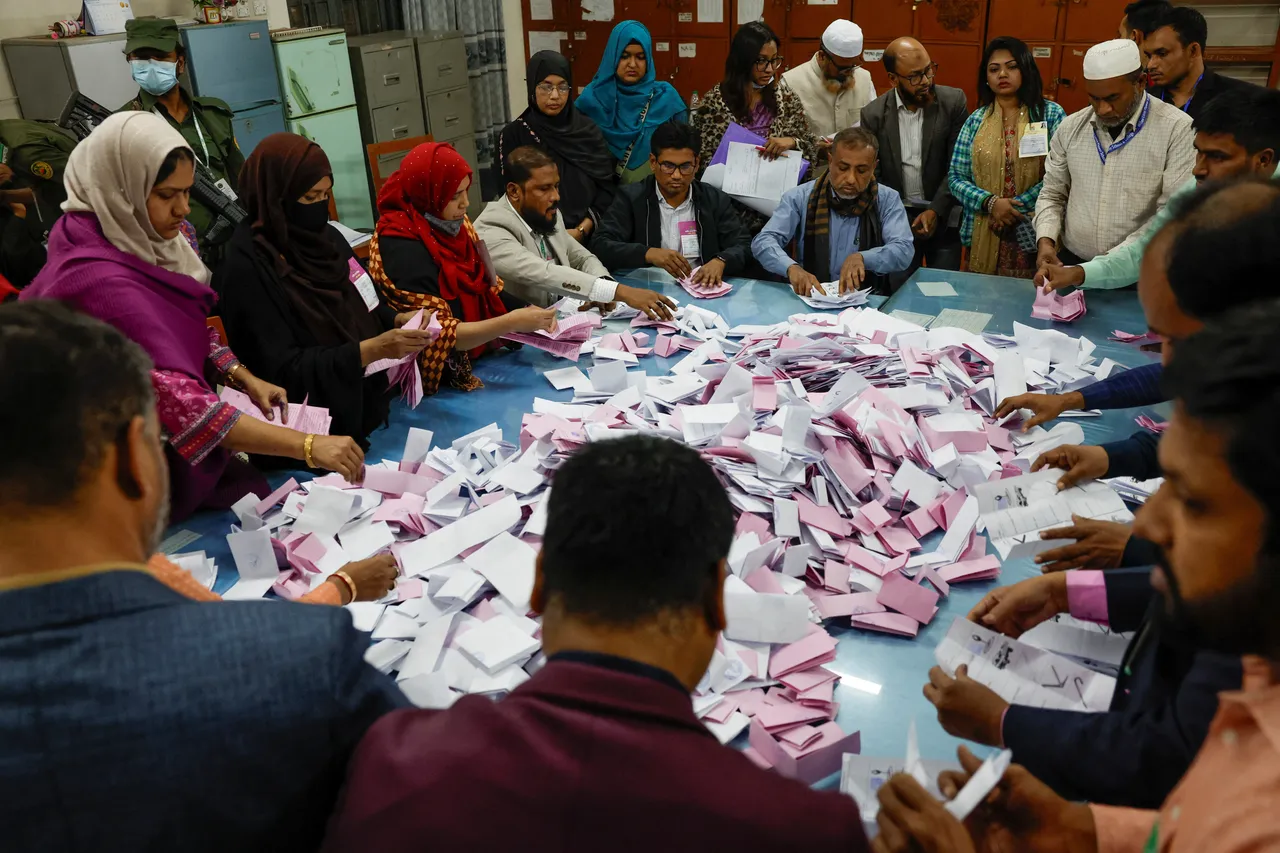
Former Bangladesh Prime Minister Sheikh Hasina on February 12 denounced the country’s latest election as an “election of deception and farce”, alleging widespread irregularities, implausible turnout figures and administrative bias.
In a sharply worded statement, Hasina said the poll would be remembered as “a disgraceful chapter in Bangladesh’s democratic history”. “This was not an election of public will; it was an industrial-scale administrative exercise in manipulating numbers,” she added.
According to official data, the total number of registered voters was 127,711,793. Voting began at 7:30 am and concluded at 4:30 pm. However, Hasina questioned the turnout percentages released in stages by the Election Commission, describing them as inconsistent and unrealistic.
The Commission’s first briefing stated that by 11:00 am, 14.96 per cent of votes — 19,105,684 ballots — had been cast. Hasina calculated that this equated to an average of 90,979 votes per minute.
In the next update, turnout by 12:00 noon was announced as 32.88 per cent. That meant that between 11:00 am and 12:00 noon alone, 17.92 per cent of votes — 22,880,350 ballots — were cast, averaging approximately 381,339 votes per minute.
“During the first three and a half hours, the hourly turnout rate was 4.27 per cent, yet in the following hour it was shown as 17.92 per cent. This rate is highly abnormal,” she said.
With 32,789 polling centres operating nationwide, she argued that the figures implied an average of 11.63 votes per minute per centre — roughly one vote every 5.16 seconds, which she described as “practically impossible”.
Hasina added that voter participation in Bangladesh traditionally peaks during the early morning hours. The reported surge between 11:00 a.m. and noon, she said, contradicted historical voting patterns.
Turnout was later reported at 47.91 per cent by 2:00 pm and 59.44 per cent by the close of polling. Hasina maintained that the pace of voting, particularly during midday, was incompatible with ground realities. “There were no voters at the polling stations, yet there were votes on the counting tables,” she alleged.
Citing media reports, she noted that casting a vote at some centres took between one and a half and nearly three minutes. Against that backdrop, she argued, the time-based statistics appeared implausible.
She also highlighted participation among specific voter categories. Of roughly 86,000 prisoners eligible to vote, around 5,000 did so, approximately 3 per cent. Of an estimated 15 million expatriate voters, about 500,000 cast ballots, around 7 per cent. “In this context,” she said, “the claim of nearly 60 per cent turnout is not just unrealistic but laughable.”
Hasina further accused the administration led by Muhammad Yunus of deploying state resources to promote the “Yes” vote in the referendum held alongside the national election. “The government itself openly assumed responsibility for campaigning in favour of ‘Yes’,” she said.
She criticised the ballot design, alleging that a tick mark beside “Yes” and a cross beside “No” constituted a psychological tactic intended to influence voters. She also questioned the absence of signatures other than those of presiding officers on result sheets, describing it as a lack of transparency.
While constituency-wise results of the national election were announced over 18 hours, the referendum results were released nearly five hours later. Hasina said the delay and the numerical inconsistencies had created a perception of vote rigging. “Did the Election Commission process the data, or did it adjust the data to fit a predetermined process? This question is both relevant and legitimate,” she said.
Her statement also referred to reported violence on the eve of polling, including clashes between the Bangladesh Nationalist Party and Jamaat-e-Islami, allegations of vote-buying, arrests, ballot-stamping in advance, and the seizure of polling centres. She claimed that in some locations, presiding officers had signed result sheets before voting began and that some voters found their ballots already cast.
On polling day, she alleged incidents of ballot snatching, coercion, fake voting, counting irregularities and crude bomb explosions.
Hasina said that although the Awami League had been “illegally banned and forcibly excluded” from the election, it had not called for violence. Instead, she said, the party had urged citizens to peacefully boycott what it described as a one-sided poll. “This election has robbed people of their voting rights,” she said.
She demanded the annulment of what she termed a “voterless, illegal and unconstitutional election”, the resignation of Yunus, the withdrawal of cases against political figures and civil society members, and the holding of a fresh election under a neutral caretaker government.
The Election Commission has not yet responded publicly to the allegations. Political tensions in Bangladesh remain high as questions over the credibility of the vote intensify.
