


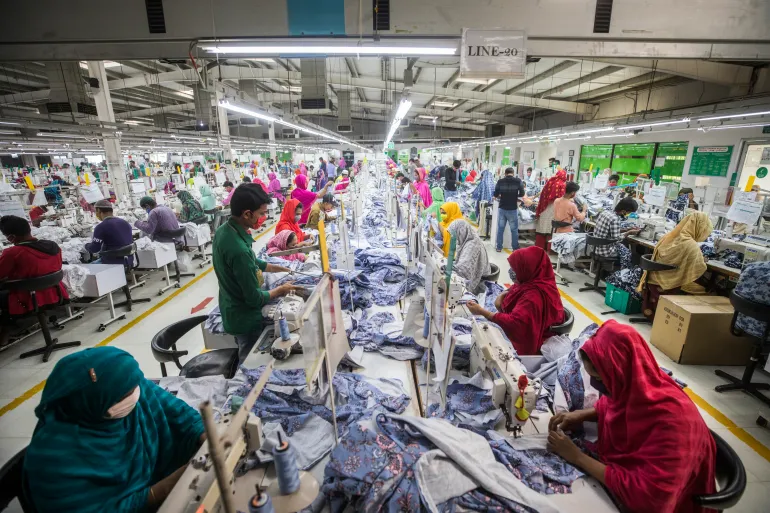
The United States and Bangladesh on Sunday signed a bilateral trade agreement that offers limited tariff relief for Bangladeshi textile and apparel exports, but only in proportion to the use of US-origin cotton and man-made fibre inputs. The new arrangement, analysts say, could reshape sourcing decisions and intensify competitive pressures for the world’s second-largest garment exporter.
Under the agreement, a general reciprocal tariff rate of 19 per cent will apply to Bangladeshi goods entering the United States, down from sharply higher duties imposed in 2025. Zero-tariff access will be available only for a defined volume of textile and apparel exports, with eligibility linked directly to Bangladesh’s imports of US textile inputs.
The mechanism effectively converts tariff relief into a sourcing incentive, rewarding manufacturers that switch to US cotton and fibres while limiting benefits for firms dependent on cheaper Asian supply chains.
High Stakes for Bangladesh’s Export Engine
Textiles and apparel account for more than 80 per cent of Bangladesh’s export earnings and employ over four million workers, most of them women. The US is the sector’s largest single market, with apparel exports exceeding $9 billion in 2024.
The agreement provides partial relief after US apparel tariffs were raised to as high as 37 per cent in 2025 under President Donald Trump’s reciprocal trade policy, a move that triggered alarm across Bangladesh’s garment industry.
However, economists said the structure of the deal falls short of broad-based market access and leaves Bangladesh exposed to new cost pressures. “Zero tariffs are available, but only if exporters realign their input sourcing,” said a Dhaka-based trade analyst. “That is a commercial decision many factories may not be able to make quickly or cost-effectively.”
US cotton is typically around 1.5 times more expensive than Indian alternatives, while longer shipping distances could add to lead times, a critical factor in a sector competing on speed and price.
Competitiveness Concerns Vis-à-Vis India
The agreement has also reignited concerns about Bangladesh’s competitiveness relative to India, which secured an 18 per cent tariff rate under its own trade arrangement with the United States.
While the one-percentage-point gap appears marginal, economists say it could influence sourcing decisions by US buyers operating on thin margins, especially when combined with logistical disruptions facing Bangladeshi exporters.
India’s recent withdrawal of trans-shipment facilities for Bangladeshi cargo has already raised freight costs and extended delivery timelines, industry groups said. “Even small tariff differences can redirect orders in a price-sensitive market such as apparel,” said an economist specialising in South Asian trade. “Bangladesh’s lower labour costs help, but logistics and compliance costs are moving in the opposite direction.”
From the Indian perspective, the US-input-linked zero-tariff provision for Bangladeshi apparel has raised fears of market-share erosion in qualifying segments, though analysts say the impact will depend on quota size and uptake.
Broader Trade-Offs
In exchange for the conditional tariff relief, Bangladesh has agreed to provide preferential market access for selected US agricultural and industrial products, including wheat, soyabeans, energy products such as LNG and machinery.
The deal also includes commitments on intellectual property protection, digital trade, including a pledge not to impose new customs duties on electronic transmissions and regulatory alignment.
Critics in Bangladesh have questioned the speed and transparency of negotiations, noting that the agreement was concluded amid domestic political uncertainty and an election cycle. Industry representatives said they were seeking clarity on quota volumes, sourcing thresholds and implementation timelines before making major procurement or investment shifts.
Labour and Structural Risks
The agreement includes binding labour commitments that directly affect the garment sector, including stronger protections for freedom of association, collective bargaining and enforcement against forced labour.
While labour advocates welcomed the provisions, factory owners warned that rising compliance costs, combined with tariff uncertainty, could accelerate factory closures in a sector already under strain from slowing global demand.
Earlier tariff hikes had threatened to reduce annual export growth by up to 5 per cent, according to industry estimates, putting thousands of jobs at risk.
Strategic Recalibration
US officials argue the agreement strengthens supply-chain resilience and reduces dependence on China by incentivising US upstream exports. Bangladeshi economists counter that the deal underscores the risks of excessive reliance on a single sector and market.
“The agreement offers Bangladesh a lifeline, not a solution,” said a former trade negotiator. “Without diversification beyond garments, the economy remains vulnerable to policy shifts in Washington.”
The agreement will enter into force upon completion of the ratification procedures by both countries. Until then, exporters say the textile sector faces a narrow window to adapt by balancing cost, compliance and competitiveness in an increasingly politicised global trade environment.
Apparel Exports to the U.S. — Bangladesh vs India vs Vietnam
| Aspect | Bangladesh (U.S. Deal, 2026) | India (U.S. Deal) | Vietnam (No Reciprocal Deal) |
| General U.S. Tariff Rate | 19% | 18% | 16–18% (MFN average on apparel) |
| Zero-Tariff Access | Yes, volume-linked to use of U.S. cotton and man-made fibres | Limited (select products such as silk; no broad textile carve-out tied to U.S. inputs) | No zero-tariff mechanism |
| Textile Sourcing Flexibility | Constrained — tariff relief conditional on U.S. input imports | High — diversified domestic and regional sourcing | High — integrated domestic textile ecosystem |
| Labour Cost Advantage | Very high (among the lowest globally) | Moderate | Higher than Bangladesh, lower than China |
| Logistics & Lead Time | Under pressure due to loss of Indian trans-shipment and longer shipping routes | Strong port connectivity and regional hubs | Highly efficient ports and strong U.S. shipping lanes |
| Export Dependence on Apparel | Very high (80%+ of total exports) | Low to moderate (diversified across pharmaceuticals, IT and engineering) | High but diversified within manufacturing |
| Exposure to Policy Shifts | High — conditional access and narrow export base | Moderate — diversified export portfolio | Moderate — no deal, but stable buyer relationships |
| Estimated Impact on U.S. Market Share | Mixed: gains in qualifying segments, risk of losses elsewhere | Potential marginal gains from lower tariff and logistics edge | Stable to mildly pressured |
Key Takeaway
Bangladesh’s deal offers selective tariff relief but at the cost of sourcing flexibility, while India’s marginal tariff advantage and logistics strength could attract diverted orders. Vietnam, despite lacking a reciprocal deal, retains competitiveness through supply-chain integration and speed.

