






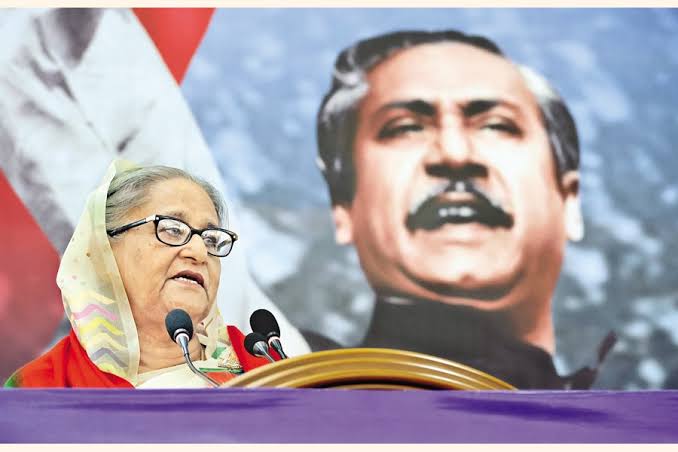
June 23 is deeply intertwined with the long struggle of the Bengali nation to achieve its rights. On this day in 1949, the Bangladesh Awami League was founded through a struggle against exploitation and deprivation to advance the people’s demands, uphold human dignity, and secure democratic rights. Today marks 77 years of that journey.
The Bangladesh Awami League is not a party born of the whims of rulers, the patronage of foreign powers, or the lust for power. It is an emotion that is inseparable from the soil, the people, the history, and the self-identity of Bengal. In its 77-year journey, this organisation has never abandoned the people, nor has it ever bowed down to injustice.
The sacrifices, leadership, and struggle of the Awami League are woven into every milestone of our nation: the 1952 Language Movement, the 1954 United Front elections, the 6-point movement of 1966, the 1969 Mass Uprising, the 1970 elections, the historic March 7 speech of the Father of the Nation, Bangabandhu Sheikh Mujibur Rahman, the Great War of Liberation, and the establishment of an independent, sovereign Bangladesh. The Father of the Nation, Bangabandhu Sheikh Mujibur Rahman, dreamt of independence for the Bengali nation; he organised the people for that dream, and under his leadership, Bangladesh achieved freedom. He even gave the country its name, “Bangladesh”. Thus, the history of Bangladesh is the history of the Awami League.
After independence, Bangabandhu dedicated himself to rebuilding a war-torn Bangladesh. He envisioned a hunger-free, poverty-free, secular, democratic, and dignified “Sonar Bangla” (Golden Bengal). However, the assassination of the Father of the Nation and his family on August 15, 1975, did not just destroy a family; it was an assault on the spirit of Bangladesh’s independence, democracy, the constitution, and the very identity of the Bengalis.
For a long time thereafter, attempts were made to drag Bangladesh backwards. Through military rule, conspiracies, coups, the distortion of history, the rehabilitation of fundamentalist forces, and anti-democratic politics, efforts were made to weaken the core spirit of independence. Yet, the Awami League never stopped. Imprisonment, disappearances, killings, torture, fabricated cases, and bans could not steer the Awami League away from the people.
Under the leadership of the Awami League, Bangladesh has stood tall time and again. During the Awami League’s tenure, Bangladesh became self-sufficient in food, poverty decreased, we moved toward 100% electrification, and new horizons of infrastructure development were opened. Bangladesh became a safe haven for its people, freed from the grasp of terrorism and militancy. The Padma Bridge, Metrorail, Karnaphuli Tunnel, Expressways, Digital Bangladesh, Community Clinics, the Ashrayan Project, social safety nets, women’s empowerment, and advancements in education and health are not just slogans or promises; they are tangible examples of Bangladesh’s development. We established Bangladesh on the global stage with dignity. We proved that if given the opportunity, a peaceful environment, and honest leadership, the Bengali nation can stand tall through its own strength.
However, today, Bangladesh is in a deep crisis once again. The path of hatred, division, vengeance, mob violence, the use of the judiciary as a political weapon, fabricated cases, and state repression initiated by the unelected and unconstitutional interim government led by Yunus continues under the current BNP government, formed through a stage-managed election.
The farce of an election held on February 12, which kept the country’s largest political party and the organisation that led the struggle for independence away from the ballot, did not reflect the people’s mandate. The Awami League was not defeated in the election; rather, knowing they would certainly be defeated, anti-state forces removed the Party from the electoral process entirely. This is not just an attack on the Awami League; it is an attack on the voting, political, and constitutional rights of the people of Bangladesh.
Today, the illegal ban on the activities of the Awami League remains in place. Leaders and activists are being charged with false cases. Through house raids, arrests, torture, harassment of families, seizure of property, and intimidation, attempts are being made to silence the Awami League. Even peaceful tributes on our founding anniversary, the hoisting of flags, or the expression of political views are being treated as crimes. It must be stated clearly: paying respect to Bangabandhu is not a crime. Saying “Joy Bangla” is not a crime. Loving the Awami League is not a crime. Speaking of the people’s rights, voting rights, and democracy is not a crime.
Law enforcement agencies, administration, and responsible officials of the state must remember that they are not a party force. They are employees of the Republic. Arresting innocent people under political directives, filing false cases, suppressing peaceful political activities, and criminalising citizens for their political identity is not a lawful duty; it is an abuse of power.
No one can escape the accountability of history by following unjust orders. Those who are stealing people’s rights, who are leaving mothers bereft of their children, who are separating children from their parents, and who are causing innocent people to suffer—every single action will eventually face accountability in the court of law, history, and the people. No government is permanent; no power is permanent; the people are permanent. Therefore, the obstruction of people’s democratic rights must end.
I know that the leaders and activists of the Awami League are going through a difficult time. Some are in prison, some are homeless due to false cases, some are injured, some are crippled, and many have lost loved ones. Homes have been vandalised, businesses closed, jobs taken away, and children intimidated. Yet, they have not bowed their heads. I know of their sacrifices. I feel their pain.
My absence is not silence. Even though I am away, I am with the people of Bangladesh; I am with the sacrifice, courage, and sorrow of every worker of the Awami League. The struggle to restore democracy in Bangladesh continues through diplomatic, political, and legal channels, and by building international public opinion. The activities of the Awami League may be banned, but the Awami League cannot be erased from the hearts of the people. The Awami League is the history of Bangladesh l, the struggle of Bangladesh, and the commitment to establish the rights of the people of Bangladesh. This party cannot be finished through lawsuits, bans, intimidation, or propaganda.
Bangladesh stands at a crossroads. On one side is the path of the spirit of liberation, democracy, secularism, the rule of law, voting rights, and development. On the other hand is the path of vengeance, mob violence, fundamentalism, the distortion of history, political bans, and darkness. The people of Bangladesh have never chosen the path of darkness, and they will not do so now. This nation has seen 1952, 1966, 1969, and 1971. The Bengali nation cannot be suppressed by intimidation.
In its 77-year journey, the Awami League has been attacked many times, has shed blood many times, and has faced conspiracies many times. But every time, the Awami League has stood up with the strength of the people. It will do so again, Inshallah. The people’s rights will be restored. The political rights of the Awami League will be recovered. Democracy will be restored. The rule of law will be established. Bangladesh will move forward on the path of the spirit of the liberation war.
During this time, the responsibility of the leaders and activists of the Awami League is even greater. We must remain united and stand by the people. We must deepen our connection with the people in every village, every neighbourhood, every ward, and every union. We must stand by the oppressed. We must be uncompromising on the issues of security and dignity for the minority communities, women, children, labourers, the poor, and the marginalised. The politics of the Awami League is not the politics of revenge; it is the politics of establishing human rights, security, and dignity.
I do not do politics for power. I do politics for the people of Bangladesh, for the establishment of my father’s dream of a “Sonar Bangla,” for the spirit of the liberation war, for democracy, and to bring a smile to the faces of the poor and distressed. The path is difficult, but the history of the Awami League is a history of overcoming difficult paths. We were not born to be defeated. We did not struggle to bow down to injustice. We have fought, we are fighting, and we will continue to fight to restore the rights of the people.
In 1981, I returned to the country with a commitment to restore democracy, the voting rights of the people, and the spirit of the liberation war. I have lost almost everyone in my family—my parents and my brothers—but I have never abandoned the people of Bangladesh. I have never retreated from the struggle to establish democracy and the rights of the people in this country.
I will return to the struggle to establish the rights of the people of Bangladesh. I will return with the commitment to restore democracy, the rule of law, the people’s voting rights, and the spirit of the liberation war. I will return through the strength of the people. The people of Bangladesh will restore their democracy, their rights, and their dignity.
All democratic, progressive, secular, and humanitarian forces in the country need to be united today. We must overcome fear. We must reject the politics of division. We must reject the politics of vengeance. We must be united against false propaganda, communalism, extremism, and anti-national forces.
On this day of our founding anniversary, I pay my respects to the Father of the Nation, Bangabandhu Sheikh Mujibur Rahman; the four national leaders; the three million martyrs and two hundred thousand oppressed mothers and sisters of the Great Liberation War; the martyrs of August 15; the Awami League leaders and activists who were martyred in the struggle for democracy; and all my fellow fighters who have been killed, injured, crippled, imprisoned, or displaced in the recent wave of repression. Their sacrifices will not go in vain. The struggle of the Awami League will not cease. Democracy in Bangladesh will be restored.
At this moment of our 77th anniversary, our oath is one: not fear, but courage; not division, but unity; not vengeance, but justice; not darkness, but the enlightened path of the spirit of the liberation war, toward which we must lead Bangladesh.
The Bangladesh Awami League was with the people, is with the people, and will remain with the people. Through the strength of the people, the Awami League will rise again, restore democracy, shatter all conspiracies of anti-national forces, lead Bangladesh back onto the path of the spirit of the liberation war, and build the prosperous “Sonar Bangla” dreamt of by the Father of the Nation.
(Sheikh Hasina is a former prime minister of Bangladesh)


