


Among the five electoral battlegrounds — Assam, West Bengal, Tamil Nadu, Kerala, and the Union Territory of Puducherry — the BJP holds meaningful ground in only two. In Assam, the party has governed for a decade; in Puducherry, it participates indirectly through an ally. In Tamil Nadu, Kerala, and West Bengal, the BJP has never once formed a government. In the Bengal assembly election of 2021, it won seats but fell well short of a majority. In Kerala and Tamil Nadu, it has yet to open its legislative account entirely.
This electoral map tells a story that a significant faction within the BJP prefers not to read. Instead, they reach for a simpler explanation: the Modi brand. Their argument is seductive in its circularity. Every BJP victory, from Lok Sabha to state assembly, flows from Prime Minister Narendra Modi’s personal appeal, and therefore this same brand will carry the party through these five contests as well.
This thinking has consequences that extend beyond electoral strategy. It has made Narendra Modi bigger than the party itself. Within the BJP today, no second-rung leader of national stature is visible anywhere. Should the party lose an election for any reason, this organisational vacuum could prove catastrophic. A structure built around one man tends to collapse with him.
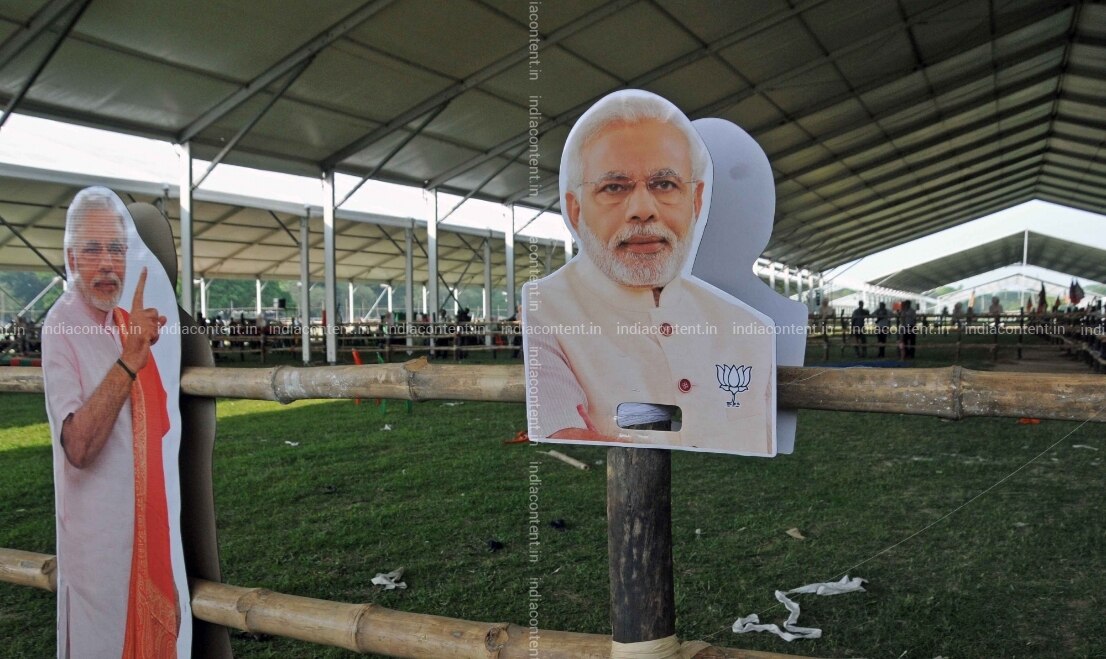
The victories in Haryana and Maharashtra following the 2024 Lok Sabha elections were promptly credited to the Modi brand. But a closer reading of those campaigns complicates the narrative considerably. In both states, the BJP ran without slogans like “Modi’s guarantee”. Modi’s photograph loomed large on posters, but there was no promise attached to it. It was brand-as-image rather than brand-as-compact with voters.
Jharkhand tells the opposite story with equal clarity. In November 2024, BJP deployed not just Modi’s imagery but the explicit “Modi’s guarantee” pledge, and lost decisively. The Mahagathbandhan alliance led by Jharkhand Mukti Morcha swept 56 of 81 seats with 44.37 per cent of the vote, while the BJP managed only 21 seats. The Modi brand, loudly invoked, delivered nothing. If anything, it underscored how context-dependent electoral outcomes truly are, and how dangerous it is to confuse a brand with a governing philosophy.
The 2025 Delhi assembly election offers yet another complication for brand theorists. BJP’s Namo devotees claim this victory for Modi as well. But they conveniently skip over 2015 and 2020, when this same brand failed to deliver in Delhi. The 2025 result had a far more mundane explanation: the Aam Aadmi Party, having governed for two consecutive terms, had squandered its carefully cultivated image for clean governance, while the controversy surrounding its excise policy handed the BJP both a legal and a moral weapon. BJP won Delhi not because of Modi’s magnetism but because of Arvind Kejriwal’s mistakes. Party leaders ought to be sending their thank-you notes to AAP.
Against this backdrop of selective memory, the BJP approaches five very different states with no unified manifesto and no overarching national message, maybe a deliberate strategic choice. The argument from within the party is sensible enough: these states have distinct social, economic, and political characters, so each must be fought on its own terms.
In West Bengal, the party’s primary weapon is the issue of Bangladeshi infiltrators, hammered relentlessly by both Modi and Home Minister Amit Shah at rally after rally. Charges of misrule and corruption against Chief Minister Mamata Banerjee accompany this, along with a cultural revival pitch — the claim that the Trinamool government has degraded Bengal’s heritage, and only a BJP government can restore it. The party has also sought to frame Mamata’s criticism of the Election Commission over the Special Intensive Revision exercise as an assault on democratic institutions.
In Tamil Nadu, the BJP has targeted the DMK government’s law-and-order record, particularly rising crimes against women, and has highlighted the state’s mounting debt burden. Just as it kept the AAP government in Delhi cornered through institutional and legal pressure over the excise controversy, the BJP appears to be crafting a similar containment strategy against Chief Minister M K Stalin. Whether this translates into votes remains to be seen. In Kerala, where politics is structurally defined by the Left Front versus United Democratic Front binary, the BJP harbours no great ambitions and has played no dramatic gambit.
In Assam, BJP faces the natural friction of a decade in power, and has little to offer beyond familiar attacks on Congress over illegal immigration. The state is somewhat exceptional in that Chief Minister Himanta Biswa Sarma provides genuine local leadership of considerable political weight. Yet even here, the national campaign will ultimately revolve around Modi.
The deeper problem reveals itself in states like Tamil Nadu, Kerala, and Bengal, where the BJP has no local leader capable of anchoring a winning campaign. This is not accidental. It is, in fact, the harvest of a deliberate cultivation of dependence on the centre. By not nurturing regional leadership, the BJP ensured that Modi would always be necessary. The election results in these states will reveal how far necessity can substitute for genuine roots.
There is also the arithmetic of identity that no brand can simply override. In Bengal, Muslims constitute approximately 27 per cent of the population. In Kerala, the minority community accounts for nearly 46 per cent. In Tamil Nadu, roughly a quarter of voters belong to minority communities. In Assam, Chief Minister Sarma himself has placed the Muslim population at around 40 per cent. BJP’s Hindutva politics, whatever its appeal in the Hindi heartland, operates as a ceiling rather than a floor in these states.
Regional parties have been shrewd in recognising this. In Kerala, Tamil Nadu, and to a degree Bengal, they have constructed competing narratives of sub-nationalism, linguistic pride and cultural sovereignty, as explicit counters to the BJP’s nationalism and Hindutva. These are not merely electoral slogans; they are identity anchors that have proven durable across multiple election cycles. Breaking through them requires more than a brand. It requires a credible local presence, a record of governance and a politics that speaks to specific regional anxieties, none of which the BJP currently possesses in adequate measure in these states.
These five elections, taken together, pose a question that goes beyond tactics: Is BJP a genuinely national party, or is it fundamentally a Hindi-speaking, Hindutva-oriented party of northern India that periodically visits the south and east? The results will offer an answer, not the answer BJP’s ideologues prefer, but the one Indian voters will write.
The Modi brand may be real. But brands have expiry dates. And elections, ultimately, are not purchased with imagery. They are won or lost on the ground.
(The author is a veteran journalist and also a political analyst)