


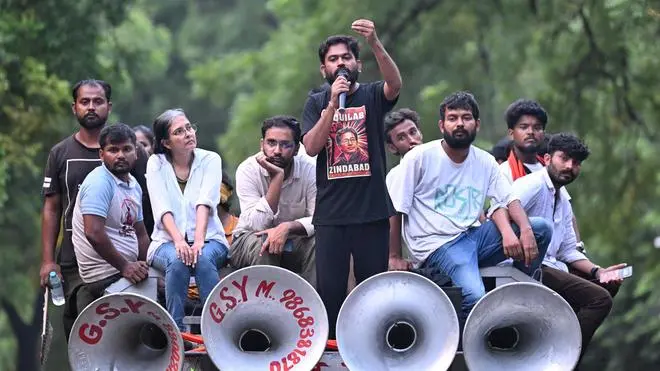
The recent controversy surrounding alleged irregularities in the NEET examination has reignited a familiar pattern in Indian public life. A legitimate grievance over the integrity of a national examination has rapidly evolved into a larger political confrontation, with competing narratives often overshadowing the central question: How should a democratic state respond when public trust in an institution is shaken?
Whether one attributes the protests primarily to genuine concern, political mobilisation, or a combination of both, the larger issue is not merely the fate of one minister or one government. It is the credibility of the institutions responsible for conducting examinations that determines the future of millions of young Indians.
Ancient Indian political thought offers surprisingly contemporary guidance for such moments.
The Dhritarashtra Dilemma
One of the most profound political conversations in the Mahabharata occurs between King Dhritarashtra and his wise counsellor, Vidura. Contrary to popular caricature, Dhritarashtra was neither ignorant nor incapable of recognising the danger before him. He knew that Duryodhana’s conduct was leading the kingdom towards disaster.
His paralysis arose from a dilemma that modern political leadership would instantly recognise. If he acted against his own son under public pressure, he feared it would signal weakness and undermine the authority of the throne. If he refused to act, he risked losing the confidence of his people.
Vidura’s response cut through this false choice. He reminded the king that institutions survive only when leaders distinguish between the individual and the office.
त्याजेदेकं कुलस्यार्थे ग्रामस्यार्थे कुलं त्यजेत्।
ग्रामं जनपदस्यार्थे स्वात्मार्थे पृथिवीं त्यजेत्॥
The verse is often translated as:
“Sacrifice one individual for the welfare of the family; sacrifice the family for the village; the village for the state; and, if necessary, sacrifice oneself for the preservation of the larger order.”
Vidura was not advocating arbitrary punishment. He was articulating a constitutional principle centuries before constitutions were written: no individual is indispensable to the health of the state.
A government weakens itself when it begins to identify the prestige of an institution with the fortunes of one individual occupying office.
Cost of Personalising Institutional Crises
Every government, regardless of political persuasion, eventually faces allegations against ministers, senior bureaucrats, regulators**,** or institutional heads. The temptation is understandable: defending an individual can appear synonymous with defending the government’s authority.
Yet this often produces the opposite effect. Public debate gradually shifts from the functioning of the institution to the fate of one office-holder. Every subsequent decision is interpreted not as an effort to uncover facts but as an attempt to protect reputations.
Once that perception takes hold, even genuine administrative reforms struggle to regain credibility. The question then ceases to be whether an individual is guilty or innocent. The larger concern becomes whether institutions possess sufficient independence and transparency to investigate themselves without fear or favour.
Success Raises the Bar of Accountability
There is another dimension that policymakers would do well to recognise. Public expectations are rarely uniform across governments. They rise in proportion to a government’s perceived competence and delivery. Institutions and administrations that consistently deliver results invite greater scrutiny precisely because citizens come to expect higher standards from them.
Over the past decade, the Modi-led government has built considerable political capital through its emphasis on governance reforms, digital public infrastructure, welfare delivery, infrastructure expansion, and administrative efficiency. Whether one agrees with every policy or not, repeated electoral mandates suggest that a large section of the public places significant trust in the government’s ability to deliver.
That trust is an asset, but it also raises the threshold of accountability. When citizens believe that a government is capable of fixing problems, they become less tolerant of institutional failures. Consequently, controversies such as the alleged NEET examination irregularities generate sharper public reactions, not necessarily because confidence in the government has evaporated, but because expectations of it are exceptionally high.
In many ways, this is the paradox of successful governance: the better an administration performs over time, the less public patience it enjoys when lapses occur. Citizens expect swift corrective action, transparent investigations**,** and visible accountability because they believe the state possesses both the capacity and the political mandate to act decisively.
Chanakya’s Psychological Map of Political Movements
If Vidura explains the ethical dimension of governance, Chanakya offers an operational manual for managing political unrest.
In the Arthashastra, while discussing internal security and the protection of the state, Chanakya identifies different categories of discontent that rulers must understand before responding.
He distinguishes among people who are:
- Krodhita: genuinely aggrieved by injustice or administrative excess.
- Bhita: fearful of state action or uncertain about government intentions.
- Lubdha: motivated primarily by material interests.
- Mānina: individuals whose sense of prestige or recognition has been injured.
Chanakya’s insight is remarkably modern. He warns that governments which fail to distinguish among these motivations inevitably prescribe the wrong remedy.
Not every protester is driven by identical concerns. Not every organiser seeks the same outcome. Nor is every public movement reducible to political conspiracy. Some demand accountability. Others seek reassurance. Still others may exploit the situation for partisan advantage.
Treating all dissent as hostile is as dangerous as assuming every protest is entirely spontaneous or entirely virtuous.
Difference Between Protest and Political Capture
This distinction is particularly relevant to the controversy surrounding the NEET examination. Students whose futures appear uncertain naturally experience anxiety. Parents demand clarity. Teachers seek institutional certainty. These are legitimate democratic responses.
At the same time, politically charged environments often create incentives for organised groups to amplify genuine grievances into broader campaigns against governments or institutions.
The phenomenon is hardly unique to India. Around the world, movements born from authentic public concerns are frequently joined by actors pursuing unrelated political objectives.
The challenge for governments is to separate the grievance from the opportunism without delegitimising either public concern or democratic dissent. That requires considerably greater administrative sophistication than simply issuing press releases or engaging in political rhetoric.
Transparency Is Stronger Than Defensiveness
The durability of institutions depends less on claims of perfection than on their demonstrated capacity for correction.
Institutions earn public confidence not by claiming to be infallible but by showing that they can correct themselves. Where procedures have fallen short, the shortcomings should be acknowledged without hesitation. Officials found responsible must face the consequences under established legal and administrative processes, and where systemic deficiencies are exposed, the reforms needed to address them should be explained openly and implemented transparently.
Public confidence is strengthened when governments show that institutions are larger than the individuals who occupy them, and that due process takes precedence over personal loyalty. Defensiveness, by contrast, often communicates insecurity.
From Vyakti to Tantra
Indian political philosophy consistently distinguishes between Vyakti (the individual) and Tantra (the institutional order). Individuals inevitably change. Institutions must endure.
The true measure of governance is therefore not whether it succeeds in protecting particular office-holders but whether it leaves behind stronger, more transparent and more trusted public institutions.
That principle is especially important in sectors like education, where millions of young citizens invest years of effort with the expectation that merit, not manipulation, determines outcomes.
Every examination controversy leaves behind more than legal disputes. It leaves behind a question in the minds of students: Can I trust the system? That question deserves an answer based not on political loyalty but on institutional credibility.
The Real Test
The NEET controversy will eventually fade from the headlines. Court cases will conclude. Political campaigns will move on to other issues.
The deeper question, however, will remain.
Will this episode become another cycle of accusation and counter-accusation, or will it strengthen India’s examination architecture through greater transparency, independent oversight, technological safeguards and administrative accountability?
Vidura warned against sacrificing the kingdom to preserve one individual. Chanakya warned against misunderstanding the psychology of public unrest. Together, they point to a simple but enduring lesson for democratic governance: public trust is restored not by defending individuals but by strengthening institutions.