



Raksha Bandhan today is closely associated with the image of a sister tying a rakhi around her brother’s wrist. There are sweets, gifts and prayers for the brother’s well-being. But the protective thread itself has a much longer history, and it was not always part of a brother-sister ritual.
Hindu ritual texts mention protective threads and amulets in different forms. They appear as rakṣā, pratisara, kautuka and rakṣāsūtra. They were tied to the body during rituals, used as amulets and sometimes attached to ritual objects. The basic idea was simple: the thread or object was meant to protect the person wearing it.
One example is found in the Viṣṇudharmottara Purāṇa 2.109. It describes maṇis, protective objects associated with the Atharvavedic tradition. These could be made from herbs and plants, metals and materials obtained from animals. They were used to protect against evil, disease and misfortune, and were also associated with good fortune and the fulfilment of wishes.
The maṇi had to be prepared before it could be worn. The material was selected and shaped according to prescribed rules, while mantras were recited during its preparation. It was then ritually empowered before being tied to the body. The text calls this process maṇikarma and gives different materials and mantras for different kinds of maṇis.
A more direct example of a protective thread comes from the Āgniveśya-Gṛhyasūtra 2.3.5. It mentions the kautuka-tantu, a thread used in a ritual called kautuka-bandha. The ritual was performed during auspicious family ceremonies, including those connected with nāndīmukha-śrāddha, which was performed before occasions such as marriage.
The thread was tied around the right arm of a boy and the left arm of a girl. The ceremony described for the boy involved his maternal uncle. Several objects were placed before him, including a porcupine’s quill, a wild boar’s tusk, a conch shell, a mirror and the protective thread. The boy’s right arm was turned three times in a sunwise direction. He was made to look at himself in a mirror. The thread was then tied around his wrist. The ritual ends with the words rakṣāṃ karoti—“he protects him.”
The Bhavishya Purāṇa gives another example, this time involving a king. On the full moon of Shravana, a rakṣā was prepared from new cotton or silk cloth. It was decorated with rice or barley grains, mustard seeds and red ochre. The rajapurohita (royal priest) tied it to the king’s right wrist for protection. The ritual also connected the rakṣā with the story of Mahabali, the king of the Asuras.
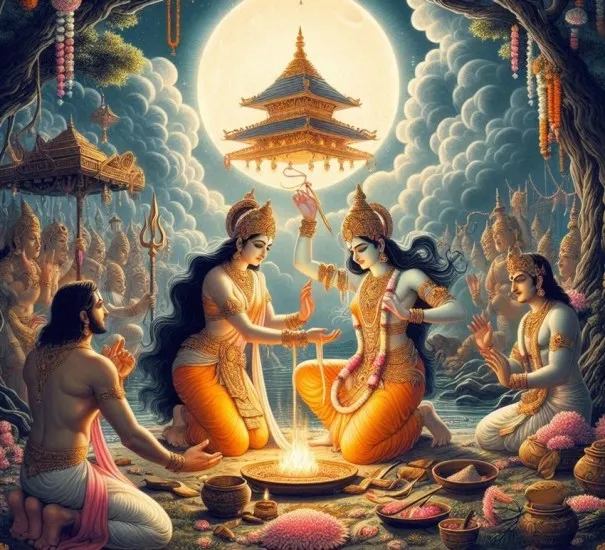
The same text contains the story of Indra and Shachi, which is more commonly connected with Raksha Bandhan. The gods are fighting the demons, and Indra suffers defeat. He then approaches Bṛhaspati, the guru of the gods, who advises him to perform the Raksha Vidhan on Shravana Purnima.
A rakṣā potli is prepared and strengthened with sacred mantras. After the puja, Shachi ties it to Indra’s right hand. Indra then defeats the demons and regains his kingdom.
In these stories, the protective thread is tied in different ways and by different people. A maternal uncle ties it to a boy. A royal priest ties it to a king. Shachi ties it to her husband. What these examples have in common is not the brother-sister relationship but the protective rakṣā.
At the same time, Shravana Purnima was also connected with regional traditions between brothers and sisters. In parts of North India, these were known as Saluno, Silono and Rakri. Sisters performed rituals for their brothers, sometimes giving them barley shoots or tying threads, while brothers gave gifts in return. For married women, these festivals were also an opportunity to return to their parental homes and spend time with their brothers.
The two kinds of traditions existed alongside each other. On the same full moon of Shravana, sisters could be performing their rituals with their brothers while Brahmin priests were tying protective threads to their patrons.
Over time, the two began to overlap. The brother-sister tradition became more prominent, while the older priestly form of protective thread gradually became less visible in the popular understanding of the festival. The rakhi increasingly came to be associated with the relationship between brothers and sisters.
By the nineteenth and twentieth centuries, dictionaries and other records increasingly described the rakhi in connection with the brother-sister relationship. The festival also spread beyond the regions where these traditions had been practised. Migration, urbanisation and modernisation helped spread it further. Later, national and political promotion helped spread the festival more widely.
The Raksha Bandhan we know today was therefore shaped by more than one tradition connected with the full moon of Shravana. The older protective-thread ritual and regional brother-sister customs gradually came together, while the rakhi became increasingly associated with siblings.
Yet the protective thread itself survived.
The mauli, also called kautuka, raksha sutra or kalawa, is still used during Hindu rituals. It is usually made from cotton and is commonly red or red and saffron. Priests tie it around the wrist of people taking part in a ceremony, and it can also be tied to ritual objects. Different regions have their own names for similar threads, including mauli, puja dhaagal, raksha sutra, kalawa, kaapu, kayiru, charandu and kautuka.
The thread is usually wound around the wrist several times before being knotted. It is generally tied around the right wrist of men and the left wrist of women. Once it has been used in the ritual, it is regarded as a consecrated thread carrying the protection and blessings of that ceremony.
The modern rakhi may be the most recognisable form of this tradition today, but it is not the only expression of the older idea of protection through ritual binding. Throughout Hindu ritual history, protective threads have been used in different contexts, between priests and patrons, within families, between devotees and deities, and eventually between sisters and brothers. The thread itself remained a symbol of protection, while the relationship through which that protection was expressed changed over time.
Behind the familiar rakhi, then, is a much older ritual practice: a simple thread tied around the wrist as a sign of protection.